When I reviewed Kobold Press’s Northlands setting recently, Northlands has Landed … and Northlands — Playable Flavour Done Right, I mentioned that my intention is to use the setting and it’s companion Northlands Sagas as the foundation for my first Tales of the Valiant campaign in Tolrendor.
One of the things I particularly like about Northlands is that it isn’t merely a collection of Nordic-flavoured names and artwork. The setting is built upon a distinctive worldview. Its cultures are shaped by stories of gods and giants, by the belief that fate is real, and by the certainty that the greatest war in history has not truly ended.
The challenge was that Tolrendor already possesses an origin story.
For many years the mythology of Tolrendor has been rooted in the Age of Strife, itself heavily inspired by the old 4th Edition D&D cosmology: a primordial war between the Astral Powers and the Elemental Lords, culminating in the fall of Karagthal and the Sundering of the world.
So I found myself facing a world-building problem.
How do I create a mythology that supports the themes Northlands expects—gods, giants, prophecy, fate and an unfinished war—without simply replacing the mythology Tolrendor already has?
At first I assumed I would need to rewrite large parts of the setting.
Instead, I discovered that the pieces were already there.
I simply hadn’t been looking at them from the perspective of the Northlanders.
Seeing The War Through Northern Eyes
When I first started thinking about Norðrlǫnd—my name for the Northlands region of Tolrendor—I assumed I needed to reinterpret the Age of Strife.
The more I worked on it, the more I realised that wasn’t necessary. The Age of Strife was never a single battle. Nor was it even a single war fought in a single place. It was a conflict that engulfed entire worlds.
The original mythology focuses on KaragTar, Bane and the siege of Karagthal because those events directly shaped the lands surrounding Tolrendor’s Inner Sea. It is the version of history preserved by the sages of Kerabos, the City of Amber founded at the very epicentre of the Sundering itself.
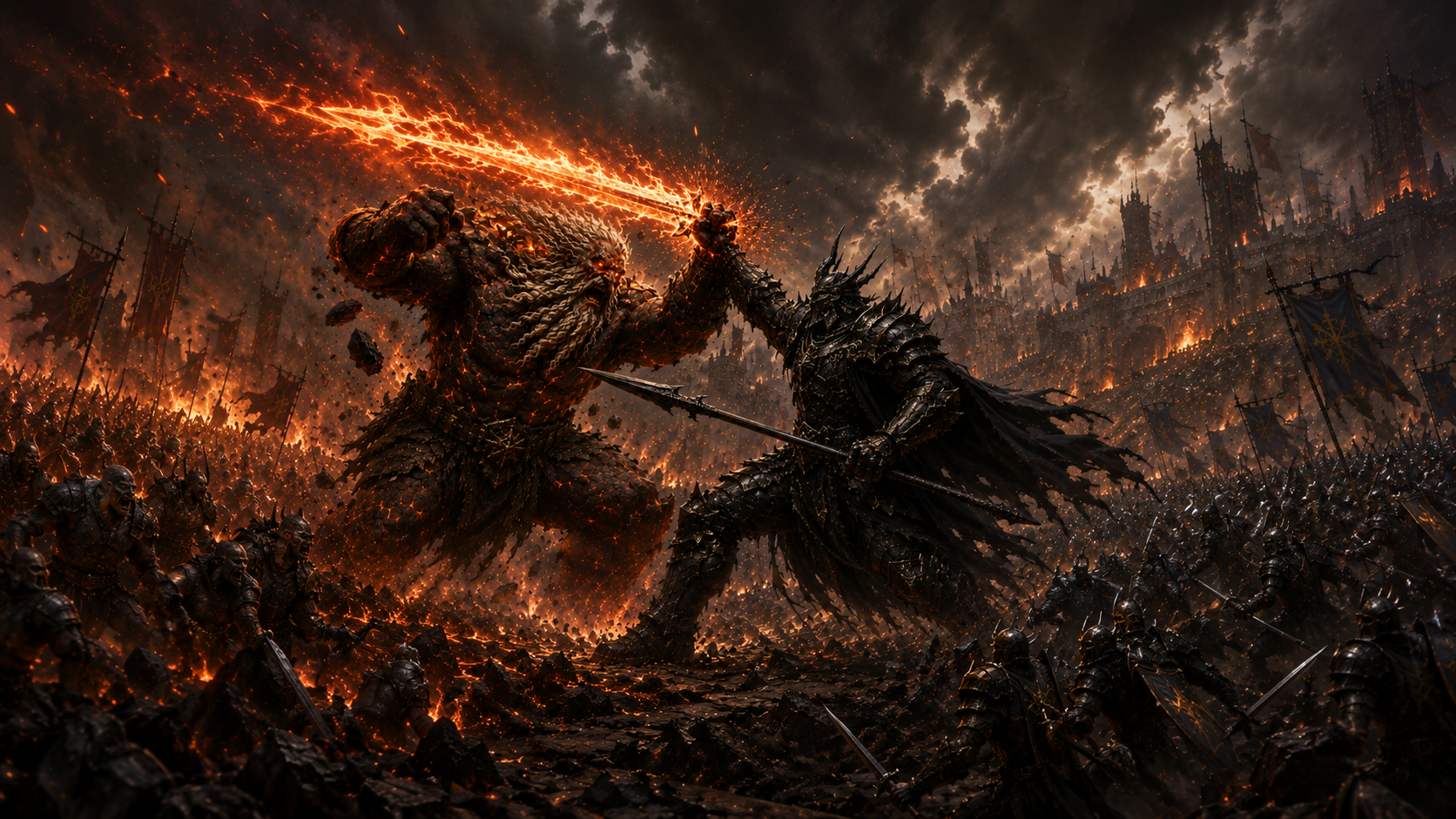
But why should the people of Norðrlǫnd remember the same heroes?
Why should their skalds’ songs focus on the same battles?
Instead, I began to think about what the people of the far North might remember.
Their stories speak of the Valdrungar and the Frumjötnar.
Of Óðvaldr, High Father of the Valdrungar.
Of the primordial giant Hrímvaldr, Lord of Frost and Stone.
Of gods and giants whose struggles shaped the glaciers, fjords and mountains of the Northlands themselves.
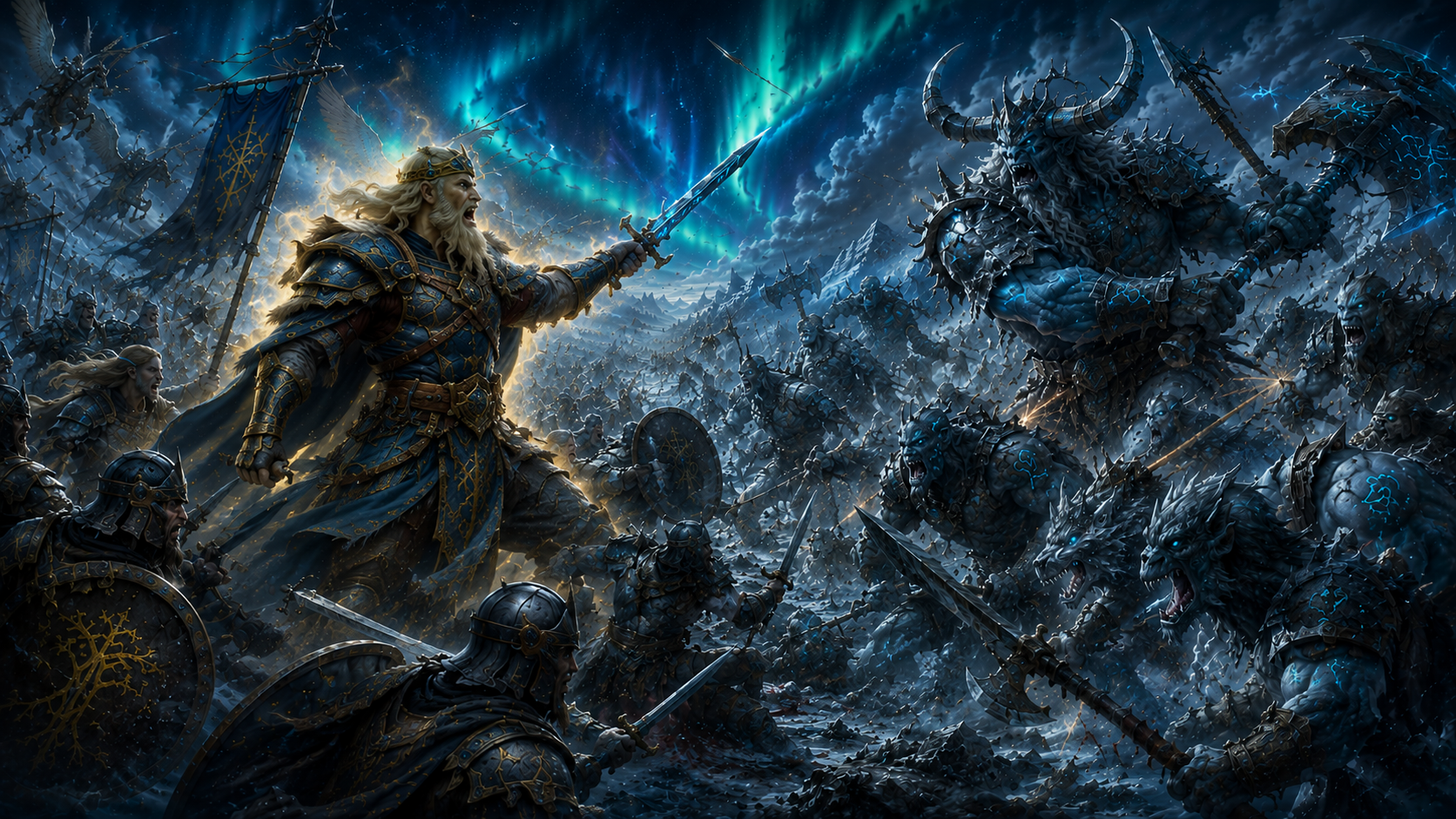
As their sagas tell it:
“Here, the fate of creation was contested between the Valdrungar and the Frumjötnar, the First Giants.”
The important realisation was that these stories do not need to replace the original mythology.
Both can be true.
The Age of Strife was vast enough to contain them all.
Two Traditions, One Age
| Age of Strife Tradition | Norðrlǫnd Tradition |
|---|---|
| Focuses on KaragTar, Bane and the siege of Karagthal | Focuses on Óðvaldr, Hrímvaldr and the war against the First Giants |
| Remembered through the sages’ histories of the Inner Sea | Remembered through the sagas of the Northlands |
| The defining battle is fought before the Gates of Malor | The defining struggle is fought across the frozen North |
| Emphasises the clash between Astral Powers and Elemental Lords | Emphasises the struggle between gods and giants |
| The Sundering ends a catastrophic war | The Sundering postpones a destined final battle |
| The Earth Mother saves creation from destruction | Foldmóðir saves creation from destruction |
The stories overlap.
But they are not the same story.
They are memories of different events from the same vast age.
Why I Avoided Traditional Norse Mythology
One deliberate choice was to avoid simply importing Norse mythology directly into Tolrendor.
There is nothing wrong with using Odin, Thor, Midgard or Ragnarök.
But those names carry enormous cultural and canon baggage.
For many readers they arrive accompanied by Marvel films, television series, video games and decades of fantasy gaming.
I wanted something that felt recognisably northern without feeling borrowed.
Using Old Norse terminology helps create that distinction.
Thus:
- Norðrlǫnd rather than Midgard
- Óðvaldr rather than Odin
- Hrímvaldr rather than Ymir
- Valdrungar rather than Aesir
- Frumjötnar rather than simply Jötnar
The aim is not Norse mythological accuracy.
The aim is lore structure that can support the flavour of the setting – something familiar enough to evoke the right atmosphere while remaining firmly rooted in Tolrendor’s own mythology.
Fate, Prophecy and The Unfinished War
The original Age of Strife already contained one of the most important ideas required by a Northlands setting.
The war never truly ended.
The Earth Mother intervened because creation itself was breaking.
As the original Tolrendor tale tells us:
“At this juncture, Nairere the Earth Mother herself stepped into the fray…”
The northern tradition remembers the same event through a different lens.
Foldmóðir sees that neither side can truly prevail.
The giants cannot win.
The gods cannot win.
Creation itself is losing.
And so she acts.
“There would be no world left to inherit.”
The gods and giants are cast beyond the veil, into the outer realms from which they came.
The Sundering begins.
But the skalds remember something else as well.
“The war was ended.
Not won.
Ended.”
That single idea introduces one of the defining themes of Norðrlǫnd.
Fate.
The belief that the old war remains unfinished.
That beyond the veil the ancient powers still gather.
That one day the barriers will fail.
And that when they do, the final struggle will begin anew.
Final Thoughts
When I started this exercise, I thought I was trying to adapt Tolrendor to accommodate Northlands.
In reality, I was doing something rather different.
I wasn’t creating a new cosmology.
I was creating a Northland mythology.
The underlying truths of the setting remain unchanged. The Age of Strife still happened. KaragTar still raised Karagthal. Bane still laid siege to its walls. The Sundering still shattered the world and cast the great powers beyond the veil.
But those events were never experienced equally by every people, in every land.
The skalds of Norðrlǫnd remember different heroes, different battles and different lessons than the scholars of Kern. Where one culture remembers the fall of Karagthal, another remembers the war against the First Giants. Where one remembers victory denied, another remembers fate deferred.
Neither story is more true than the other.
Both are attempts by mortal peoples to understand events far greater than themselves.
In many ways, that feels closer to how real mythologies evolve. People remember the events that shaped their ancestors. They elevate their own heroes. They preserve the lessons that mattered to them. Over centuries, those memories become stories, and those stories become belief.
Perhaps that is the lesson I have taken from this exercise.
History may be universal. Mythology rarely is.
The Age of Strife was not a single battle, nor even a single war fought in a single place. It was a struggle that touched every corner of creation, leaving behind different memories, different heroes, different warnings—and different truths.
The myths that survive are simply the stories people chose to remember.
And for a world-builder, that is far more interesting than having a single “correct” version of the past.
 Tolrendor DM's Blog