There’s something slightly ironic about the fact that it took playing more in-person tabletop RPGs to rekindle my interest in RPG technology.
Over the past few months, playing regularly at RPG Taverns has absolutely re-energised my love of the hobby. It’s also been a major reason this blog has come back to life after a very long quiet period.
If you’ve been following the recent posts on Tolrendor World, you’ll know I’ve been diving back into campaigns, world-building, Tales of the Valiant, Northlands, and generally rediscovering why I fell in love with tabletop RPGs in the first place.
But something else has been happening too.
The more I play around digital tables in a genuinely social, in-person setting, the more I find myself thinking:
We still haven’t really solved technology at the physical tabletop.
And that thought has quietly reignited something I haven’t explored deeply in years:
The ‘Tech’ Table
The COVID era massively accelerated digital tabletop gaming.
There’s really no debate about that anymore.
Virtual Tabletops exploded in capability during that period. Online play matured rapidly. Shared maps, dynamic lighting, automation, integrated character management, remote dice rolling, music, handouts — all of it advanced at incredible speed.
And none of that is going away.
But interestingly, sitting around the tables at RPG Taverns has reminded me that in-person play is fundamentally different.
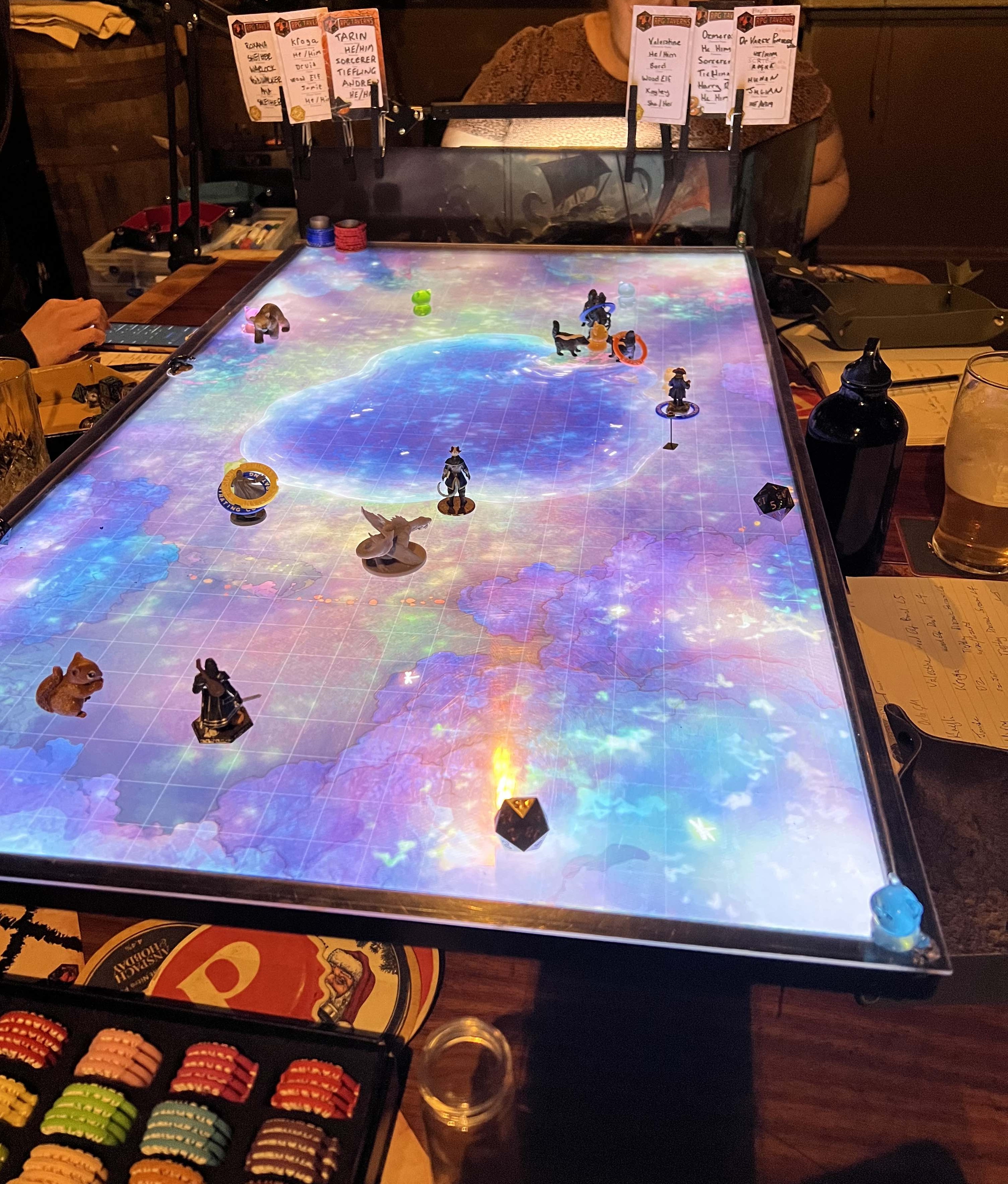
Even though we use digital displays at the table, the experience is still overwhelmingly physical:
- Real miniatures
- Real dice
- Physical condition rings
- Face-to-face roleplay
- Shared reactions
- Tangible table presence
The digital table itself is usually just acting as a map surface, rather than a full VTT experience.
I think that’s the right instinct.
Because VTTs were never really designed for the realities of in-person tabletop gaming. They excel at remote play, but can feel awkward or intrusive when everyone is physically sitting together.
At RPG Taverns, several GMs even combine digital maps with physical terrain — which looks fantastic and preserves that tactile tabletop feel.
That hybrid model fascinates me.
What I’d Love to See at the Table
The more I think about it, the more I believe there’s a huge gap between:
- A printed (or hand-drawn) battle-map
- And a full-blown VTT
There’s a middle ground that still feels surprisingly unexplored.
Imagine a tabletop system focused entirely on augmenting the in-person experience rather than replacing it.
Things like:
- Automatically scaled digital maps
- Simple GM controls for revealing or hiding map sections
- Miniature movement sensing
- On-table measurement tools
- Area-effect templates projected directly onto the map
- Integrated dice systems using either physical or virtual dice
- Character app integration
- GM tools connected to encounters and initiative tracking
Not to replace physical play.
Not to force everyone behind laptops.
But to enhance the table itself.
Because the reality is that many of the tools we now take for granted in VTTs are genuinely useful — fog of war, dynamic measurements, quick condition tracking, integrated encounters — but they need to be redesigned around shared physical presence.
That’s the key distinction.
The table should remain the centrepiece.
Not the software.
Enter… the Tolrendor Table?
So yes…
I’ve finally decided to stop merely thinking about this stuff and actually start prototyping some ideas.
For a long time I’ve wanted to experiment with:
- Smart digital battlemaps
- Mini tracking
- Interactive overlays
- Lightweight GM controls
- Hybrid physical/digital encounters
- Hardware integration
- And potentially even modular “table appliance” concepts
And I think the time has come.
So let’s call the project:
The Tolrendor Table
At least for now.
No promises yet. No timelines. No polished product announcements.
Just a genuine passion project that I’m excited to start exploring properly again.
And honestly?
The modern tooling landscape is far more capable than it was the last time I dreamed in this space!
The ‘Tech’ GameMaster
Of course, the table itself is only part of the equation.
The modern GameMaster already lives in a deeply digital ecosystem.
- Worldbuilding notes.
- Character apps.
- Campaign planning.
- Discord servers.
- Maps.
- Lore documents.
- Session prep.
- Music.
- Scheduling.
- Handouts.
- PDFs.
- Encounter tools.
- AI-assisted brainstorming.
We use an enormous amount of technology in tabletop RPGs.
But the ecosystem still feels fragmented.
And heavily siloed.
A classic example is D&D Beyond.
The tools themselves are actually pretty good.
But they fundamentally operate as a tightly controlled ecosystem around official content. Homebrew support exists, but often feels secondary to the commercial platform model.
Other VTTs are technically more open — and platforms like Foundry Virtual Tabletop have genuinely strong APIs and extensibility — but in practice most content still ends up deeply tied to the platform hosting it.
And for homebrew-heavy GameMasters?
That creates friction.
A lot of friction.
Campaign Nexus
Which leads me to the other major project idea quietly evolving in the background.
For a long while now, I’ve been sketching out the concept of an ecosystem of GameMaster tools that sit above individual VTTs and platforms.
A sort of campaign-centric architecture.
The working name for that project is:
Campaign Nexus
The vision is ambitious — perhaps dangerously ambitious — but the core idea is actually pretty simple:
Create a system that helps GameMasters manage the entire lifecycle of running campaigns.
Not just encounters.
Not just maps.
Not just character sheets.
But everything.
Things like:
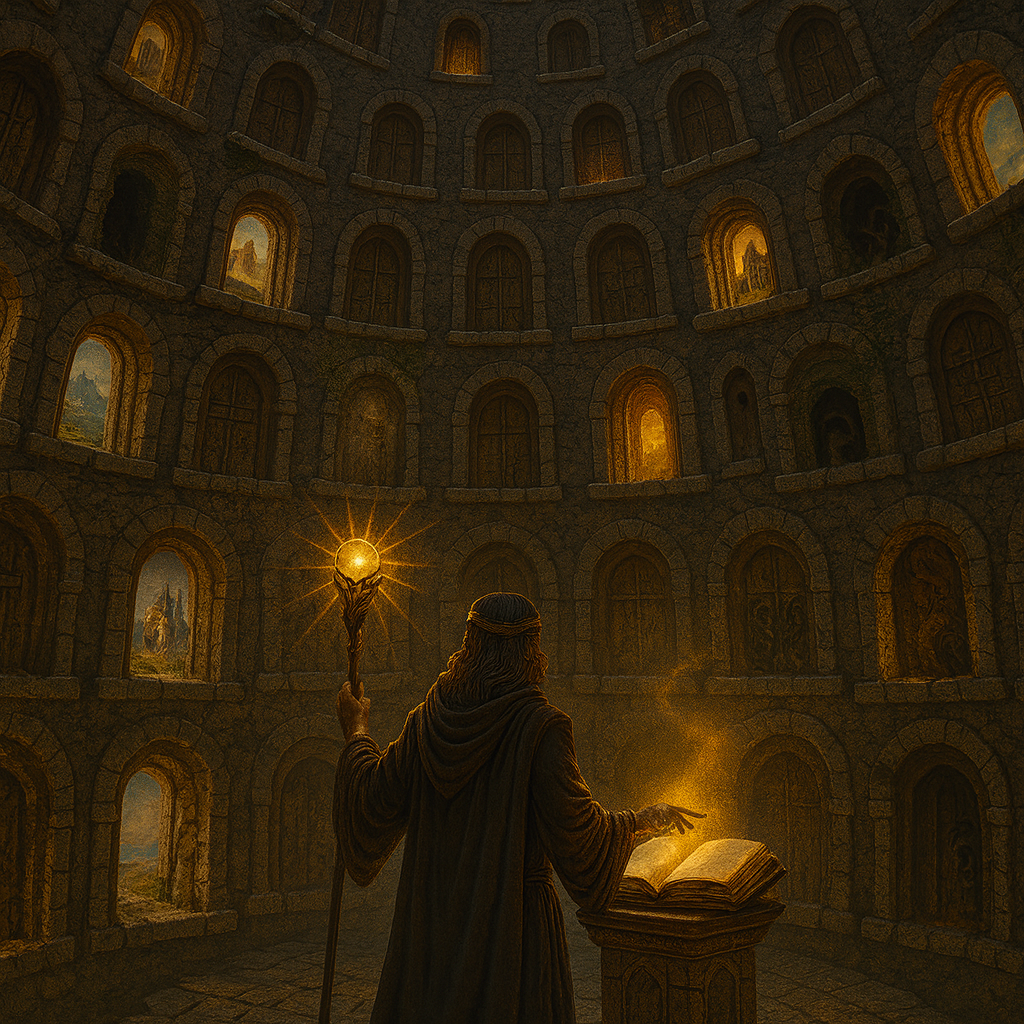
- Worldbuilding and lore management
- Campaign organisation
- Session planning
- Homebrew management
- Monster, spell, item, and faction creation
- Narrative continuity tracking
- Scheduling and player communication
- Cross-platform VTT integration
- AI-assisted tooling
- And eventually deep integration with the Tolrendor Table concept itself
The key idea is that the campaign becomes the primary entity — not the VTT.
That matters enormously to homebrew creators.
Because ultimately, your world should belong to you, not to whichever platform currently hosts it.
Where This Goes Next
Right now, I’m working towards defining what an actual MVP for Campaign Nexus might realistically look like.
And trying very hard not to accidentally design six different products simultaneously.
Which, if you’ve ever built software passion projects before, you’ll know is a very real danger.
But after years away from serious RPG tech experimentation, it genuinely feels exciting to be thinking creatively in this space again.
And the best part?
This renewed inspiration has come directly from sitting around a real table with real players, rolling real dice.
Which feels oddly fitting.
The technology should support the magic of tabletop roleplaying.
Not replace it.
And I think there’s still a huge amount of unexplored territory there.
So yes.
RPG Tech Talk is officially back.

 Tolrendor DM's Blog