And it might be exactly what I’ve been waiting for…
There are Kickstarters you back on a whim… and then there are the ones you quietly (and impatiently..) wait for because you know they’re going to shape your next campaign.
Northlands for Tales of the Valiant (PDF version) sits firmly in the latter camp.
Having now dug into both the Northlands Worldbook and its companion volume of adventures, Northlands Sagas, I’m increasingly convinced that this is going to form the backbone – or perhaps more accurately, the overlay – for my first proper Tales of the Valiant campaign in Tolrendor.
The “Campaign Overlay” Concept – Genius!
What resonates most strongly with me is that Northlands isn’t just a standard setting supplement — it’s positioned as a campaign overlay.
And that distinction matters.
It means it’s deliberately designed to be flexible:
- Drop it wholesale into a homebrew world
- Use it as a northern region in any setting
- Layer it over an existing setting
- Or even treat it as a mythic parallel land
For Tolrendor, this is gold.
I love Midgard as inspiration, but I’m firmly homebrew when it comes to my own world. I want to adapt, not adopt.
Northlands gets that balance exactly right.
First Impressions — Strong, Immediate, Evocative
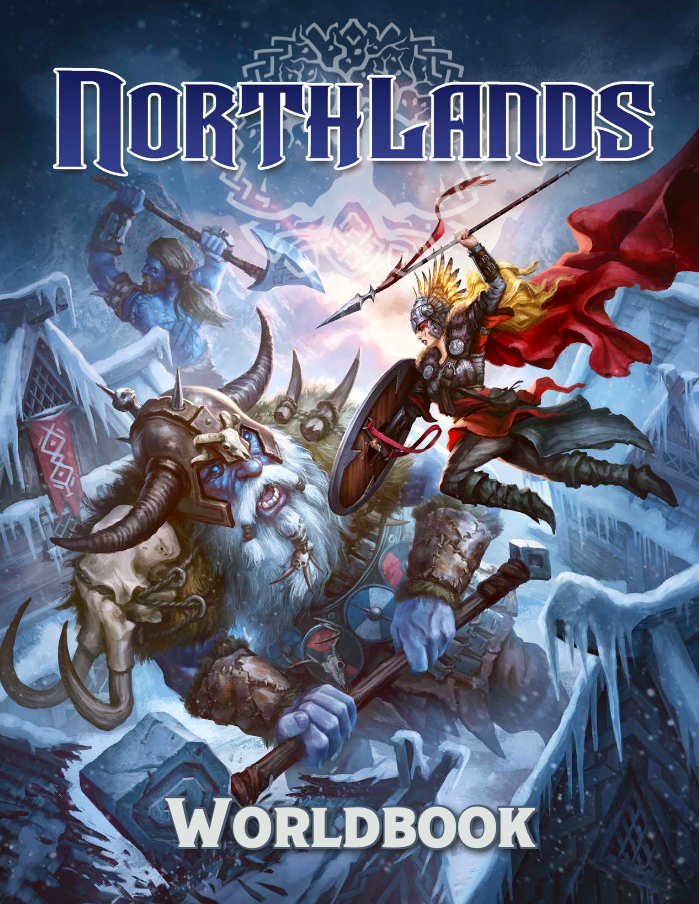
The opening chapter does something I’ve come to really appreciate in Tales of the Valiant material:
It gets to the point fast.
The “Seven Secrets of the Northlands” immediately establish:
- Honour and reputation
- Reaving culture
- The role of the gods
- Harsh environment
- Giants, runes, and sagas
In little more than a page, we are grounded in the setting and eager for more. That’s excellent design.
The rest of the chapter builds on this:
- Daily life
- People and culture
- Festivals
- An historical timeline
It’s rich, evocative, and highly readable. There is little in the way of mechanics here, it’s full-on flavour, although there are references to later sections of the book that bring mechanics to the table where relevant.
A Small Tension — History vs Overlay
There is, however, one point where I found myself hesitating.
The timeline is detailed — and very good.
But for an overlay, it may be too specific.
For Tolrendor, I’ll almost certainly need to reshape this to bring it cleanly into Tolrendor.
Because while history adds depth… too much specificity reduces flexibility.
That said — it’s still excellent source material.
Regions and Factions — Exactly the Right Level of Detail
The regional breakdown (Chapter 2) is classic Kobold Press:
- Strong flavour
- Memorable identities
- Just enough detail
Bear-folk kingdoms, bardic islands, giant territories — all immediately usable.
Yes, the detailed (and gorgeous) maps do “fix” a setting somewhat — but in practice, this is material to harvest, not obey.
I’ll definitely redraw the map for Tolrendor, but I’ll absolutely use:
- The structure
- The ideas
- The cultural hooks
Factions (Chapter 3), in particular, are a highlight:
- Cults of Ragnarok
- Giant-aligned forces
- Guilds of Wanderers, hunters, and guides
These are incredibly easy to port — and immediately useful at the table.
The Gods — The One Real Design Trade-Off
You can’t do a Norse-inspired setting without gods.
And Kobold Press leans fully into that:
- Wotan, Loki, Thor etc.,
- The Norns
- Primordial Giants
This is a comprehensive chapter covering background, worshippers, symbols and books, shrines and priests. It’s authentic, and reinforces the setting.
But for a homebrew world like Tolrendor… this is where things get complicated.
I don’t tend to use direct real-world mythological imports.
The gods matter too much to ignore for this setting. So the question becomes:
- Do I make an exception?
- Replace them?
- Or reinterpret them entirely?
Changing them would represent a significant amount of work. For example, there are many talents, abilities and spells directly tied to the gods that would need re-work.
That’s probably the single biggest design trade-off in the book: the gods are both a strength of the setting and the hardest thing to adapt cleanly into a homebrew world.
Final Thoughts (For Now…)
Overall, this is a supplement that understands what Dungeon Masters need:
- Structure, not constraint
- Inspiration, not prescription
- Portable lore
Northlands doesn’t demand you use it.
It invites you to adapt it.
And for a Tolrendor campaign?
That’s exactly what I was hoping for.
(Next post: I’ll be diving into the mechanics — and why this might be one of the best “playable flavour” supplements I’ve seen in a long time.)
 Tolrendor DM's Blog
Pingback: Reimagining the Age of Strife for Norðrlǫnd | Tolrendor DM's Blog
Pingback: Northlands — Playable Flavour Done Right | Tolrendor DM's Blog
Hey there! On behalf of myself and the other designers thanks for the great review. We really appreciate it.
You’re very welcome, and thanks to you all for the work! I’ve been supporting Kobold Press products for years, but IMO the momentum of Tales of the Valiant is raising your products to another level!
I wrote the factions so I’m really pleased you like them. Enjoy the frozen Northlands!
I will (brrr…), and thanks for replying. Ditto my reply to Brian above!