There’s a particular rhythm to returning to RPG Taverns. You step back through the door, dice in hand, and the world has moved on without you—but somehow still feels familiar. This session was exactly that: a re-entry into Aranoa, with the party already entangled in events far beyond my last visit. No laborious recap, no continuity anxiety—just a quick orientation and straight back into the fray.
And that, frankly, is one of the great strengths of RPG Taverns.
We found ourselves once again in pre-Cataclysmic Aurelium—always a fascinating temporal playground—and quickly assembled into what can only be described as an eclectic and somewhat fragile party composition. Plenty of arcane firepower, but not much in the way of a front line. The kind of group where positioning, spell choice, and sheer nerve matter far more than raw durability.
The Shape of the Table
The party dynamic was interesting from the outset. A mix of tieflings (including Tarin), a drow with conflicting allegiances, a goblin warlock, and others—hardly a group that naturally trusts either each other or the world around them.
That tension came to the fore when we met Glorya at the Echo Tree.
Now, the Echo Tree itself—vast, alien, and undeniably present—was one of those classic Taverns set-pieces: evocative, mysterious, and clearly important without being over-explained. Glorya, meanwhile, was positioned as a benign druidic guide… but not everyone at the table bought into that framing.
Notably, the halfling and goblin players leaned hard into suspicion, based I believe on a previous session, but not knowledge I was party to. There was a palpable undercurrent of “this is not as it seems,” which Tarin—fresh from his quiet refuge in Noa’s Rest—was ill-prepared to interpret. It created a subtle but effective friction: do we trust the NPC?
Naturally, we all agreed to touch the strange, magical tree.
Because of course we did….
When “Communing” Goes Sideways
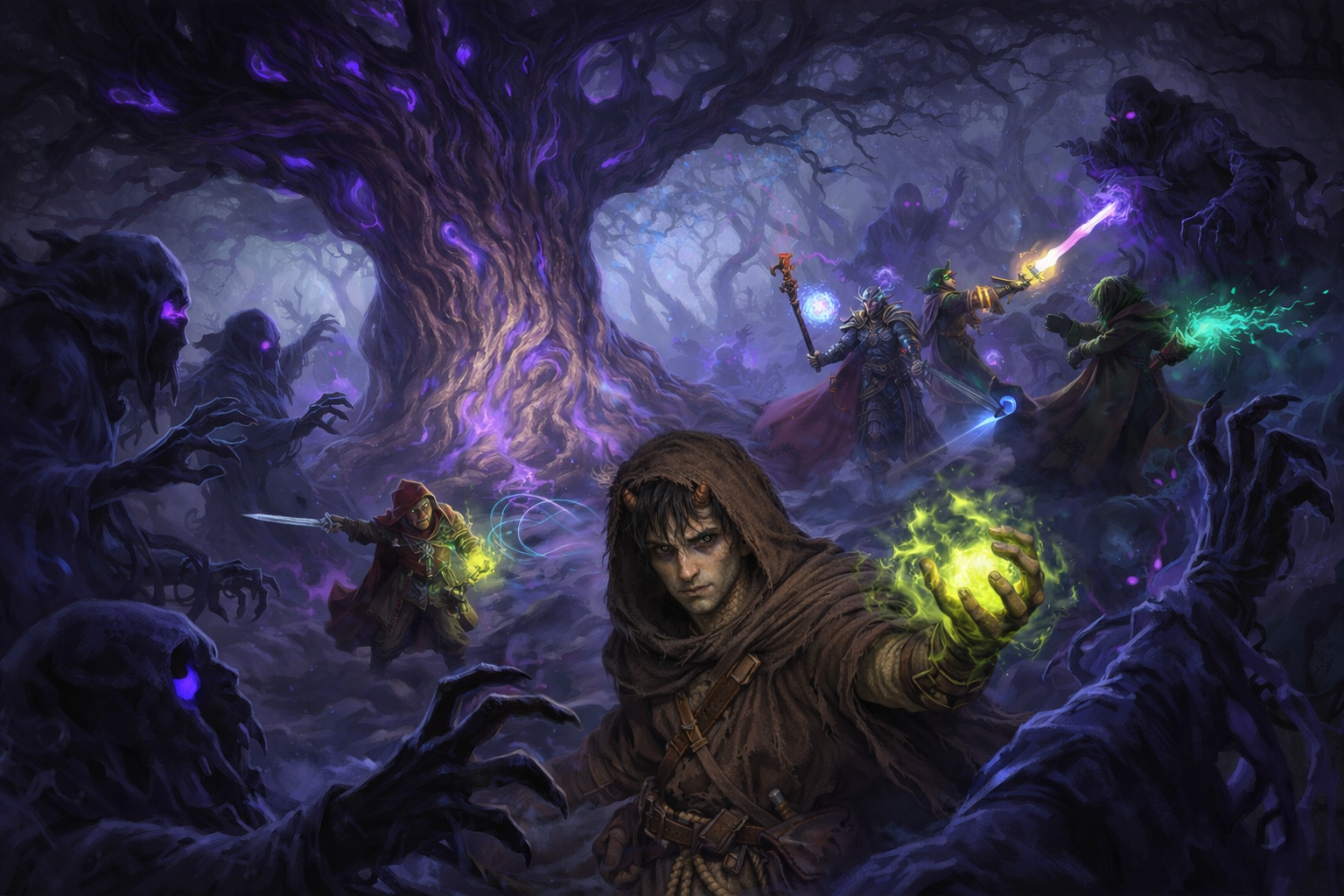
The moment the entire party engaged with the Echo Tree, the tone shifted …
The glade twisted into something darker, angrier. What had been a place of verdant calm became a psychological battleground, with each character confronted by their own past. This is where the session really sang: through player-driven narrative.
Tarin’s moment was particularly sharp, the first time his background had really been called into play. The memory of his childhood in the slums—being bullied, hunted, and ultimately cast out after his powers first manifested lethally—surfaced in full force. It wasn’t just flavour; it informed play. His reactions, his hesitation, even his spell choices all stemmed from that emotional grounding.
And then, of course, came the monsters.
Shadowy dream-creatures—very much in the mould of Dementors—manifested as embodiments of those memories. Mechanically, they were punishing. Psychically damaging, resistant to certain damage types, and capable of locking characters in place if they failed Wisdom saves.
That last point became crucial.
Lessons Learned (The Hard Way)
There’s always a moment in a session where you realise—too late—that you’ve been playing sub-optimally.
For Tarin, this was it.
Leaning heavily into fire-based spells (a thematic choice, but not always a practical one), I found myself largely ineffective against the creatures. The fallback—Chromatic Orb—kept me in the fight, but at a cost: losing the advantage from Innate Sorcery due to ranged casting in close quarters.
Meanwhile, more effective options—Dragon’s Breath, Thunderwave—sat unused. A classic case of “know your spellbook better.”
Compounding this, repeated failed Wisdom saves left Tarin effectively grappled by the dreamscape itself. Immobilised, battered by psychic damage, and forced into a grim war of attrition against his own past.
Most rounds left him bloodied. Survival became less about clever tactics and more about resource management—healing potions, well-timed support from Glorya, and just enough luck to stay upright.
It was messy. It was tense. It was exactly what you want from this kind of encounter.
After the Storm
Eventually, Glorya managed to pull us free from the dreamscape, returning us to the real glade.
The relief at the table was palpable—but so too was the aftertaste.
For Tarin, this wasn’t just “another fight.” It was a forced confrontation with memories he would very much prefer to leave buried. Mechanically challenging, yes—but more importantly, narratively impactful.
And that’s the quiet brilliance of sessions like this. They don’t just advance the plot—they deepen the characters.
Final Thoughts
This was a session that leaned heavily into experience over outcome. We didn’t uncover vast new lore or decisively shift the campaign’s trajectory—but we felt the world more keenly.
- The drop-in nature of RPG Taverns worked seamlessly again.
- The party’s lack of traditional balance created genuine tension.
- The Echo Tree encounter blended narrative and mechanics in a way that elevated both.
As for Tarin?
He’ll be giving ancient, sentient trees a very wide berth for the foreseeable future. There are, after all, plenty of other adventures around Aurelium… and not all of them involve being hunted by your own memories.
Oh, and he’s Team Glorya – he wouldn’t be still here otherwise!

 Tolrendor DM's Blog