There are moments when a landscape presents itself as something else.
Walking east through the high country beside Hadrian’s Wall, I passed a low, layered crag on a bleak sweep of Northumbrian moorland. Grass ran over its back. Beneath the projecting rock was a dark recess—not, so far as I know, a cave of any consequence, and certainly not a human-made entrance. But it had exactly the right look.
“Now is that the mouth of a dungeon or what?”
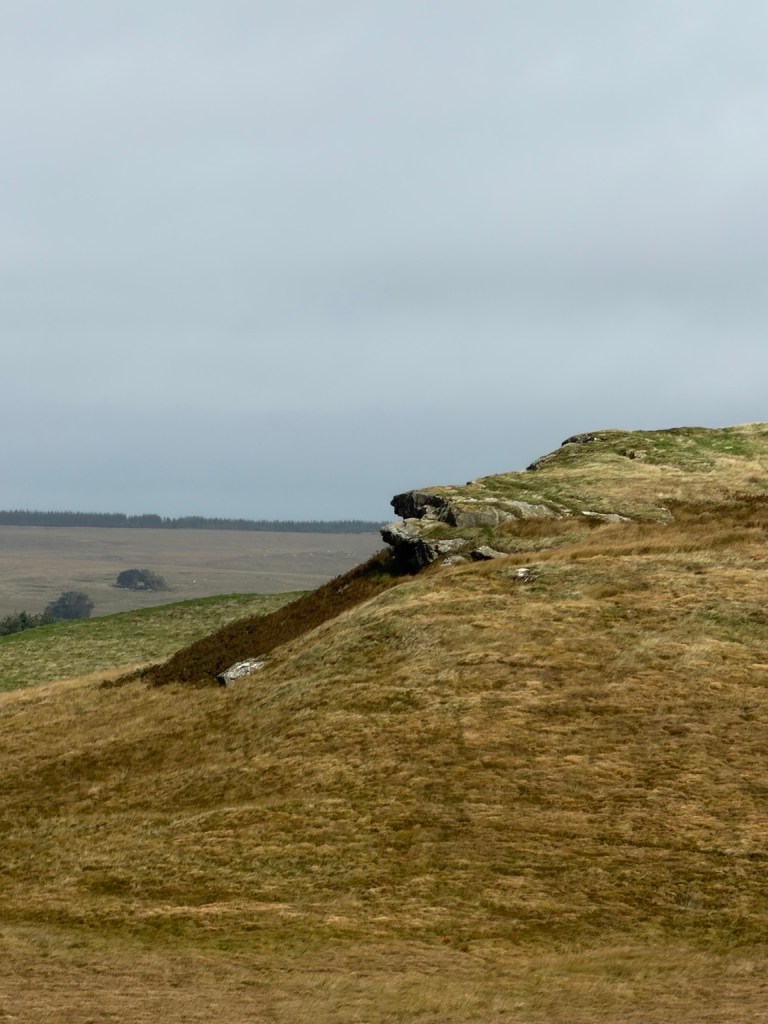
A doorway waiting to be imagined
A dungeon entrance does not require much. A shadow beneath a stone. A gap just large enough to suggest that the hillside is hollow. The suspicion that the darkness continues further than it ought.
Perhaps steps descend behind it. Perhaps forgotten hands cut a passage into the rock. Perhaps someone—or something—has been waiting beyond the reach of daylight.
That was the first thought, and it was a familiar one. Forty-odd years of roleplaying games have trained me well: show me a dark opening in a lonely hillside and I will start stocking rooms before I have finished taking the photograph.
Then came the more interesting thought.
What if nobody built the dungeon beneath the crag?
What if the crag is the dungeon?
The hill that was a beast
In Tolrendor, the Ages have left wounds in the land. Kingdoms have risen over the remains of older kingdoms; roads cross forgotten boundaries; ruins acquire new names long after their builders have vanished. Yet the deepest history of the world belongs not to fallen empires but to the Age of Strife, when powers far older and greater than mortals shaped—and broke—the world.
Suppose one of those powers fell here.
Not a dragon, at least not necessarily, and not a creature that can be tidily identified in a sage’s bestiary. A primordial beast vast enough that, over the millennia, its body became landscape. Soil gathered over its hide. Heather and grass rooted in it. Rain entered old wounds, frost split petrified tissue and whole layers of anatomy became indistinguishable from stone.
The hill is not covering its carcass.
The hill is its carcass.
That dark recess might be the gap beneath a shattered jaw, or the place where some ancient weapon pierced it. What appears outside as a shelf of rock might be a weathered plate of bone. A line of harder stone running along the ridge could be a spine buried beneath the turf.
And once adventurers force their way inside, the passages need not follow the sensible geometry of miners or architects. They follow anatomy.
The anatomy of a dungeon
A narrow descent might once have been a throat. Branching tunnels could be calcified veins. Smooth, curving passages run through hollow bones, while cramped fissures open without warning into a chamber formed by an immense ribcage.
Water gathers where a lung collapsed. Pale fungi cling to mineralised membranes. Roots break through from the living hillside above and hang into spaces that have not seen daylight since the Age of Strife.
Nothing remains recognisably fleshy. This is not a dungeon of blood and gore, but of troubling resemblance. The stone beneath a character’s hand is too smooth, too ivory-coloured, too much like the inside of something. Ridges repeat with an organic regularity that no geological process quite explains.
The deeper the party travels, the less convincing “cave” becomes.
There are almost certainly other traces too. Perhaps memories have survived without a mind to contain them: momentary visions of a broken sky, impossible figures crossing a burning landscape, or the last sight the creature witnessed before it fell. Such glimpses could reveal something of the Age of Strife without providing a neat historical account.
I prefer the uncertainty. The explorers should encounter evidence, not an explanatory plaque.
What came after
Perhaps the real nature of the hill remained hidden through all the Ages.
That does not mean nobody ever entered it. Later peoples may have discovered shallow cavities through fissures that have since collapsed. Someone might have built a shrine between the ribs, quarried fragments from what they took to be an unusual seam of stone, or sealed a passage that descended too deeply. An Order of the Age of Heroes may have glimpsed part of the truth. A later empire may have added doors and stairs to a natural cavern—and confidently misunderstood everything beneath them.
But the dark mouth in the crag could be new.
A winter of hard rain might have washed away the soil concealing it. A rockfall could have opened a path into spaces no mortal has entered before. Or perhaps it was exposed by some less natural act: a movement beneath the hill, the reopening of an ancient wound, something within seeking a way out.
That possibility gives the dungeon two histories. Its outer chambers bear the traces of those who found earlier ways inside, used them and vanished. Beyond them lies the greater carcass, sealed since the Age of Strife. The newly exposed entrance is not necessarily the first—it is simply the first to reveal how deep the mystery runs.
The most evocative dungeons are rarely products of a single moment. They are places used, abandoned, rediscovered and misunderstood. Here, the primordial carcass provides the impossible foundation; later visitors have left human—and inhuman—histories within it without ever comprehending the whole.
Even its present inhabitants need not understand their home. Creatures might be drawn to its residual power. Cultists could worship what they believe sleeps below. Tomb robbers may have followed rumours of Ember-stone. A scholar might hire adventurers to prove that the “fossilised” structure cannot possibly be bone.
They may all be wrong in different ways.
The frontier beneath the frontier
Hadrian’s Wall makes it easy to think in layers. The Roman frontier still shapes the ground, but it crosses a landscape far older than Rome and has itself been quarried, buried, exposed and reinterpreted over centuries. Walking beside it, history does not feel neatly sealed in the past. It protrudes through the turf.
That small Northumbrian crag provoked the same instinct. First came the obvious adventure: a dark mouth beneath the rock, waiting for someone foolish enough to enter. Then the landscape opened beneath it, and the dungeon became something older than walls, doors or treasure chambers.
I still do not know exactly what the beast was, what killed it, or what an adventuring party would find at its heart. I am not sure I want to know yet.
For now, it is enough that somewhere in Tolrendor a grassy ridge rises beneath a grey sky. A dark opening waits beneath an overhanging slab. Travellers call it a cave.
But the dungeon was not built inside the hill.
The hill is the dungeon—and the hill is a dead primordial beast.
Or at least, everyone hopes it is dead.
This article is part of Finding Tolrendor on the Roman Frontier, a series inspired by walking Hadrian’s Wall.