There was a definite point at which the walk became an expedition.
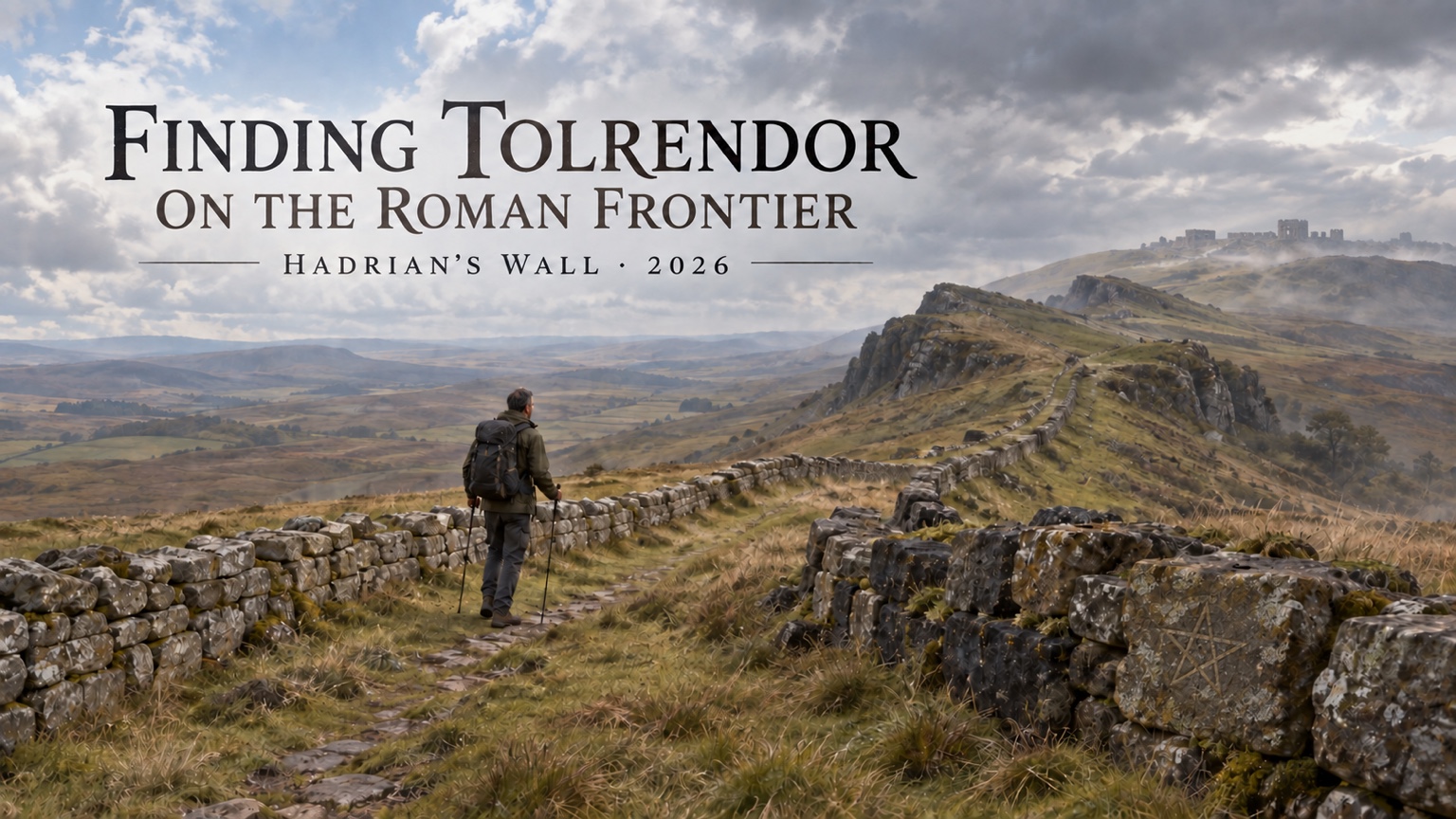
On Day 1, I walked from Bowness-on-Solway to Carlisle with a daypack. On the morning of Day 2, I left Carlisle carrying everything I would need on my back: tent, sleeping gear, cooking kit, food, spare clothes and protection against whatever the northern weather chose to provide.
In practical terms, it was simply the first full-pack stage of my journey along Hadrian’s Wall.
In my imagination, however, something rather different was happening.
I was setting out on an adventure.
The road is the story
Again and again, the fantasy stories that shaped my imagination begin when someone leaves the familiar road behind—or discovers that the road leads much further than expected.
Bilbo walks out of Bag End and towards the Lonely Mountain. Frodo leaves the Shire on a journey that will carry him across Middle-earth. Garion is drawn away from Faldor’s farm and through the kingdoms of David Eddings’ Belgariad. In Raymond E. Feist’s Magician, the road from Crydee eventually opens onto other kingdoms and even another world.
These are stories about great conflicts, lost objects, ancient powers and the fate of nations. But they are also stories about travelling.
Their characters cross mountains, forests, rivers and borders. They sleep beneath unfamiliar skies, meet strangers on the road, become lost, run short of supplies and discover that the world is much larger—and considerably more dangerous—than it appeared from home.
The landscape is not merely scenery between important events. The journey changes the travellers. Very often, the journey is the story.
Valshea and the promise of the road
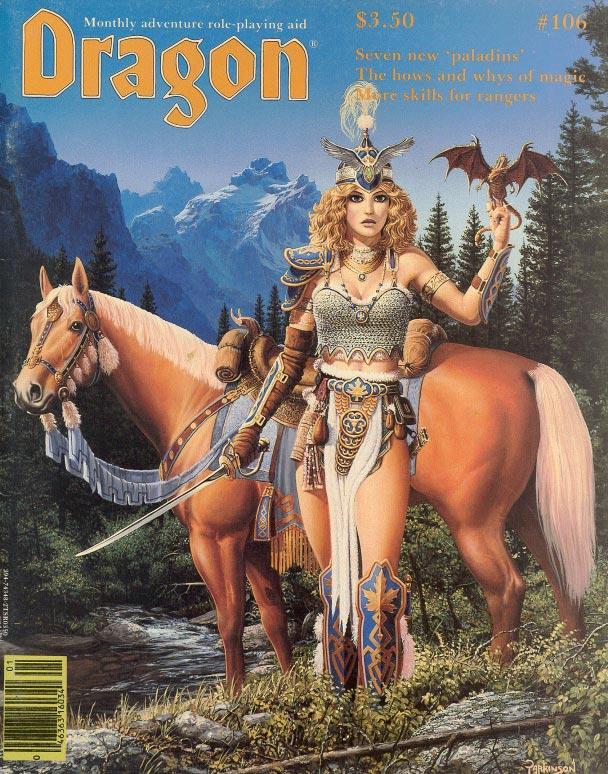
One image that has remained with me since the 1980s is Keith Parkinson’s Valshea, painted for the cover of Dragon Magazine #106.
Lady Valshea stands beside her saddled horse, a small pseudodragon familiar perched on her raised hand. Behind her, a vast mountain landscape stretches into the distance.
There is no battle taking place. No monster is charging into the foreground. Valshea has simply paused during a journey through Blue Rock Vale.
That is precisely what makes the image so evocative.
Her equipment is packed. Her horse is ready. The mountains promise distance, danger and places not yet explored. The picture leaves us wondering where she has come from, where she is going and what lies beyond the next ridge.
It remains one of my favourite Dragon covers. As I prepared to shoulder my own pack and set out along the Wall, it was one of the first images that came to mind.
My equipment is rather less elegant, and a pseudodragon would probably complicate campsite bookings, but the imaginative impulse is much the same.
There is a road ahead. Everything I need is on my back. It is time to find out what lies beyond the horizon.
Beyond the dungeon
Dungeons & Dragons understood the imaginative power of journeys from the beginning.
The third volume of the original 1974 rules was explicitly titled The Underworld & Wilderness Adventures. The game provided rules for movement across open country, becoming lost, different terrain, waterborne travel and encounters far beyond the dungeon entrance. It even directed players to Avalon Hill’s Outdoor Survival board as a ready-made wilderness map.
The wilderness was not simply empty space between settlements. It was uncertain territory in which direction, distance, weather, supplies and chance encounters all mattered.
As D&D developed, its maps made that promise of a wider world increasingly tangible. The great two-sheet map of the Flanaess accompanying the 1980 World of Greyhawk folio turned names, coastlines and mountain ranges into invitations to travel. The 1981 Expert Set expanded play beyond the dungeon, while The Isle of Dread gave players an extensive wilderness to explore rather than a sequence of rooms to clear.
Those maps mattered. A dungeon map presented an immediate problem. A world map presented possibilities.
Where does that road go? What lies beyond those mountains? Who controls the river crossing? How long would it take to reach the distant city—and what might happen before we arrive?
The moment characters began travelling across those maps, fantasy roleplaying became capable of telling the same kind of journey stories that had filled the novels on our shelves.
Walking with my father
There is, of course, a more personal reason why this journey matters to me.
Some of its roots lie in the hikes I took with my dad when I was a boy. Decades ago, I also visited Hadrian’s Wall with him. Long before I began looking at the frontier as inspiration for Tolrendor, it was already connected in my mind with walking, discovery and time spent together.
Those memories are part of the landscape I am crossing now.
Walking creates a particular relationship with a place. At the speed of a car or train, towns, rivers and hills become brief impressions. On foot, the ground asserts itself. Distance becomes physical. Weather matters. A climb has a cost. A sheltered stopping place becomes valuable. The next settlement is no longer a name on a sign but somewhere that must actually be reached.
Carrying a full pack intensifies that relationship. Everything has weight. Every unnecessary object announces itself. Food, water, warmth and shelter cease to be background assumptions and become part of the day’s decisions.
That is not hardship on the scale endured by historical travellers—or most fantasy adventurers—but it is enough to change how the landscape is perceived.
Finding Tolrendor on foot
For a worldbuilder, maps are dangerously easy.
A line can cross a mountain range in seconds. A road can connect two cities with a stroke of the pen. A frontier can be drawn, named and forgotten.
Walking reminds me that every one of those marks has consequences.
A believable road needs destinations, stopping places and reasons to exist. A frontier is not merely a wall: it is a network of forts, watchtowers, patrol routes, settlements, shrines, supply points and controlled crossings. Travellers need water, shelter and food. Terrain determines where people can move, while weather decides whether they move at all.
A journey also determines whom characters meet.
The road brings soldiers, merchants, pilgrims, refugees, officials, thieves and fellow travellers into temporary contact. Campsites, bridges, ferries, inns and gates become natural stages for stories because they gather together people who might otherwise never meet.
This is part of what I am looking for along Hadrian’s Wall. Not simply ruins to adapt into Tolrendor, but the experience of moving through a frontier landscape: how its parts connect, where the natural pauses occur and how distance changes the meaning of a place.
Setting out
I was not leaving Bag End, Crydee or Faldor’s farm. I had GPS mapping, modern waterproofs, carefully chosen equipment and campsites waiting ahead.
But when the straps were tightened, the poles were in my hands and the road turned east out of Carlisle, something older and more imaginative stirred.
The walk became a journey. The journey became an expedition. And somewhere between the Roman road beneath my feet and the imagined roads of Tolrendor, an adventure began.
From the Dragon’s Hoard: Opening an old issue of Dragon Magazine again for this post was so much fun that I have decided to make a habit of it. Look out for a new regular column in which I delve into my collection, revisit ideas that still deserve attention, and rebuild them as inspiration for Tolrendor. Lady Valshea’s own full return will wait until February—the month in which issue #106 originally appeared.

 Tolrendor DM's Blog