Split, Croatia
The first few days in Split were really just supposed to be a short city break before the backpacking ‘research’ journey got underway properly with my first train north to Zagreb.
But that didn’t last long. Inspiration hit pretty much as soon as I took my first stroll into the old town.
There is something wonderfully strange about Split.
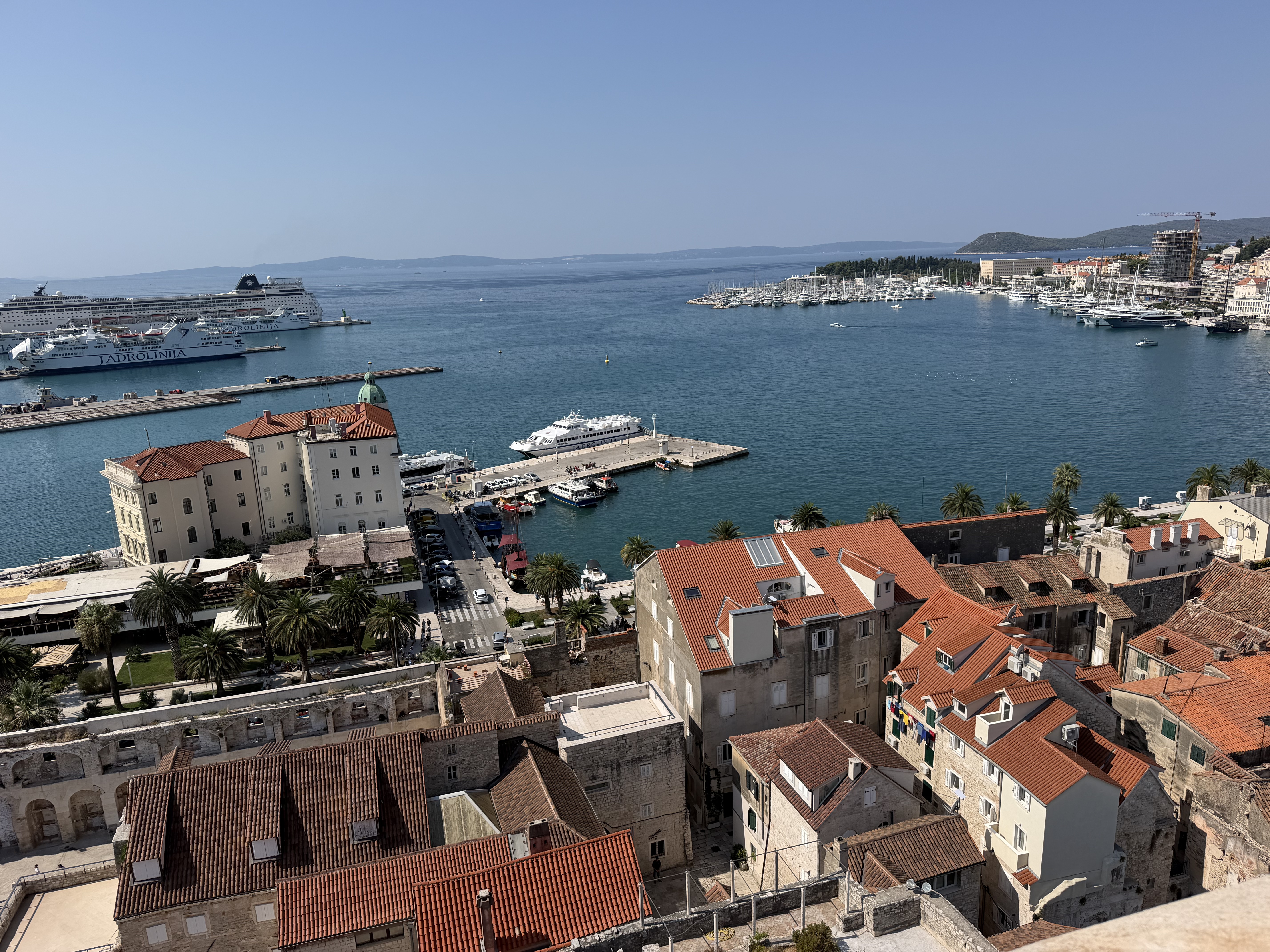
At first glance, it has many of the things you expect from an old Mediterranean city: pale stone walls, red-tiled roofs, narrow alleys, church towers and little squares packed with cafés.
Then you realise that the old city isn’t merely beside the ruins of a Roman palace.
It is inside them.
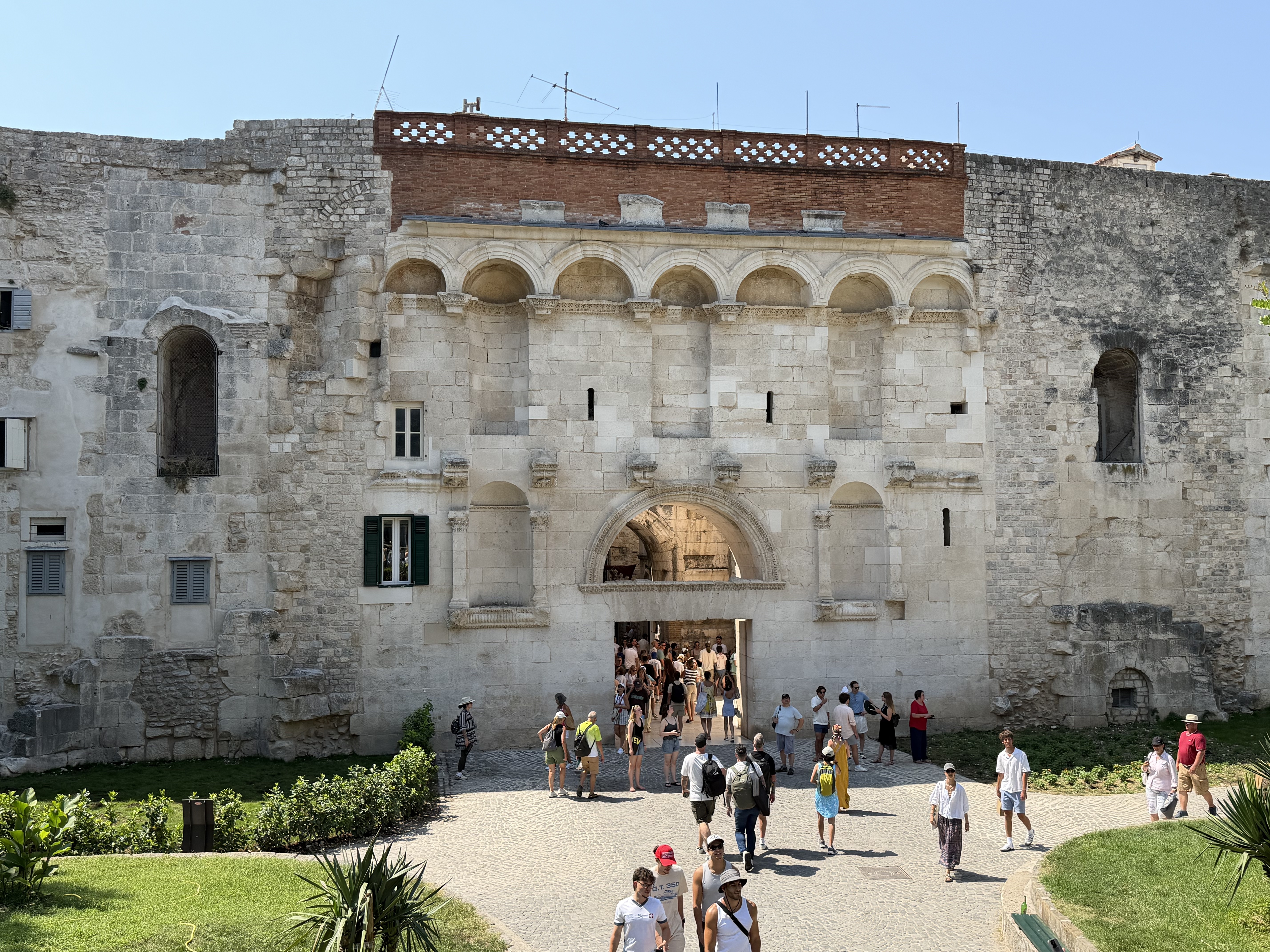
Diocletian’s Palace was built at the beginning of the fourth century as an enormous fortified retirement residence for the Roman emperor. As the western Roman world fragmented and the centuries passed, people didn’t simply abandon the palace. They moved into it.
Rooms became houses. Corridors became streets. Walls became the foundations of other buildings. Shops appeared beneath ancient arches. Diocletian’s mausoleum eventually became the Cathedral of Saint Domnius.
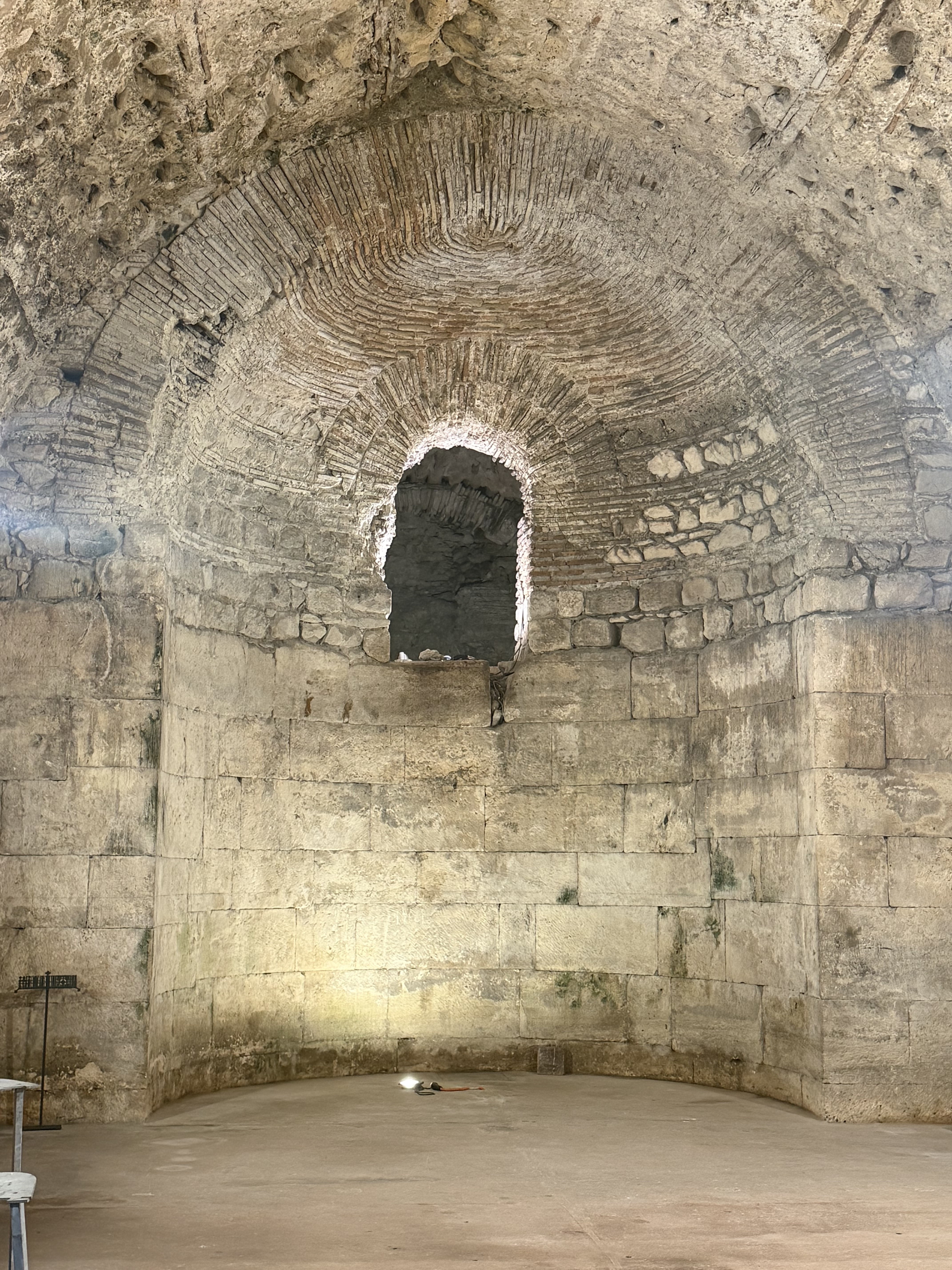
And beneath all of it survive the enormous vaulted substructures of the original palace.
Walking through Split, you’re not really walking through a Roman ruin or a medieval city.
You’re walking through both at once.
And that immediately started me thinking about Tolrendor.

The Palace of a Dead Empire
Tolrendor has plenty of fallen empires.
One of the greatest was Varandia, the ancient dragon empire whose power once stretched across lands surrounding the Inner Sea.
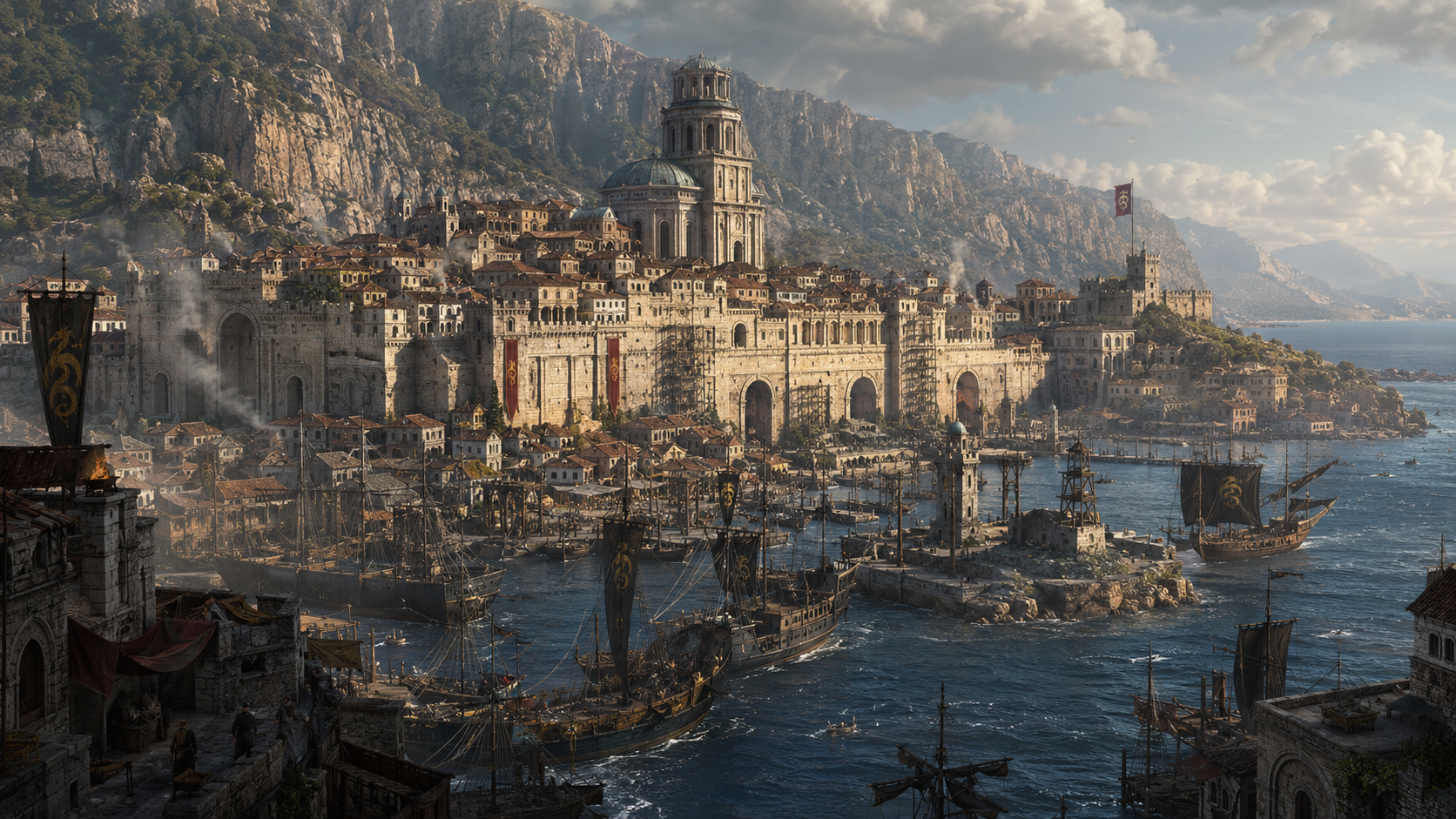
So imagine a rocky peninsula thrust into that sea, on the south-western coast, perilously close to the blighted lands that mark the fall of the draconic realm.
Behind it rises a great limestone escarpment. Before it lies a naturally sheltered bay, opening onto the sea lanes connecting the kingdoms of the Inner Sea.
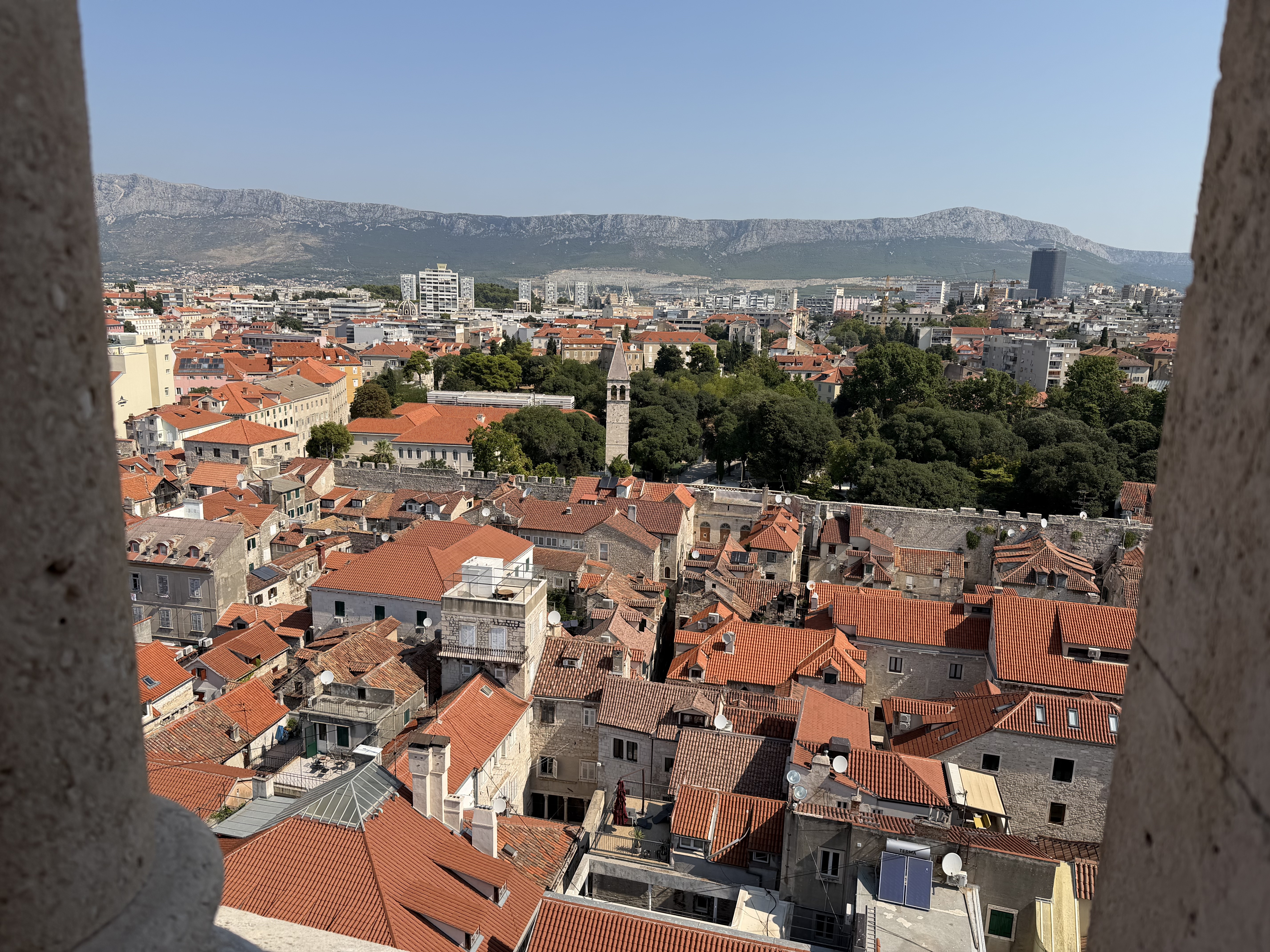
And on the shore stands the palace of a dead emperor.
Not merely a palace, but a vast fortified complex constructed during the final centuries of Varandian power. Perhaps its builder was an ageing Dragonborn emperor who had withdrawn from the intrigues of the imperial capital.
Or perhaps the title emperor conceals something rather more interesting.
Perhaps he was himself a dragon.
Whatever the truth, he intended this place to be both his final residence and his tomb.
Thousands of years later, the empire is gone.
The palace remains.
And people have moved in.
They call the city Karsos.
A City Inside the Walls
This is the part of Split I most want to steal for Karsos.
The old palace shouldn’t survive as an archaeological ruin conveniently sitting beside the fantasy city.
The palace should be the city.
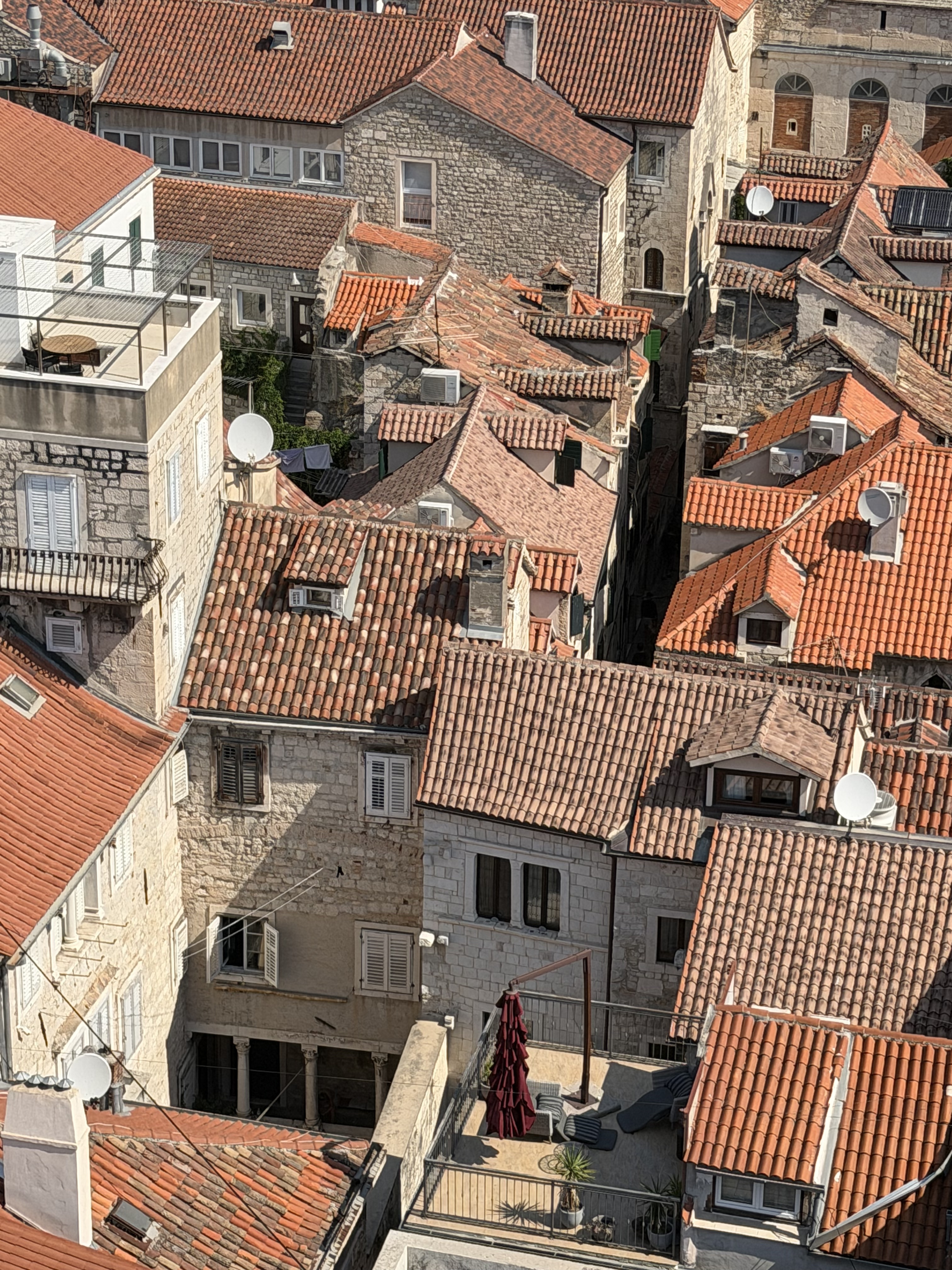
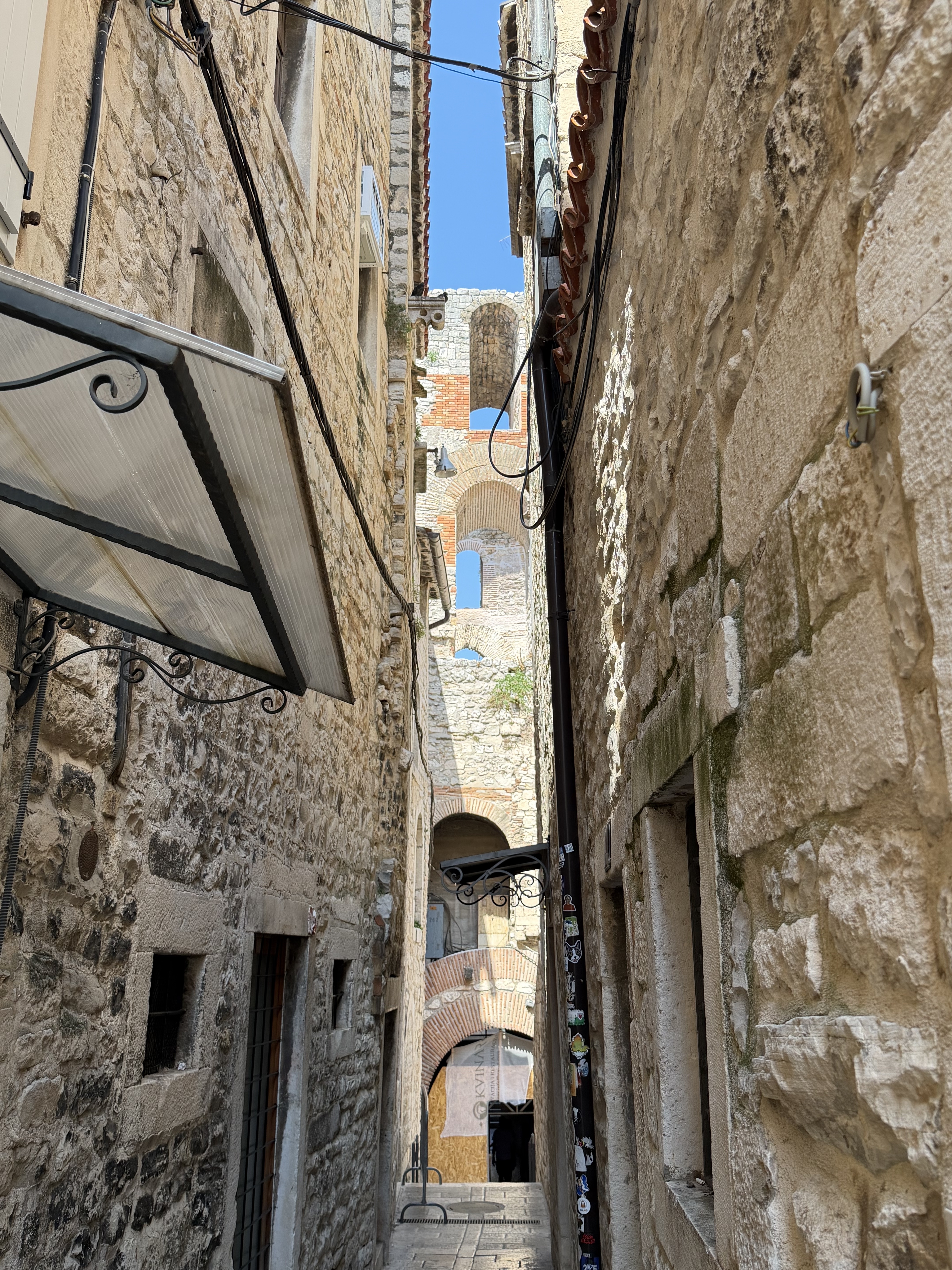
Its ceremonial avenues have become crowded streets. Houses have been built between enormous Varandian columns. Workshops occupy former guardrooms. Taverns have punched doors through walls raised for long-forgotten imperial officials.
Ancient courtyards have become marketplaces.
The upper levels are a chaotic mass of roofs, balconies, washing lines, bridges and additions accumulated over centuries.
And everywhere there are fragments of the older city.
A dragon’s head protrudes from the wall of a fishmonger’s shop. An imperial inscription sits upside-down in the foundations of an inn. A perfectly ordinary house has one wall made from blocks carved with the victories of a Dragonborn legion nobody remembers.
Then there are the passages underneath.
Split’s extraordinary palace substructures suggest something much larger beneath our Tolrendian city: vaulted chambers, cisterns, crypts, forgotten temples and sealed corridors descending through successive periods of Varandian construction.
Most are used as warehouses, workshops, smuggling routes and cellars.
Some have been sealed for centuries.
Nobody agrees why.
The Emperor’s Tomb
At the centre of Diocletian’s palace stands one of history’s rather pleasing ironies.
The mausoleum of an emperor who persecuted Christians eventually became a Christian cathedral.
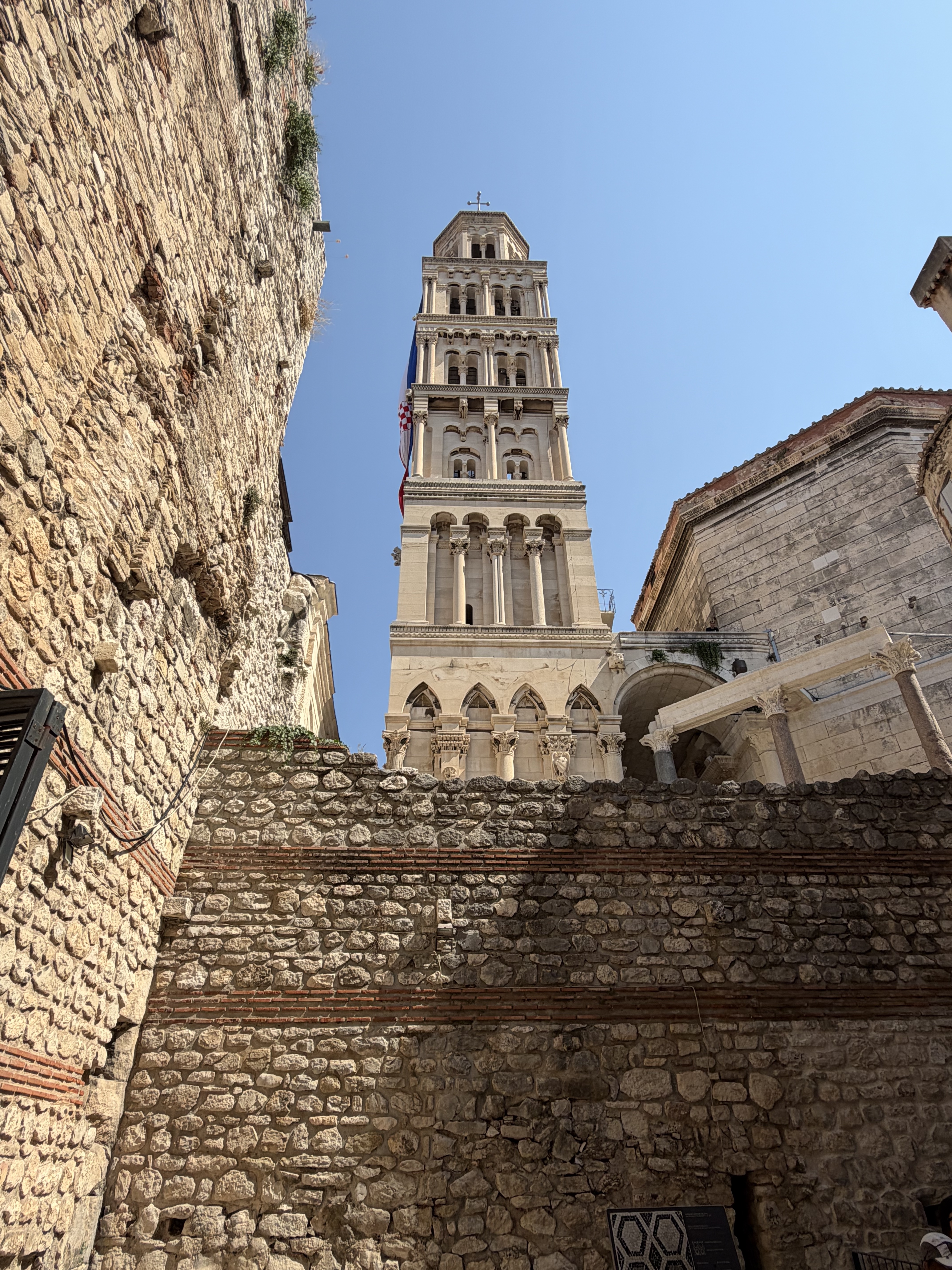
That deserves an equivalent in Tolrendor.
At the heart of the old Varandian palace stands the tomb of its builder.
Or at least, everyone believes it is his tomb.
Long after Varandia fell, the mausoleum was appropriated by the Akayin peoples who came to dominate much of the Inner Sea. It is now one of the city’s principal temples, dedicated to the Mariner, Akayin god of sailors, voyages and the sea.
The ancient imperial iconography hasn’t entirely disappeared.
Dragon mosaics still coil beneath later religious carvings. Great columns of polished stone support the temple roof. Priests descend into crypts whose lowest doors they have never had the keys to.
And somewhere beneath the temple lies the emperor.
Or what remains of him.
A Pirate Kingdom
Split itself was never particularly renowned as a pirate city, but I didn’t have to travel far for that part of the inspiration. The medieval Adriatic coast and its islands had a rich tradition of piracy and privateering — including the notorious pirates of nearby Omiš.
And that suggested what Karsos has become.
It is a pirate port.
Although pirate is perhaps an unfair description.
Even the city’s religion has adapted to its peculiar relationship with the sea. Elsewhere around the Inner Sea, the Mariner is the patron of sailors, voyages and safe harbour. In Karsos, another aspect has come to prominence: the Dark Mariner, patron of those who sail beyond the protection — and sometimes the laws — of more respectable shores.
Ask the city’s rulers and they will tell you that their captains are perfectly legitimate privateers and mercenaries. Their ships escort merchants, suppress piracy, fight wars and transport armies throughout the Inner Sea.
They merely have a somewhat flexible interpretation of who constitutes an enemy vessel.
The distinction becomes especially hazy when nobody has hired them recently.
That makes the city simultaneously a menace and a necessity.
Norbaer condemns its piracy while quietly employing its captains. Lorondor has fought several naval wars against it and hired its ships in several others. The Free Baronies regularly have Karsan privateers in their fleets when asserting their independence from Lorondin influence.
The Akayin city-states are the enemies and rivals of Karsos, and yet just as often its allies and trading partners. Elven vessels, however, are particularly unwelcome in its harbour, and the swift Elven patrols of the Inner Sea take a dim view of Karsan ships wherever they encounter them.
Beyond the old palace walls the city has spread along the harbour: shipyards, warehouses, ropewalks, markets, taverns and entire districts catering to sailors.
And somewhere through the rocky peninsula, an ancient Varandian passage has been enlarged into a tunnel leading to a second, heavily fortified anchorage.
That is where the real fleet waits.
The Dragon of the Inner Sea
Of course, a city like this needs someone sitting at the top.
At present, that someone is Thessara, First Pirate of Karsos — a female Dragonborn, charismatic, enormously wealthy and dangerously ambitious.
At least, that is what almost everyone believes.
Perhaps Thessara is actually a dragon.
I rather like that idea, although I’m not yet certain what kind…
What matters is what she wants.
She doesn’t merely want wealth.
She looks at the squabbling kingdoms around the Inner Sea and sees weakness. Her mercenary fleets already intervene in their wars. Her captains know every harbour. Her agents operate in every major port.
Why remain a pirate queen when she might become an empress?
And there are people in the city encouraging precisely that thought.
Dark Amber
A pirate port attracts people who prefer not to answer too many questions.
Mercenaries. Smugglers. Exiles. Treasure hunters. Fugitive mages. Adventurers.
And the Conclave of Dark Amber.
The Conclave has established itself quietly among the city’s antiquarians, merchants and arcane dealers. Its agents have become useful advisers to Thessara, bringing her fragments of Varandian lore and feeding her stories about the power once wielded by the palace’s ancient master.
They have discovered something beneath the city.
The emperor’s tomb is not empty.
His bones — and perhaps something more than his bones — remain hidden in chambers far beneath the former mausoleum.
The Conclave believes he can be restored.
Not resurrected.
Transformed.
A dracolich beneath an ancient Varandian palace would be a formidable weapon for an aspiring empress.
The First Pirate of Karsos believes she could control it.
The Conclave intends to make certain that they do.
Finding Tolrendor
This is exactly what I hoped this journey would produce.
I came to Split because my wife had been here before and wanted to share it with me. From here, she would go sailing in the Adriatic while I began my journey north.
I’m leaving it with a new city for Tolrendor.
Not a fantasy copy of Split. The bell tower, Diocletian and the Roman Empire won’t simply acquire different names.
What I want to take with me is something deeper: the idea of a city that has consumed an ancient imperial palace and made it part of everyday life.
A place where you can drink in a tavern whose cellar was built for a Dragonborn emperor, worship the gods of the sea above his forgotten tomb, hire a pirate captain beneath the statues of a dead empire — and perhaps discover that something ancient is stirring beneath your feet.
Tomorrow morning I finally shoulder the backpack and begin travelling north.
Somewhere between Split and Zagreb, my Richard the Lionheart-inspired journey properly begins.
But before I’ve even boarded the first train, I’ve already found my first place in Tolrendor.


 Tolrendor DM's Blog