RPG Tech Talk: The PDF Dilemma (Part 2)

In Part 1 of this article, we looked at the PDF security options that are available natively in the Acrobat PDF format itself. These included the ability to password protect and encrypt a document, as well as control actions that are available, such as copying or printing. Ostensibly, this seemed like a sufficient set of controls to protect the IP of electronically published D&D products. Unfortunately however, it seems there are two quite significant potential issues with the native approach:

  • The Adobe encryption is relatively easy to crack, being only 40-bit, and there are plenty of programs out there that can achieve this on normal equipment.
  • The Adobe PDF specification does not enforce that a specific PDF viewer implements the security restrictions! This does seem rather lax in current times!

So it looks like a more solid DRM (Digital Rights Management) solution would be needed to persuade publishers like WOTC to get back into the PDF game. There certainly are options out there, but there are often constraints that come with them. Lets look at a list of key potential ‘wants’ for such a system:

  • Simple access and technology requirements
  • To be able to use PDF files both on-line and off-line.
  • To be able to use PDF files on any device – PC, Mac, Phone, iPad etc…
  • Ability to print PDFs
  • To be able to read PDFs as soon as they are purchased
  • To be able to lend a PDF to a friend, like you would a hard-copy book

The above is a feature list from a user’s point of view. I can imagine WOTC might have an expanded list of requirements:

  • Able to integrate the DRM system into a ‘branded’ store
  • Able to work with 3rd party distributors such as RPGNow.
  • Simple administration of licences
  • Simple publishing of protected documents
  • Ability to provide various publication options e.g. perpetual licence, subscriptions, time expiry etc.

Are there products out there that can support these features? After some research, I decided to review one product against the requirements: Safeguard Enterprise PDF Security from LockLizard. Unlike many products that I looked out, their product did not rely on continuous access to a central server and/or passwords to be maintained for each document (if you remember the vitriol when WOTC moved to an online only Character Builder, I think you know where I’m coming from…). So, lets have a look:

End User Requirements:

The Safeguard product works by encrypting the entire PDF document with AES 256-bit encryption – this is military strength, so there’s not much out there that can break that without super-computer efforts! So how does the user read the document? Well, this is the downside – the user needs to use a specific secure PDF reader, supplied by Lock Lizard, rather than a standard Adobe Acrobat Reader. Its available for Windows and Mac (with some constraints), so straight away this rules out your phone or tablet :(. Still, I reckon most people would take this over no PDFs, at least to start with. As smartphones and tablets start to dominate the end-user computer market, I’m sure the product would catch up.

The upside is that once you have the PDF, and the secure reader, you don’t need to remember a password, or be connected to the Internet, except for the first time you load it. Once only the secure reader will connect to the licensing server, download a machine specific licence file, and from that point on the PDF can be read on that machine forever (unless the publisher has specifically added some expiration controls). It is also possible to ‘transfer’ the licence to another machine, in case the user upgrades, or even to ‘lend’ the PDF to a friend (i.e. the original user would no longer be able to access it). The PDF can also have print and copy controls built into it, but the secure reader can put watermarks or user information in the printout to discourage mass distribution.

Wizards’ Requirements

Pretty much all of the requirements that Wizards might have from their perspective seem to be catered for, although I’m sure there would be some significant integration requirements. Using the LockLizard eCommerce Add-in, most of the functionality could be hidden behind D&D branding, whether on their own website, or via a 3rd party. The product also has features to allow the licences to have various expiry options based on both the document or the user. For example, for a Core Rulebook distributed as a PDF you would expect the document to have a perpetual licence; but for a subscription based PDF (e.g. Dragon Magazine) the licence for the user might expire in a year (renewable of course…), allowing access to documents published in that annual period, but nothing after that.

Of course, this is a theoretical look at the problem based a small amount of research, and clearly there would be many many issues and details to resolve, but the fact that products are definitely out there that could fulfil a significant proportion of the required use cases does lead me to believe the problem is solvable … if Wizards really want to 🙂

I for one, hope they do, and can …

And if not …

I mentioned in Part 1 that WOTC might be looking at other forms of electronic distribution, like eBooks, but that these formats weren’t really suitable for publications with complex layout requirements…

… Well, recently Apple released a software product called iBooks Author, aimed primarily at  producing interactive textbooks. Might it be applicable to RPG products? Lets take a look at this in another column 🙂

Posted in Columns, RPG Tech Talk, RPG Technology | 6 Comments

DM for Kids: DM Style

GM Merit badges are cool! After coming across this neat set of icons  (I know, quite late compared to everyone else…) intended to reflect a GM’s approach to their game, I thought it would be fun to consider my style when running a 4E D&D game for my kids.

In general, I don’t think my style would be massively different in an ‘adult’ campaign (I’m not currently running a regular one), but there are definitely some things to consider when running a kids’ game. So here goes my take on the ‘DM for Kids’ Style:

My games will tell an interesting Story

Story Based

I certainly hope this is the case! To me, D&D is about creating worlds and telling stories using game mechanics. My daughter, especially, is very much into the story aspect of the game, so this is definitely something I aim for. Quite often she will be disappointed when ‘Roll Initiative’ is called, if she thinks it’s interuppting the flow…

Tactics are an important part of my games

Tactics

However, I’ve got to keep my son happy too, so combat is an important aspect of my game. As I’ve mentioned before, they both love the battle-maps and minis etc associated with D&D combat, so its follows that Tactics are important. My son has started Warhammer Fanstasy as well, so he loves all this!

My games use a pre-made Map and pre scripted content

Maps

It would be a bit hard with even a cursory read of this blog to miss the fact that I think battle-maps are cool 🙂 In fact, all maps are cool! Back in 1E days, I still used a grid and minis for combat regularly, but with the tools available now … well I’m probably a bit over the top in terms of my encounter and props preparation! It is one aspect of the game that I enjoy a lot, although I am trying to cut back a bit, just to get a bit more efficient!

My games are Safe and you don't need to worry about content or character death

Safe

This probably goes without saying for a kids’ campaign, certainly on the content side! Not that I shy away from popular fantasy concepts – at 12 and 10 they’re old enough to be reading and watching a fairly wide range of material – but clearly there are some concepts I avoid 🙂 On the character death aspect, there are  times when one of the PC’s has been dropped to negative hit points in a fight, and this definitely comes with the chance of tears! The kids do invest heavily in their characters, so while I like to crank the tension up, care is needed…

The GM is In Charge in my games and "rule-zero" is in effect

Rule 0

Of course I’m in charge, I’m DM Dad 🙂


Animals are an important part of my game

Animals

This is an extra ‘badge’ I just had to add for my kids campaign!! As I’ve posted before, my kids characters are steadily amassing a large menagerie: beast companions, war dogs, horses, and a fervent desire to acquire a baby griffon! It isn’t an aspect of my game that I had planned, so this is definitely rolling with the kids’ input. Great fun though, and an obvious source of adventure … 

So there you have it, my DM for Kids style. Works for my campaign so far 🙂

Posted in 4E D&D, Columns, DM for Kids, Roleplaying with Kids | Leave a comment

Getting out there…

I’m very pleased to share that this blog now a member of the RPG Blog Alliance!

The site started pulling TolrendorDM’s RSS feed last night – it came as a bit of a surprise, as I’d been having issues with my email address and had never got the certification email, but hey who cares!

Anyway, I’m very pleased to be in the list with a huge number of great blogs – I can’t pretend that I’ve visited them all, but quite a few are familiar. This all adds to the (positive) pressure to keep up with my more consistent posting schedule!

Happy Gaming!

Posted in Miscellaneous | 1 Comment

Content Corner: Spider Fey

Content Corner LogoRecently in the 4E campaign I’m running for my kids, the party had a little detour to the Feywild, to rescue a unicorn foal from some evil fey brigands. When designing the short adventure, I was casting around for a suitable ‘nasty’ to be the boss of the bandits. I wanted to bring out a specific aspect of the Feywild – the concept that you can never quite trust what you see; that all is potentially a glamour or trick of the mind.

Not  being able to find exactly what I wanted, I decided to design my own, and after a little brainstorming came up with the idea of a type of intelligent giant spider which could also take on other forms in order to deceive the characters, and would be masters of illusion – and so the Spider Fey were born.

One of the things I like best about 4E is the ease of creating new monsters using the Adventure Tools, and the ability to pillage neat powers from throughout the Monster List or Compendium. There are so many available that you seldom have to create a power from scratch, but simply give it a little twist perhaps to find the right flavour. The Spider Fey have powers drawn from other types of spider and from creatures with similar powers (e.g. Gnome arcanist …) to to the style I was looking for. I also took some inspiration from the recent Heroes of the Feywild book to give one type of Spider Fey some cool evil witchcraft powers!

And so I’m pleased to present the first Monster offerring for the Content Corner column! Hope you enjoy it. If you do, let me know in the comments 🙂

Tolrendor Bestiary: Spider Fey

Posted in 4E D&D, Columns, Content Corner, Monsters, Roleplaying with Kids, Self-publishing | 3 Comments

Wizards Watch: DnD Next Round-up…

Wizards Watch Logo

Right now, the main DnD Next activity is centred around the new ‘hub‘ that’s been created on the Wizards website. All the Legends and Lore columns are accessed here, as well as a number of blog posts by the design team. These columns all have one thing in common – a poll at the end, where interested people can vote on some question raised in the poll.

I’m not sure this is working! There is a lot of noise being generated, both in the comments on the blog, or in the wider blogosphere, that the polls are not very well thought out (“how can we vote on how many hit points a fighter should have at first level if we don’t know average damage…”), or that the blogs are biased in some way versus 4E or any particular edition.

In my opinion, one issue is that snippets of information (and lets be honest, none of this is real information, its just trying to seek feedback) are being released, which in turn generates lots of discussion (and angst…) because there isn’t enough context available within which to evaluate the blog posts. I understand WOTC want to generate interest, and not go silent, but my friends, the problem is with the D&D internet community is that discussion in a near vacuum generates as much vitriol as it does constructive ideas… and that’s not necessarily a good thing for D&D Next!

For my part, I haven’t been reading too much into these blogs and polls, as I think they are more about keeping engagement and feedback going than any real decision making. I certainly haven’t got the anti-4E vibe that a number of people are highlighting, although its clear that if you’re firmly of the belief that 4E was a flexible well-balanced game (as I am), then D&D Next is definitely going to have some things to get used to …

In some ways, I think WOTC would have been better to go a bit silent at this point, and concentrate on getting out the first playtest material. I assume this will largely be the stripped down core (Basic D&D?), but it will be enough to give a solid framework on which to gather further feedback.

As usual, open mind firmly engaged …


Posted in Columns, DnD Next, Miscellaneous, Reviews, Wizards Watch | Leave a comment

March Update

February in review …

February turned out to be a very successful month. I once again managed to post regularly (9 in total), and published the second instalment of each of my new columns (5).

Very pleasing also were my viewing stats! I had my best month ever in terms of hits (35% greater my previous best), and my best day ever. Now the numbers are still very low in absolute terms, but in relative terms I’ve had almost 40% of hits so far in 2012 than I had in the whole of 2011. So that’s progress!

Onwards to March …

I certainly hope I can continue the progress in March with another set of solid posts – as usual my publication targets are shown in the Content Calendar!

Happy Gaming!!

TolrendorDM

Posted in Columns, Miscellaneous | Leave a comment

Content Corner: Havenscoast Overview

Content Corner LogoBack in the day, the D&D products I used to like more than any other were ‘Gazetteer’ style guides, like the original Greyhawk and Forgotten Realms products. I used to peruse these voraciously. Strangely, I seldom ran adventures using these products, but more used them as inspiration for building my own world, Tolrendor!

The Havenscoast Project is my personal project to update all the reams of notes I created for one region of my world into the 4E (and I guess eventually D&D Next…) rule-set. This is quite a big task, and has taken a bit of back-seat lately as I’ve tried to concentrate on both this blog, and my kids’ campaign. However I hope in the coming months that this project will contribute quite a lot to this column!

This month’s Map of the Month column showed off my latest map of the Havenscoast region. I’ve now started on a Gazetteer of the region, which I’ll be looking to update over a number of columns. It’s only an ‘Overview’ at the moment, but I’m looking forward to this growing:

 Havenscoast Gazetteer

Posted in Area Map B4: The Havenscoast, Columns, Content Corner, Self-publishing, The Havenscoast Project, Tolrendor Gazetter, World Building | 2 Comments

Beautiful Greyhawk Maps

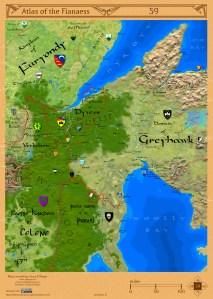
For all Greyhawk fans out there, I came across this wonderful site recently – a project looking to map the entire Flanaess in a wonderful style, with a textured look reminiscent of satellite imagery.

All the research and cartography is carried out by a lady called Anna Meyer, and her enthusiam and love of the Greyhawk setting really shows though.

An example, covering the City of Greyhawk of course (!), is shown on the left; I strongly recommend that you take the time for a browse on the site, its really something!

I always loved the Greyhawk setting, although I seldom actually ran adventures in the Flanaess, as it more inspired me to create my own detailed settings, but when you see it mapped this beautifully…

And for all cartography buffs, check this out … have you ever seen a more beautiful (effective) layout of a map key? 🙂

Posted in Cartography, World Building | 2 Comments

RPG Tech Talk: The PDF Dilemma (Part 1)

In my last RPG Tech Talk column, I talked about some of the hopes that I have for the ‘DnD Next’ generation of technology tools for role-players. One of the items I would like Wizards of the Coast to look seriously at again is the distribution of their core books through an electronic mechanism such as PDFs.

It’s almost 3 years since WOTC pulled the plug on PDF sales, citing piracy as the main reason. They also mentioned at the time that they would be exploring other means of digital distribution, but that hasn’t come to much, other than their novel lines being released for a number of e-reader platforms. This is however a much different case than role-playing product digital distribution, where the need for a controlled layout is required. E-readers in general do not lend themselves to displaying such publications, and in fact there are few wide-spread digital formats other than PDFs for this purpose (Microsoft’s XPS format has a similar role, but despite having been around for several years now, how many people actually know about it…).

In the meantime, all other third-party publishers have continued to make their content available through PDFs, seemingly without any major piracy worries. Pazio, who with their Pathfinder RPG are seemingly now Wizards’ biggest competitor, has clearly continued to embrace the PDF format, and I think they’re benefiting from it. Now I do realise, Wizards, as the 800 pound gorilla in the RPG zoo, are a bigger target for piracy than many other companies, but surely there is a solution out there that works!? I for one would rather they put their tech budget into solving this problem for their customers than sinking it into VTT tools etc that only a fraction of their user base will ever use regularly for gaming!

Another point worth noting is that although Wizards do not sell any of their published books in PDF form, they do produce PDFs of all their DDI content – which actually accounts for a significant proportion of their content. Strange that they do not view this as a priacy risk?? I guess it’s because this content is only distributed digitally, so can’t affect book sales, but it’s still an interesting anomaly.

So, how could WOTC go about giving us what we all want – the ability to carry our tomes of D&D books round in digital form? Some ideas:

Simple stuff …

In most cases when you purchase and download a PDF online (e.g. from RPGNow or its variants), the actual file will be ‘watermarked’ with your  account name, so its obvious who purchased the PDF. Just as obviously, there are simple ways of removing this watermark, unless the file has a password added that prevents this happening.

In the simplest form of piracy protection, Wizards could ensure that all distributors of its PDFs introduce a watermark at point of sale which identifies the document sufficiently to trace the actual purchaser, and to password protect the document so that the watermark cannot be removed by standard tools (this password would not need to be user-specific, as only the distributor would ever need to know it).

This doesn’t stop someone loading the PDF onto a file-sharing site, but it does mean that without taking some effort, it would be like leaving your contact details at the scene of a crime!! However, one flaw with this approach is that you don’t want the watermark to obscure the actual text, so they are typically placed at the page borders; this unfortunately means that someone could use image editing tools to remove the watermark, and recreate the PDF without it – a time-consuming process, and quality would undoubtedly suffer, but this wouldn’t deter a determined pirate…

A Step Up …

The next level of security is to set a password that must be used to open the file, which prevents any illegal copying or imaging editing of the content.

The process might be that when you purchased a PDF from Wizards’ online store, they would require you to log on with your DDI account, and the password for the PDF would be generated using these credentials. Each PDF in circulation would then have a unique password – making the required piracy effort even greater. What, you say – you mean everyone would need a DDI subscription just to purchase a PDF!? Well no, I’m sure that Wizards could have the concept of a free DDI account which was just used as an ‘account’ on their site, and from which you could retrieve password details for your previous purchases if required.

This scheme would preclude purchasing Wizards’ PDFs from any online site other than their own – this may be desirable for WOTC – but if they do want to support third-party distribution, this could be achieved by providing a web-service or similar interface that the distributor could use to pass credentials in and receive the appropriate password in return.

A downside to this idea is means that everytime you want to access a PDF, you need to enter a password. It might also cause platform issues if some PDF readers (e.g. on a smartphone) did not implement the ability to de-crypt secured PDFs. I think many people would take this over not being able to have their D&D books in any digital form however!

The two ideas above are possible using security features that are built directly into the PDF format, so there’s nothing particularly complex or clever here. They do however, rely on the quality of the security, which can always be broken by the application of enough technology and computing power, so you can never completely stop piracy. The real goal is to make it difficult enough that ‘casual piracy’ is deterred’.

Unfortunately, it does seem that perhaps Acrobat PDF security isn’t necessarily as strong as you’d like, so maybe we need to look at some more complex options… which I’ll cover in Part 2…

Posted in Columns, RPG Tech Talk, RPG Technology | 2 Comments

DM for Kids: Session Props

Heroic Tier, Level 1

The characters have just finished a tough and rousing battle in the main hall of the kobold lair, finishing off the kobold chieftain and his shaman side-kick, plus a bunch more of the nasty little humanoids.

But all is not finished with the adventure as yet. There is of course, the spit roasted pig to be devoured, and there are still more doors leading to rooms unknown… a large stone double set on the eastern side of the hall, and a smaller wooden affair on the western wall…

D&D Kids: We want to go through the wooden door first!

DM Dad: Ok, the door opens easily into a rough-hewn cave, lit by the cooking fires. The smoke from the fires escapes through a crevice in the roof, but …

D&D Kids: Dad, put down the map, we want to see the map!

DM Dad: There isn’t a map of this room, I’m just describing it.

D&D Kids: We don’t want to go this way then, we’ll go the other way …

This was my own fault really; I was a victim of my own success! 🙂

For virtually all of the adventure so far, I had produced hand-made dungeon tiles: drawn in CC3, printed out on card stock and cut into a jigsaw of pieces that I had laid out as the characters progressed through the kobold lair. Laid end to end, it covered most of the lounge floor. The kids loved it. This section of the dungeon, however, was just the kitchen and quarters of the kobold women and young – who had already fled, so there was no combat in the offing – so I decided not to print it out. Boy, did that backfire!!

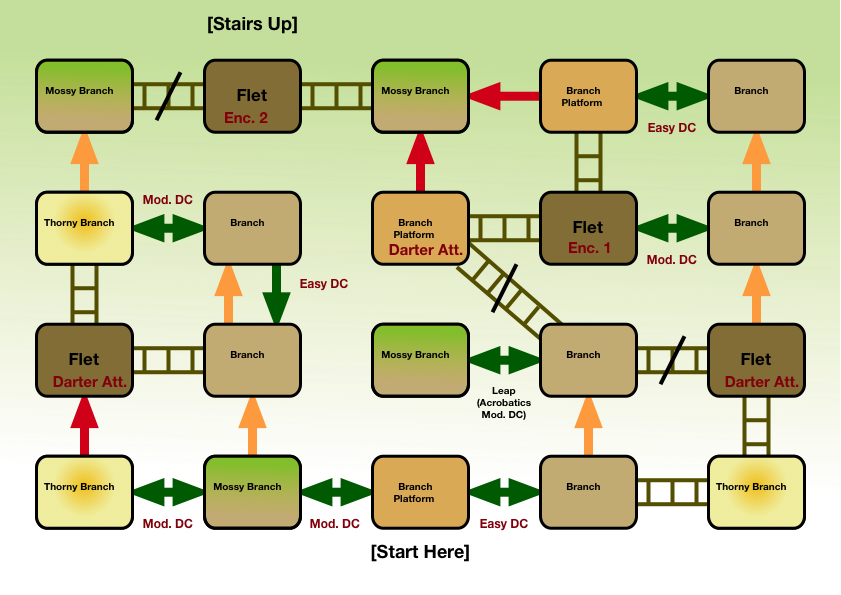
More recently I ran a skills based encounter which had the characters clambering through the branches of a huge tree in the Feywild, climbing across rope-ladders, all the while dodging Xivort darts or fighting the little blue nasties atop wooden flets. I adapted the idea from a ‘street-chase’ skill challenge published a while back on Geek Ken’s blog, so had put together a simple ‘flow-chart’ as below:

I then decided to use a version (minus the DC and encounter notes) as a little game-board for the encounter. I’m sure a few die-hards out there might cringe, but it really worked in practice. Seeing the options visually seemed to inspire them to try different ways of attacking the challenge – after a couple of (Acrobatic) leaps between branches, one of which went wrong, they changed tack and started using Dungeoneering to whip up some rope contraptions. I even got a few quick sketches produced to ‘prove’ to me they would work. All-in-all, this was a fun and successful encounter (of course, the couple of short but exciting combats broke it up and made it suitable for my son…)!

Lessons learnt: 

  • Failure to provide suitable maps is at your our peril when DMing for kids 🙂 In subsequent sessions, I’ve tried to have a balance of using battle maps and not, and the kids are more used to this now, but there is no doubt that they prefer visual props in the game.
  • Props can be potentially have the danger of taking away from the imaginative nature of the game; however in the right circumstances I think they can really stimulate the role-playing experience.

Till next time, get your kids involved!

TolrendorDM

Posted in Columns, DM for Kids, Roleplaying with Kids, The Amber Tower Campaign | 7 Comments