Tales of the Valiant: An Introduction

As promised here, I am going to be delving deep into Tales of the Valiant over the coming months and look forward to sharing my excitement for this new entry into the Dungeons & Dragons genre. Let’s get started!

An Interesting Blend of Familiar and Distinct

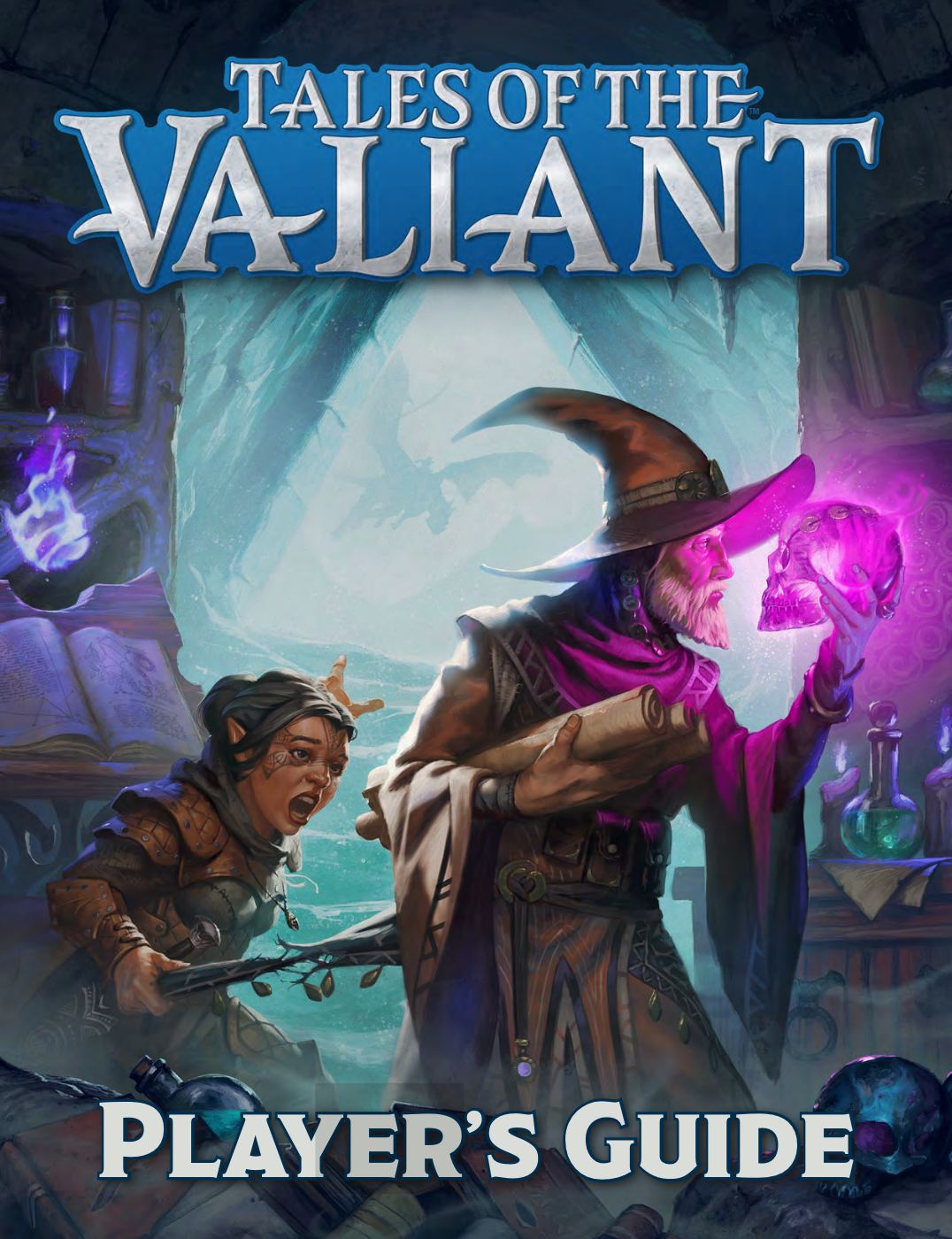
The introduction to Tales of the Valiant (TotV) Player’s Guide is an intriguing mix of familiar tone and distinct branding. It sets the stage for the game as an “action-oriented roleplaying game” where “heroes shape the world,” emphasizing collaborative storytelling and high-fantasy adventure.

Yet, what is perhaps most notable about this introduction is what it does not say: it makes no direct mention of Dungeons & Dragons 5E or Wizards of the Coast (WOTC), despite being a clear derivative of the 5E system.

A Clear But Unspoken Lineage

Reading through the introduction, anyone familiar with 5E will recognize the DNA of Tales of the Valiant instantly. It explains the fundamental elements of play—Game Masters (GMs), players, character roles, dice mechanics, and collaborative storytelling—in a way that is structurally identical to 5E. Even the basic roll-a-d20, add modifiers, and compare against a DC mechanic remains unchanged.

The book does acknowledge its origins by referencing the Open Gaming License and System Reference Document 5.1 in the credits, but it does not explicitly position itself as a variant of 5E.

This omission is a conscious branding choice. By avoiding direct comparisons, Tales of the Valiant establishes itself as its own game rather than a D&D spinoff. In my opinion, this follows the post-OGL controversy trend, where third-party publishers are seeking independence from WOTC’s influence while still utilizing the framework players are comfortable with.

Key Similarities and Differences with 5E

Mechanics & Dice System

TotV retains the standard d20-based gameplay with advantage/disadvantage mechanics, ability checks, and saving throws. Nothing in the introduction suggests a drastic deviation from core 5E mechanics.

Collaborative Storytelling

Just like 5E, TotV emphasizes player agency, with GMs reacting to player choices and weaving stories dynamically.

The Setting—The Labyrinth

One notable distinction is the introduction of The Labyrinth, described as “infinite worlds linked by twisting corridors of magic.” This presents a multiversal approach similar to Planescape but unique to TotV. The explicit mention of settings like Midgard and the Dreadful Domains suggests Kobold Press is setting up its own “home base” for adventure, distinct from the Forgotten Realms-centric focus of 5E.

As mentioned before, this is one of the innovations of ToV that excites me the most.

Safety Tools

The introduction also highlights safety tools early on, an area that D&D has only recently started to address in official books. It explicitly discusses “lines and veils” and the need for collaborative agreements on potentially uncomfortable topics. This approach shows a clear intent to make the game accessible and enjoyable for all players.

Final Thoughts

The Tales of the Valiant introduction does a great job of setting up the game as its own entity, even though it is unmistakably a 5E-based system. The lack of reference to WOTC or Dungeons & Dragons is an intentional move that aligns with the current wave of independent 5E alternatives.

Is this a strength or a weakness? Well, I think it depends on perspective. As a long-time gamer, it is, of course, obvious to me that the link with 5E exists, and in fact, one of the key attractions is that I should be able to seamlessly use existing material across both systems. However, for a new gamer, this connection would not be obvious, which could be a deterrent to choosing TotV over 5E, which has far greater brand recognition.

Either way, the message is clear: Tales of the Valiant is here to stand on its own—not as a supplement to 5E, but as a full-fledged RPG experience.

Coming Next…

Stay tuned for the next installment, where we will dive into one of the most critical and enjoyable parts of role-playing: the creation of a new adventurer!

Posted in Kobold Press, Tales of the Valiant | Tagged | Leave a comment

Rolling the Digital Dice…

When this blog was last active, prior to 2020, COVID-19 had not yet turned the world upside down. Back then, the Virtual Tabletop (VTT) industry was a growing niche, a useful tool for the tech-savvy TTRPG community, but hardly a mainstream necessity. Fast forward to today, and the industry is nearly unrecognizable. Fueled by the pandemic and the need to connect remotely, VTTs have become an indispensable part of how Dungeon Masters (DMs) and players experience tabletop role-playing games. In this post, I’ll explore the rapid evolution of VTTs, the platforms leading the charge, and what may be next—including topics I plan to delve into more deeply in the coming months.

Before 2020, VTTs were a niche but growing segment of the TTRPG community. Established platforms like Roll20 and Fantasy Grounds catered to gamers looking to enhance their online sessions. Key features included 2D maps, digital dice rollers, and basic character sheet management, but adoption was limited compared to traditional in-person gaming. Other platforms like Tabletop Simulator on Steam provided physics-based sandboxes for a variety of tabletop games, but their versatility was often seen as overkill for standard TTRPG campaigns.

The sudden halt to in-person gaming in early 2020, driven by lockdowns and social distancing measures, forced TTRPG enthusiasts to seek digital alternatives. VTT platforms saw unprecedented growth as they became the default method for playing. Roll20, for example, reported over 10 million registered users by 2023, doubling its user base within three years. Similarly, Fantasy Grounds and newcomers like Foundry Virtual Tabletop and Owlbear Rodeo experienced significant spikes in adoption.

The Current VTT Landscape

There’s no going back! The VTT market has exploded, and gamers are spoilt for choice. In fact, for many gamers who would never have used a virtual tabletop prior to the pandemic, this has now become their preferred method of gaming, even if they are playing in-person. Some of the reasons for their increased popularity include:

  • Post-Covid Culture: COVID-19 fundamentally reshaped the perception of remote collaboration, both in professional and gaming spaces. (Microsoft Teams and Zoom, anyone…), and this has permeated the world of gaming as well.
  • Increased Accessibility: Many platforms, like Roll20 and Owlbear Rodeo, offered browser-based solutions requiring no downloads, reducing technical barriers to entry.
  • Content Expansion: VTTs have hugely expanded their available content, both through community-generated resources and strong support from third-party publishers. Even Wizards of the Coast (WotC) has entered the space, despite their previous missteps.
  • Technological Advancements: Platforms like Foundry VTT and Alchemy pushed the boundaries with advanced APIs, immersive storytelling features, and seamless integration with third-party tools.

The list below represents a snapshot of the key platforms on the market:

  1. Roll20
    • Browser-based with robust 2D mapping and automation tools.
    • Supports multiple systems, including D&D, Pathfinder, and Call of Cthulhu
    • Over 10 million users, making it the largest VTT by market share.
    • Official Site
  2. Foundry Virtual Tabletop
    • Self-hosted with extensive API capabilities and community modules.
    • Supports hundreds of systems and custom content.
    • Popular for its flexibility and automation capabilities.
    • Official Site
  3. Fantasy Grounds
    • Desktop application with advanced automation and official content integrations.
    • Strong focus on rule enforcement for systems like D&D and Savage Worlds.
    • Longstanding reputation among dedicated gamers.
    • Official Site
  4. Owlbear Rodeo
    • Lightweight, browser-based, and easy to use.
    • Focuses on simplicity with minimal automation or rule integration.
    • Ideal for casual gamers and on-the-fly sessions.
    • Official Site
  5. Alchemy Virtual Tabletop
    • Emphasizes immersive storytelling with high-quality audiovisual features.
    • Strong partnerships with publishers like Kobold Press.
    • Growing user base among indie TTRPG fans.
    • Official Site
  6. D&D Beyond Maps / Project Sigil (WotC)
    • Integrates tightly with D&D Beyond’s ecosystem.
    • “Maps” provides a 2D VTT, while “Project Sigil” offers Unreal Engine-powered 3D environments.
    • Still in beta but poised to compete with leading platforms.
    • Official Site
  7. Shard Tabletop
    • Tailored for D&D 5E with built-in automation and a streamlined UI.
    • Supports limited import functionality but excels in curated experiences.
    • Official Site

Over the next few months, I’ll be delving into each of these platforms in greater detail, evaluating their functionality from the perspective of running a published adventure. To put them to the test, I’ll be using Shards of the Spellforge by Kobold Press (Check it out here). Each VTT has its strengths and weaknesses, and I’m eager to explore which one provides the best experience for preparing and running a rich, engaging adventure. Stay tuned as I break down the features, usability, and overall effectiveness of each platform!

Posted in RPG Technology | Tagged | Leave a comment

What Is Tales of the Valiant and Why It Matters

For those of us who have long been captivated by the world of tabletop role-playing games, the launch of Tales of the Valiant (TotV) by Kobold Press was a seminal moment. Born out of the turbulence caused by the Open Gaming License (OGL) controversy in early 2023, TotV represents not just a new imagining of the D&D game, but a rallying cry for openness, creativity, and community-driven development.

On a cool January day in 2023, Wizards of the Coast set the stage with the announcement of proposed restrictive OGL changes, sparking widespread community backlash from creators and fans alike. In response, Kobold Press announced Project Black Flag, signaling their commitment to creating an open and innovative D&D system. Their Kickstarter campaign for Tales of the Valiant (Kickstarter Link), launched later that year, was a resounding success, raising over $1.2 million from more than 11,000 supporters. This positioned it as one of the most successful 5E RPG Kickstarters and demonstrated the significant community support for an open D&D system.

Why Tales of the Valiant Excites Me

Several aspects of TotV stand out to me, and I’m eager to explore them in depth:

  1. Long-Time Support for Kobold Press: Having backed Kobold Press products for years, I trust their dedication to quality. Their supplements have consistently enriched my campaigns, and I have no doubt that TotV will continue that tradition.
  2. Compatibility with 5E: The ability to use familiar mechanics while introducing new elements ensures that TotV is both accessible to newcomers and refreshing for veterans. This compatibility allows me to continue to use existing materials and still enjoy the new.
  3. Openness, Flexibility, and Digital Tools: TotV encourages creativity and collaboration. Whether you’re a homebrew enthusiast or a third-party publisher, the open nature of this system invites experimentation. Additionally, its flexibility extends to digital tools, enabling developers to create innovative platforms for campaign management, NPC generation, and more—giving GMs and players unprecedented support. Kobold Press has already demonstrated their commitment to this by releasing multiple VTT versions of the TotV material.
  4. The Labyrinth Concept: For me, one of the standout features of TotV is its “Labyrinth” concept, reimagining the D&D multiverse as a core component of the system. This concept expands the possibilities for storytelling, allowing GMs and players to explore interconnected worlds and parallel dimensions. The Labyrinth isn’t just about physical spaces; it represents a framework for infinite creativity, where campaigns can shift seamlessly between diverse settings and genres. For someone who enjoys blending different ideas and themes in their games, this multiverse approach is incredibly inspiring.

What to Expect from Tales of the Valiant

At its heart, Tales of the Valiant is about empowering players and GMs to tell incredible collaborative stories. The core product line includes the Player’s Guide, the Monster Vault, and the Game Master’s Guide, each packed with features that build on the foundation of 5E while introducing new ideas and mechanics. The Monster Vault, for example, brings familiar D&D monsters into the system with fresh ideas and twists, continuing Kobold Press’s strong legacy of monster publications from the Creature Codex and Tome of Beasts series.

Kobold Press is clearly putting a huge amount of effort into growing the ecosystem of support for TotV, from adventures and supplements to third-party content, and supporting multiple VTTs (Foundry, Roll20, Fantasy Grounds, Shard, and Alchemy at time of writing). As part of the original Kickstarter stretch goals, they created the Guide to the Labyrinth, with another already funded (Enter the Labyrinth Kickstarter) to produce the Labyrinth Worldbook and Adventures. This is an update I can hardly wait for…

This level of support underscores their commitment to creating a vibrant and sustainable system.

Looking Ahead

Over the coming months, I’ll be delving deep into Tales of the Valiant, reviewing its core components and highlighting what makes it special. From exploring the revamped character creation process to dissecting its innovative world-building tools, I’ll be sharing insights, tips, and practical applications for GMs and players alike.

Whether you’re a die-hard Kobold Press fan like me, a 5E player looking for something new, or a creator excited by the possibilities of an open system, Tales of the Valiant is worth your attention. Stay tuned for a series of posts that will unpack this exciting system and showcase how it can enhance your gaming experience.

Posted in Kobold Press, Tales of the Valiant | 2 Comments

A New Chapter for Tolrendor DM’s Blog

Greetings, fellow adventurers and world-builders!

It’s been a while—over three years, in fact—since the last post here on Tolrendor DM’s Blog. Life, as it so often does, swept me away on its own adventures, and the blog went on hiatus. During this time, I’ve navigated family milestones, professional challenges, and other quests (sadly, none involving dragons). The COVID pandemic reshaped much of our daily lives, company mergers and de-mergers brought unique hurdles, and the children (subjects of several blog posts) grew up and went off to university! But through it all, my interest in world-building and tabletop roleplaying games continued.

Now, as we enter 2025, my hope is to bring life back to the blog, rejuvenated and ready to explore new horizons!

Reflecting on the Past

When I first embarked on this blogging journey, it charted my reintroduction to playing Dungeons & Dragons within the homebrew setting of Tolrendor.

Fantasy cartography was always the cornerstone of my enjoyment, as I sought to bring my imaginary world to life in vivid detail. The process of creating these maps, whether by hand or with digital tools, was the subject of many posts, including a whole year of mapping the Profantasy Cartographers’ Annual.

During the most active years of the blog, I was playing D&D with my kids. I posted about sessions where their youthful creativity brought unexpected twists to the story, such as the dragonborn ranger’s drake companion eating the kobold guards’ baked potatoes, or devised clever solutions to seemingly insurmountable problems. The “DM for Kids” column captured these moments, showcasing how roleplaying games foster imagination, problem-solving, and family fun.

Beyond map-making, I also explored RPG technology. Virtual tabletops and character management apps were beginning to change the way we played, and I eagerly explored their potential. These tools allowed for greater accessibility and creativity, and I shared my experiences with them here on the blog. Sadly, as the RPG Tech Talk column highlighted, my opinion that there was still some way to go before my dream of [technology combining seamlessly with RPGs] could be realised.

A New Direction

As I return to the blog, I find myself excited by the possibilities that lie ahead. While some things will remain familiar, there are new frontiers to explore.

Map-making remains close to my heart, and I’ll continue to delve into this area. However, advancements in mapping software and AI-driven tools have opened up possibilities that were unthinkable just a few years ago, and I’m eager to explore and share these discoveries with you. 

The RPG landscape itself has transformed significantly since 2020. Wizards of the Coast panicked the industry with significant changes to the Open Gaming Licence (OGL). Although they of course back-tracked, this drove an industry reaction – for example Kobold Press’ Project Black Flag which has culminated in the release of the Tales of the Valiant RPG, a 5E compatible but open system. As a long-time backer of Kobold Press products, this is a subject I’ll be delving into. 

Technology in RPGs has exploded since 2020, of course significantly driven by the Covid pandemic, but also the fast-moving world of AI. Many tools and platforms have evolved, offering features that enhance gameplay in remarkable ways. Exploring these advancements and their impact on storytelling will be a key focus moving forward. From AI-driven world-building to dynamic NPCs and the generation of game session content, I’ll be diving into how this technology can augment, but never replace, the creativity and collaboration that define our games. Of course, I also have my own embryonic venture in this space.

The Adventure Continues

Tolrendor DM’s Blog is back, with a renewed focus on blending tradition with innovation. Whether you’re a seasoned Dungeon Master, a new player, or a fellow lover of world-building, there will be something here for you. Together, let’s explore the evolving frontiers of RPGs while staying grounded in the timeless magic of storytelling.

So grab your dice, dust off your maps, and prepare to embark on this new chapter with me. The world of Tolrendor—and beyond—awaits!

Stay tuned for the next post, where I’ll dive into the latest advances in RPG cartography.

Happy adventuring,

Posted in Miscellaneous | Tagged , , , , | Leave a comment

A new journey …

As you can clearly see, this blog has not had much attention over the past few years, after a great run!

It hasn’t been forgotten, but the focus has been elsewhere. With my children busy with exams and growing up (they’re about to start their 3rd and 1st years at University), role-playing time has been unusual.

During this time, I have probably spent more time on my other hobby (which is also my career…), software development. In hobby terms, my interest in programming centres around technology for RPG, as readers of this blog will know from the regular column RPG Tech Talk, and in particular the concept of an open ecosystem of RPG tools that one could select and use inter-operably.

Unfortunately, despite some of the fantastic tools that have come on the market over the last few years (e.g. Roll20, World Anvil, Foundry VTT to name but a few …), I still don’t quite see this happening as I’d love to see…

So I’ve decided to take the plunge and see what I can do about this … or at least put some things out there that help the community.

As a first step I have created a new software brand, Tolrendor Software (I think you can see where that comes from…) and a new blog to chart my journey:

I hope you’ll join me … and in the mean-time this blog is going to get some much-needed attention as well!

Posted in RPG Technology | 1 Comment

Heroic Maps – a Shout Out!

I love mapping! There’s nothing better than creating a fun and interesting battle-map…

Mapping is hard … it takes a lot of time and effort to produce even one battle-map, let alone enough maps for a whole adventure.

Which is why I want to call out out what I think is one of the best Patreon sites out there: Heroic Maps….

heroicmaps

For $5 a month, you get the following:

  • A 20 by 20/30 (5′ grid) detailed battle map – Map of the Month
  • An alternate version of the MOTM
  • A third map, voted on by patrons
  • An adventure supplement for the MOTM.
  • Regular discounts for Heroic Maps publications on their DrivethruRPG store

I’ve been subscribed for a few months (since April), and have also purchased a number of back-catalogue items. The quality is fantastic, and I can honestly say I’m now thinking of my adventures in terms of ‘how can I use last month’s map’, rather than ‘what map do I need to create’ … I may never design another battle map 🙂

Posted in Cartography, Patreon | Leave a comment

Icon Rolls

I am definitely not what you would call an ‘off-the-cuff’ DM!

The happiest DMing I do is when I’ve prepared well, both in terms of the session that I think I’m going to run, and for those parts of the session that I’m not really expecting to happen, but that might crop up if the PCs go off-piste. If I’ve done this, I’m generally pretty flexible and let the game flow; if not, I’m more likely to try and keep the party on a certain path.

I’ve just got back into running the Amber Pendant campaign, a solo campaign with my son, following a long (almost 2 years) hiatus due to many life things, including GCSE exams, as discussed here. This campaign has always had Icons, even when we were playing 4E. However, on re-starting this campaign, we’ve decided to convert fully to 13th Age. So how do I reconcile the improvisational concepts of 13th Age with my need to be prepared?

Well, I simply take the designers’ advice on p179 of the core rules: If you aren’t entirely comfortable improvising on the fly, consider asking the players for story guide rolls at the end of the session to prepare for the next game. 

This suits me much better. I have found myself mulling over the Icon rolls for several days between sessions, and this has lead to some interesting changes in the encounters that I potentially had planned for the next session. For example, we had a ‘6’ roll for the Twilight Lady (an Icon in my setting somewhat analogous to the Elf Queen) at the end of one session. The next episode was planned to be a dangerous trip downriver, with goblins ambushing the party with war canoes and archers on the shore – how could that relate to the Icon in play? Eventually I struck on the idea of a fey giant turtle surfacing from the river and aiding the characters (as the advantage conferred by the roll). This turned out not only to be a cool addition to the encounter, but also quite necessary to stop a potential TPK … as the battle was pretty vicious!

I now try and make notes in the planning for my next session as to how the Icon rolls (if any) will impact the session, as shown in this snippet (from my Scrivener campaign workbook)

IconRolls

Originally, this whole episode was not even envisaged … but once I had the roll to work with, the creative juices started flowing…

Until such time as I feel more comfortable with an improv style (i.e. not very likely …), Icon story guide rolls at the end of an session or episode is definitely going to be my method of choice 🙂


Posted in Adventures, Amber Pendant campaign, Icons, Miscellaneous, The Amber Pendant campaign | Leave a comment

Faint Stirrings…

It’s been a long time … dust has settled …

As is obvious, it’s 18 months since the last post on this blog. Pretty much dead then? The honest answer is that at times I pretty much thought so. Due to 2 years of A-levels and GCSE exams in the house, no D&D was being played, and quite frankly, motivation for any sort of writing, or mapping, or gaming, just wasn’t there.

So much so that although I subscribed to the 2016 Cartographer’s Annual from Profantasy.com, which I’ve blogged about many times, even doing a whole year of monthly maps in 2013, I recently discovered that I’d never even downloaded an issue! Whenever I had some time (rare…) and thought about doing some writing, I just couldn’t get going … I can’t realistically blame the lack of playing, as I’ve had many periods in my life where no gaming was happening, but it had never stopped me creating before!

4f1f4f8b_Kingdom-Hearts-3D-Enchanted-Broom-Artwork

So what now? Well, it’s summer 2017, and the kid’s exams are well and truly over, results are in (all good!) … and we’ve even played a few sessions of D&D! Does that mean my enthusiasm is back? Well, whilst I’ve enjoyed the sessions, it’s still a struggle getting going again, but as the title of this post suggests, just maybe …

I’m not promising much here, but I’d like to think it’s time to get the broom out …


Posted in Miscellaneous | 1 Comment

The Amber Pendant

A new fantasy artist on the block …

The Amber Pendant - blue - cropped

I’ve posted before about the 4E solo campaign I’m running occasionally (very occasionally as it happens…. doesn’t life just get in the way!!) for my son, called the Amber Pendant. His character has been called upon to embark on a quest for this relic of a bygone age, which has been stolen by agents of the Conclave of Dark Amber, one of the villainous Icons (yes this is 4E with 13th Age spice) of my Tolrendor setting.

So, a little while ago I commissioned (aka asked nicely…) my daughter, now 16 and studying A-level Fine Art, for a painting of the Amber Pendant … and here you have the result!!

I fully accept that I’m a bit biased, but I’m pretty chuffed with the outcome! This was produced using the Art Rage program on her iPad, and I hope this is the first of many further family collaborations – I may even have to start actually paying 🙂

Love to hear your views in the comments.


Posted in 4E D&D, Amber Pendant campaign, DM for Kids, Roleplaying with Kids | 3 Comments

Map of the Month: CC3+ and Mike Schley Overland

MapoftheMonthLogoIt seems an age since I really got my teeth stuck into a proper map e.g. one which wasn’t just a quick CC3 hack to print out a scale battle-map.

For my ‘Amber Pendant‘ solo campaign with my son, I needed to start detailing the northern borderlands of the Kingdom of Norbaer, as his character would be travelling through this region on his quest. In Tolrendor, this area is just to the south of the Nentir Vale (where my ‘Amber Tower‘ campaign is taking place) from the 4E source-books.

I decided to use the ‘Mike Schley Overland‘ style, which comes with CC3+ Beta, the new version of Profantasy‘s premier map-making program. Although I’ve had this installed for some time, I’ve hardly touched it, so that was a good incentive as well.

CC3+ was great to use: much faster than its predecessor, and very able to cope with leaving sheet effects turned on the whole time, as promised! In CC3, doing this was usually a recipe for white screens and frequent crashes. I also really liked the tool prompts displayed with the cursor, so you weren’t continually looking to the bottom of the screen for options.

Of course, the proof of the pudding is in the results, and here I am also very pleased with this style; in fact it may just have got to the top of the list of my preferred styles for area maps. Nice soft colours with excellent blending and effects, great bitmap symbols, and especially, gorgeous forests combining the simplicity of drawing tools with symbol fills.

Here it is:

Northern_Norbaer_and_Borderlands_Area_Map

Posted in Cartography, Columns, Map of the Month | 1 Comment