Beautiful Greyhawk Maps

For all Greyhawk fans out there, I came across this wonderful site recently – a project looking to map the entire Flanaess in a wonderful style, with a textured look reminiscent of satellite imagery.

All the research and cartography is carried out by a lady called Anna Meyer, and her enthusiam and love of the Greyhawk setting really shows though.

An example, covering the City of Greyhawk of course (!), is shown on the left; I strongly recommend that you take the time for a browse on the site, its really something!

I always loved the Greyhawk setting, although I seldom actually ran adventures in the Flanaess, as it more inspired me to create my own detailed settings, but when you see it mapped this beautifully…

And for all cartography buffs, check this out … have you ever seen a more beautiful (effective) layout of a map key? 🙂

Posted in Cartography, World Building | 2 Comments

RPG Tech Talk: The PDF Dilemma (Part 1)

In my last RPG Tech Talk column, I talked about some of the hopes that I have for the ‘DnD Next’ generation of technology tools for role-players. One of the items I would like Wizards of the Coast to look seriously at again is the distribution of their core books through an electronic mechanism such as PDFs.

It’s almost 3 years since WOTC pulled the plug on PDF sales, citing piracy as the main reason. They also mentioned at the time that they would be exploring other means of digital distribution, but that hasn’t come to much, other than their novel lines being released for a number of e-reader platforms. This is however a much different case than role-playing product digital distribution, where the need for a controlled layout is required. E-readers in general do not lend themselves to displaying such publications, and in fact there are few wide-spread digital formats other than PDFs for this purpose (Microsoft’s XPS format has a similar role, but despite having been around for several years now, how many people actually know about it…).

In the meantime, all other third-party publishers have continued to make their content available through PDFs, seemingly without any major piracy worries. Pazio, who with their Pathfinder RPG are seemingly now Wizards’ biggest competitor, has clearly continued to embrace the PDF format, and I think they’re benefiting from it. Now I do realise, Wizards, as the 800 pound gorilla in the RPG zoo, are a bigger target for piracy than many other companies, but surely there is a solution out there that works!? I for one would rather they put their tech budget into solving this problem for their customers than sinking it into VTT tools etc that only a fraction of their user base will ever use regularly for gaming!

Another point worth noting is that although Wizards do not sell any of their published books in PDF form, they do produce PDFs of all their DDI content – which actually accounts for a significant proportion of their content. Strange that they do not view this as a priacy risk?? I guess it’s because this content is only distributed digitally, so can’t affect book sales, but it’s still an interesting anomaly.

So, how could WOTC go about giving us what we all want – the ability to carry our tomes of D&D books round in digital form? Some ideas:

Simple stuff …

In most cases when you purchase and download a PDF online (e.g. from RPGNow or its variants), the actual file will be ‘watermarked’ with your  account name, so its obvious who purchased the PDF. Just as obviously, there are simple ways of removing this watermark, unless the file has a password added that prevents this happening.

In the simplest form of piracy protection, Wizards could ensure that all distributors of its PDFs introduce a watermark at point of sale which identifies the document sufficiently to trace the actual purchaser, and to password protect the document so that the watermark cannot be removed by standard tools (this password would not need to be user-specific, as only the distributor would ever need to know it).

This doesn’t stop someone loading the PDF onto a file-sharing site, but it does mean that without taking some effort, it would be like leaving your contact details at the scene of a crime!! However, one flaw with this approach is that you don’t want the watermark to obscure the actual text, so they are typically placed at the page borders; this unfortunately means that someone could use image editing tools to remove the watermark, and recreate the PDF without it – a time-consuming process, and quality would undoubtedly suffer, but this wouldn’t deter a determined pirate…

A Step Up …

The next level of security is to set a password that must be used to open the file, which prevents any illegal copying or imaging editing of the content.

The process might be that when you purchased a PDF from Wizards’ online store, they would require you to log on with your DDI account, and the password for the PDF would be generated using these credentials. Each PDF in circulation would then have a unique password – making the required piracy effort even greater. What, you say – you mean everyone would need a DDI subscription just to purchase a PDF!? Well no, I’m sure that Wizards could have the concept of a free DDI account which was just used as an ‘account’ on their site, and from which you could retrieve password details for your previous purchases if required.

This scheme would preclude purchasing Wizards’ PDFs from any online site other than their own – this may be desirable for WOTC – but if they do want to support third-party distribution, this could be achieved by providing a web-service or similar interface that the distributor could use to pass credentials in and receive the appropriate password in return.

A downside to this idea is means that everytime you want to access a PDF, you need to enter a password. It might also cause platform issues if some PDF readers (e.g. on a smartphone) did not implement the ability to de-crypt secured PDFs. I think many people would take this over not being able to have their D&D books in any digital form however!

The two ideas above are possible using security features that are built directly into the PDF format, so there’s nothing particularly complex or clever here. They do however, rely on the quality of the security, which can always be broken by the application of enough technology and computing power, so you can never completely stop piracy. The real goal is to make it difficult enough that ‘casual piracy’ is deterred’.

Unfortunately, it does seem that perhaps Acrobat PDF security isn’t necessarily as strong as you’d like, so maybe we need to look at some more complex options… which I’ll cover in Part 2…
Posted in Columns, RPG Tech Talk, RPG Technology | 2 Comments

DM for Kids: Session Props

Heroic Tier, Level 1

The characters have just finished a tough and rousing battle in the main hall of the kobold lair, finishing off the kobold chieftain and his shaman side-kick, plus a bunch more of the nasty little humanoids.

But all is not finished with the adventure as yet. There is of course, the spit roasted pig to be devoured, and there are still more doors leading to rooms unknown… a large stone double set on the eastern side of the hall, and a smaller wooden affair on the western wall…

D&D Kids: We want to go through the wooden door first!

DM Dad: Ok, the door opens easily into a rough-hewn cave, lit by the cooking fires. The smoke from the fires escapes through a crevice in the roof, but …

D&D Kids: Dad, put down the map, we want to see the map!

DM Dad: There isn’t a map of this room, I’m just describing it.

D&D Kids: We don’t want to go this way then, we’ll go the other way …

This was my own fault really; I was a victim of my own success! 🙂

For virtually all of the adventure so far, I had produced hand-made dungeon tiles: drawn in CC3, printed out on card stock and cut into a jigsaw of pieces that I had laid out as the characters progressed through the kobold lair. Laid end to end, it covered most of the lounge floor. The kids loved it. This section of the dungeon, however, was just the kitchen and quarters of the kobold women and young – who had already fled, so there was no combat in the offing – so I decided not to print it out. Boy, did that backfire!!

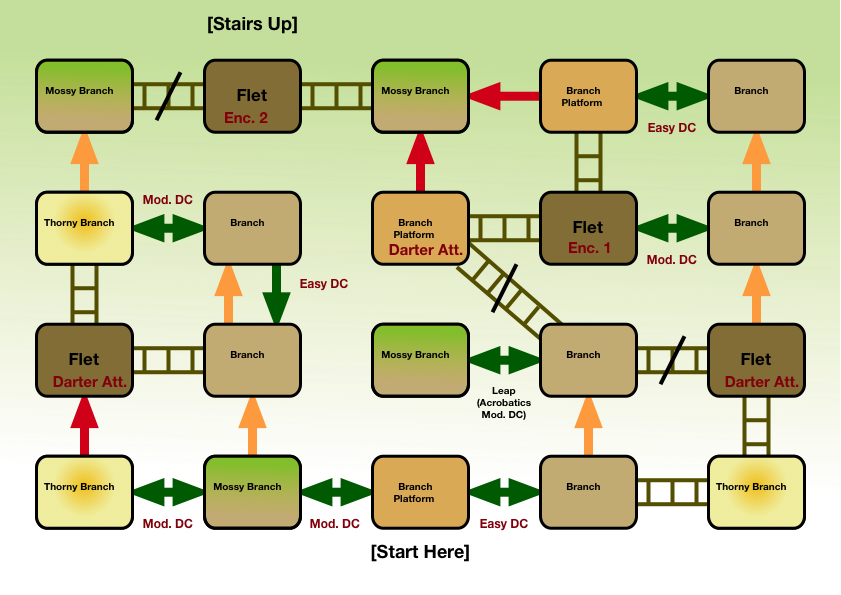
More recently I ran a skills based encounter which had the characters clambering through the branches of a huge tree in the Feywild, climbing across rope-ladders, all the while dodging Xivort darts or fighting the little blue nasties atop wooden flets. I adapted the idea from a ‘street-chase’ skill challenge published a while back on Geek Ken’s blog, so had put together a simple ‘flow-chart’ as below:

I then decided to use a version (minus the DC and encounter notes) as a little game-board for the encounter. I’m sure a few die-hards out there might cringe, but it really worked in practice. Seeing the options visually seemed to inspire them to try different ways of attacking the challenge – after a couple of (Acrobatic) leaps between branches, one of which went wrong, they changed tack and started using Dungeoneering to whip up some rope contraptions. I even got a few quick sketches produced to ‘prove’ to me they would work. All-in-all, this was a fun and successful encounter (of course, the couple of short but exciting combats broke it up and made it suitable for my son…)!

Lessons learnt: 

  • Failure to provide suitable maps is at your our peril when DMing for kids 🙂 In subsequent sessions, I’ve tried to have a balance of using battle maps and not, and the kids are more used to this now, but there is no doubt that they prefer visual props in the game.
  • Props can be potentially have the danger of taking away from the imaginative nature of the game; however in the right circumstances I think they can really stimulate the role-playing experience.

Till next time, get your kids involved!

TolrendorDM

Posted in Columns, DM for Kids, Roleplaying with Kids, The Amber Tower Campaign | 7 Comments

Points of Light …

Is this the ultimate ‘Points of Light’ picture?? 🙂 (from telegraph.co.uk)

Posted in Miscellaneous | Leave a comment

Map of the Month: Havenscoast Overland

As I mentioned recently, I’m on a Jon Roberts vibe. For those that don’t know his work, you can check it out at Fantastic Maps. Not only does he present his wonderful work here, he also regularly posts tutorials and tips on how he achieves some of his great effects.

A feature of his work that I really like is the muted natural colours and textures that he uses on all types of maps: battle maps, overland maps and even city maps. To the delight of non-artistic mappers like myself, Jon has worked with Profantasy to create some ‘styles’ for use with CC3 that include many fills and symbols that allow the creation of maps in a similar style to his work.

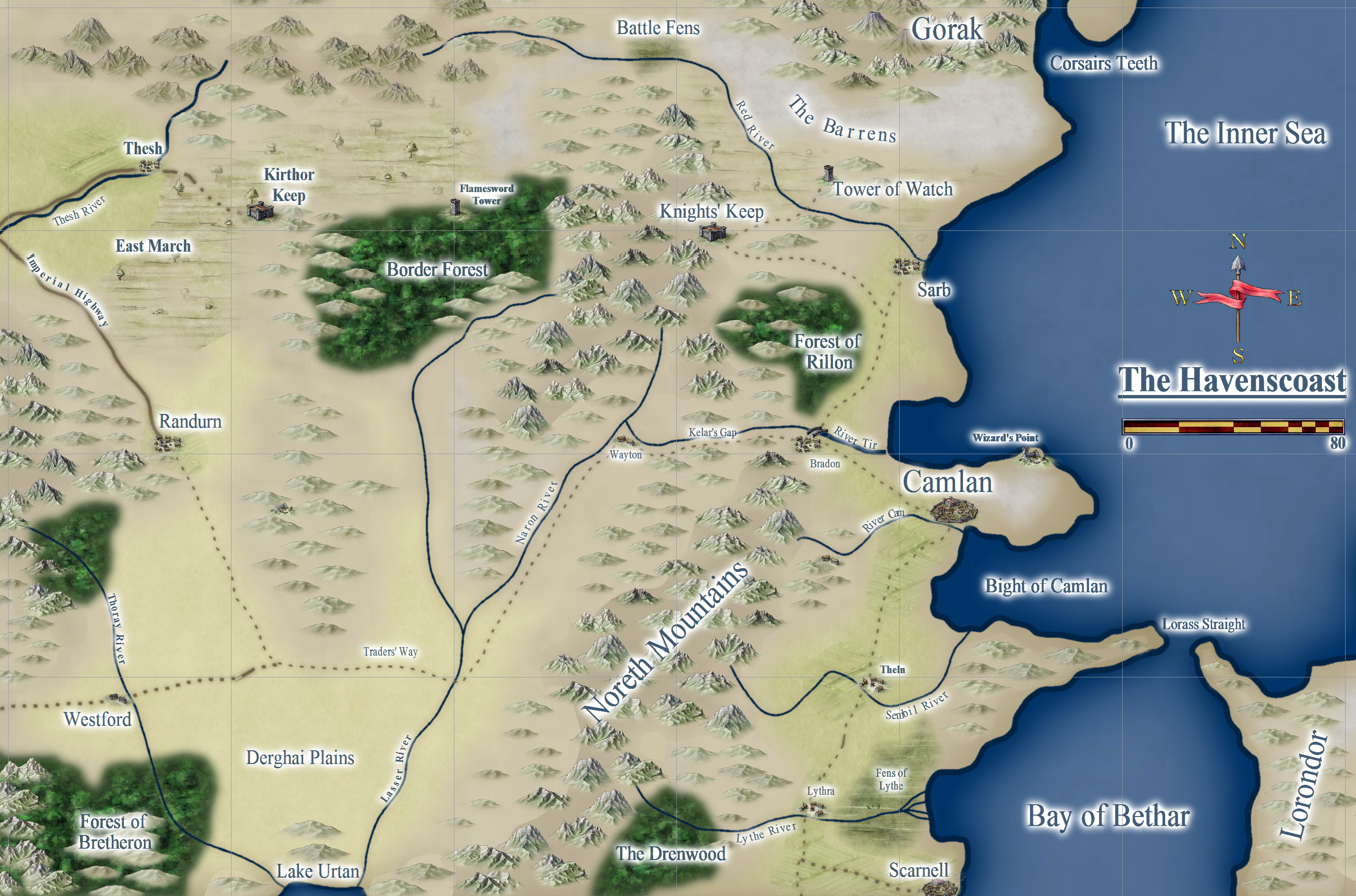
For my first column in this series, last month, I posted some battle maps using his style. This month, its an overland map of the Havenscoast region, using the style from the March 2011 issue of the Cartographer’s Annual. I’ve already previously mapped this area in a hex style, and a ‘hand-drawn’ parchment style, so I’m getting quite familiar with it!

I’m not sure this is 100% finished – I’m always spotting new details to add, or a section I don’t like so much, but I think its in a good enough state to post 🙂 Hope you like it!

The Havenscoast - Jon Roberts Overland Style

Posted in Area Map B4: The Havenscoast, Cartography, Columns, Map of the Month, Self-publishing, The Havenscoast Project, Tolrendor Gazetter | 4 Comments

Wizards Watch: DnD Next

Wizards Watch LogoWell, the blogosphere is awash with comments about DnD Next, and some real information is starting to come out from Wizards: from the seminars held at D&D XP; the Community Site; and from some of the recent Rule-of-Three and Legends and Lore columns on the website.

So let’s have a look at some of the stuff we’ve heard. Realistically I think it’s way too early to depend on any of this information, as there is little point shaping up for a major play-testing initiative if you’ve made all the decisions already, but the snippets do give a pointer as to the way the design team are thinking. Anyway, we all like to speculate, don’t we … 🙂

The Design Team

So it’s been announced that the main initial design team consists of Monte Cook, Bruce Cordell and Rob Schwalb. Certainly a strong team, and I am glad that Rob is part of it. He’s built a reputation as one of the strongest (and most prolific) 4E designers, and I think it’s important to have that experience on board. Monte has iconic status in the game, and for good reason, but I don’t think he has had much 4E involvement, and obviously was the driving force behind 3rd Edition. If you’re going to take on the difficult task of ‘uniting the versions’, a good balance in the design team is important!

Powers are good

There was an interesting paragraph in the recent Rule-of-Three column that I was very pleased to see: “Powers do a lot of things right. By and large, their function is to serve as a discrete, packaged action that doesn’t overlap with other actions. An action doesn’t need to worry about stacking with other actions (unless they have some kind of ongoing effect), so when using or designing a power you know that you have everything you need to resolve that action. In the end, powers are just a method of formatting discrete actions. I would argue that powers have always been in D&D, they were just called spells and limited to magical effects. Tome of Battle: Book of Nine Swords took that and applied it to non-spell elements, and then 4E spread it across all classes.”

There was a lot more about simplifying some aspects (e.g. keywords), but that is largely details. To me, the powers concept is one of the strongest components of 4E, even though so many have ridiculed it as an MMO concept. But if the designers are serious about providing the ability for multiple styles of play, IMO the Powers concept is a great way to achieve it. For example, if you want to play an AD&D fighter, you effectively only have 1 power – Melee Basic Attack (modified of course by Level, Strength and Weapon stats); if you want to play a 4E fighter, you have a different range of options. To my mind, the class progression structure, and the choices you can make at levelling-up time, are largely irrelevant to the game – your character is defined by the set of powers he/she has at any one time and how they operate mechanically (this is why I can never understand the Essentials/Non-Essentials debate…). As the long as the rules define reasonably the frequency at which powers can be used (e.g. 1 standard action per turn), really the only difference between a 1E and 4E fighter is how many ‘things to do’ you have to choose from each turn!

Vancian Magic

Monte Cook made it pretty clear that he regarded Vancian Magic as a core and iconic part of D&D. I’m cool with that. However, I also want my D&D rules to be able to cope with all the other archetypes of magic and sorcery in fantasy – sorcerers, warlocks, witches, you name it. It certainly sounds from the D&D XP Seminar transcripts that the designers are thinking along similar lines. Again, using powers in the right way seems the right way to achieve this: e.g. a Vancian wizard has powers which relate to the spells he has in his spell book – but he has to choose at the start of each day which he has memorised, and obviously has constraints on how many of each level he can choose. Effectively, each spell is a daily power – once he’s used it thats it until the next extended rest and the chance to re-memorise. A sorcereress however, knows her spells innately, and can cast them as long as she has the willpower and strength left to do so i.e. her powers at more At-Will or Encounter types, depending on their potency. Obviously there’s a balance issue to be addressed here if you want to mix both types of spell caster in the same campaign, but I think the concept is very workable!

Skills

The designers’ view seems to be that there is no ‘iconic’ skill system in D&D, as each edition pretty much re-invented the concepts. Therefore, they seem comfortable that they can take a ‘best-of-breed’ approach and come up with an entirely new system. So far the main theme looks like skills being more closely tied to ability scores. I’m pretty relaxed about this – I don’t have too many strong views mechanically on this aspect of the game, although I do think a solid skill system is important. I remember writing my own adventures back in AD&D, and coming up with all sorts of percentage tables for potential outcomes of non-combat ‘scenes’. Good fun, but pretty time consuming, and I’ve enjoyed the simplicity and flexibility of 4E skill checks.

Looks like Skill Challenges may be on the way out as well, based on the comments of Rob Schwalb. Similarly to Rob, I like the concept of skill challenges, but have often felt they interrupt the story, and impose forced outcomes. Most of my skill challenges become skills-based roleplaying scenes – where the skill checks are used as the mechanical structure for deciding various outcomes, and driving the direction of the scene, rather than a formal ‘4 success before 3 failures’ meta-gaming type encounter.

Am I feeling good …?

I think so far I’m feeling cautiously optimistic – the designers don’t seem to be taking a ‘4E was a failure, so lets ditch its concepts’ approach, which was one of my key concerns. Rather the vibe is one of ‘lets explore all the good bits across all the editions and look for the synergies.’

I still think its a pretty tall order, but its hard to argue with the approach – and hey, that’s why they’re professional game designers and I’m not! 🙂

Looking forward to the play-testing when it gets underway!

Posted in Columns, DnD Next, Wizards Watch | Leave a comment

So many maps, so little time!

I can’t keep up! The Cartographer’s Annual has released the February issue, and it’s another amazing overland style ‘Overland Satellite’, as shown in the example map (from the Profantasy website).

Now I want to re-do my world map in this style – arrghh!!

Well, I might at some point, but as you’ve probably noticed, I’m currently on a Jonathan Roberts vibe. Last month’s Map of the Month column showed some efforts using his ‘Dungeon’ style for Campaign Cartographer 3, this month I’ll hopefully be presenting an overland map of the Havenscoast region using his Overland style … and … the March issue of the Annual is a CC3 style for City Maps based on his work. So you can probably guess where I’m going for my March column 🙂

Posted in Cartography, RPG Technology, The Havenscoast Project | 1 Comment

February Update

Well, 2012 has certainly started with a bang in the RPG world, with the announcement that Wizards are working on the next edition of Dungeons and Dragons. At the very least it gives us all something new to blog about! 🙂

January was a very successful month from my perspective. At the end of 2011, I posted my intention to concentrate on a small number of distinct columns, to give myself a realistic target of consistent posting.  At the end of the month, I am very pleased that I managed to produce a solid debut column for each of the planned columns. Even more encouraging, the challenge of having several specific column themes has helped focus my ideas, so I have several months worth of post outlines and/or notes in the pipeline.

Looking forward to my Feburary columns, a couple of themes will evident:

  • the topical subject of DnD Next will be touched on in a couple of posts.
  • my ‘content’ columns will concentrate on the ‘Havenscoast Project’ which I kicked off some time ago, but to date haven’t made much progress on!

I’ve also created a permanent ‘Content Calendar’ page (link at top-right of the blog). This will maintain a record of previous published content, and also have the planned publication schedule for the current month (which will of course be a living document and subject to change…).

Finally, a key target for the end of this month, especially if I can continue my regular posting schedule, is to join one (or more) of the RPG syndicated feeds. This hopefully will help to drive up the views on the blog!

Happy Gaming!

TolrendorDM

Posted in Columns, Miscellaneous, The Havenscoast Project | Leave a comment

RPG Tech Talk: 5E Tech

Welcome to another (the last…) debut column: RPG Tech Talk. This is my opportunity to share my views on and discuss the marriage of two of my main interests: Roleplaying and Technology! We are lucky enough to live in an era where many of the tools we wished for way back when (you know, as you spent hours, or days, hand drawing maps or typing out adventures on your Dad’s ancient typewriter…) are now real and available in the role-playing world. But things can always get better, right? 🙂

So why do I want to talk about this? Well, in real life I’m an IT professional with 20 years experience in hardware and software development, mainly in the area real-time distributed financial trading systems. So I like to think I have some understanding of the process (and pain!) of developing commercial technology products, but on the other hand I’m just your normal tech junkie, and I like to rave on about this stuff 🙂

Anyway, with the announcement of DnD Next, I thought I’d kick off this column with some views (some a bit ‘blue sky’) on what I want to see on the technology side from Wizards of the Coast for the next edition:

1) Scope it right!! I think almost everyone agrees that WOTC royally screwed up the launch of DDI. They promised the World, and delivered … well, a small hamlet in the borderlands at best! This isn’t to say the DDI tools aren’t good – IMO they are – but the expectation/delivery divide has been a chasm! So this time round, concentrate on the stuff that people will use day-in/day-out: IMO, the Compendium, Character Builder and Monster Builder are these key tools, with perhaps a good Encounter Builder, as they are the applications that will save significant prep time for Tabletop Gamers, which I believe is still the core audience. Yes, Virtual Tabletops etc. are all very nice, but they’re not a core part of gaming. WOTC’s track record so far shows it would be better focus its efforts on a small number of achievable projects…

2) Open it up! DDI is a great thing for subscribers, giving them access to all the rules and material developed by WOTC. Its a terrible thing for 3rd party publishers however, as it prevents them from getting their content into the content repository used by a significant proportion of the people playing the game! I strongly think WOTC should take a leaf out of the Apple book – build a ‘content store’ that encourages other publishers to provide content through that ecosystem (and take a cut!) Users could purchase individual ‘products’ from either WOTC or a third party, and the other tools (Character Builder etc.) would provide access to the purchased content.

3) Stimulate Tools Development! Provide the technology services that allow other developers to build tools: i.e. open up access to the Compendium data via a proper set of Web Services, and let the tools proliferate. WOTC can still mandate that use of its own IP material within the Compendium requires an individual DDI subscription, so maintains it’s revenue stream, but makes it a greater value proposition, as this data would be useful and applicable to a wider range of tools. In 4E, WOTC tried to control everything, ostensibly to provide a consistent and quality product. However, the last decade or so in the software development industry has shown that this approach can be less successful than creating a solid platform and opening it up to the huge range of independent talent that is out there.

4) Embrace PDFs… or another effective and globally accessible electronic publication mechanism!? WOTC, a majority of your customers want to carry their D&D books around electronically!! It’s great that Wizards have started releasing novels in ePub formats, and what’s more have committed to all formats (i.e. iBooks, Kindle, Nook etc), but it’s quite a difference between that and the complex graphical layout requirements of most RPG books. Here, PDFs are still king, and if every other small third party publisher can survive the ‘piracy’ issues, why can’t Wizards? Yes, I realise they’re a bigger target than other companies, but there has got to be a technical solution out there that solves this!

5) Last but not least, continue support for 4E tools! There are a lot of people out there that love 4E – I’m one of them – and probably feel that the life cycle of this edition has been too short. This may due to the money invested, or the time invested in building campaigns/worlds that they don’t [yet] want to convert, or simply it’s just the ‘right’ D&D for them. However, gamers of this edition, more than any other, have come to rely on the DDI Tools – and why not! With the change to a fully online toolset, they are (I am…) fully at Wizards’ mercy! I personally will probably move to the new edition at some point – but I want to have an option on both the decision and the timing – so please don’t dump my tools!? 🙂 [I’m aware there has been an announcement on the Community Site that they intend to continue support, but things can change…]

That’s some of my list of hopes. So far, there hasn’t been a lot that I’ve seen so far about DnD Next ‘Tech’ – and to be honest I think that’s the right approach. Get the game right, and the tech will follow. But Wizards, please don’t forget the tech, and learn some of the lessons from last time – that’s all I ask!

Posted in Columns, DnD Next, RPG Tech Talk, RPG Technology | 3 Comments

DM for Kids: The Menagerie

Welcome to the debut of a new column  ‘DM for Kids‘, which will highlight some of the great times I’m having playing D&D with my (currently) 12 -year old daughter and 10-year son, and some of the lessons I’m learning. My inspiration for the format of this column is the excellent ‘Dungeon Master Experience’ column on the Wizards of the Coast website. If you enjoy this column a fraction as much as I enjoy Chris Perkin’s writing, I’ll be thrilled 🙂

 Heroic Tier, 1st Level (in fact the first ever adventure!):
 
The party are fighting their way into a heavily defended kobold lair, attempting to rescue captives from an earlier raid on the King’s Road east of Fallcrest. The kobolds have retreated deeper into their tunnels, releasing some captive monsters to (they hope…) destroy the heroes. A hard fight ensues against a Spitting Drake, a Dire Boar, and a Scuttling Centipede, resulting in the first two slain, but the Centipede fleeing back to its cage and being locked back in. 
 
Son: “Ok, what do we see in the room.” 
 
DM Dad: “Well, there are the two large winch mechanisms that are clearly used to raise the monster cages to the trapped tunnel above; there’s a passage to the south leading into darkness. Oh, and a glowing brazier in the middle of the room. I guess the kobold guards were cold.”
 
Son: “Drakkar [the Drake, the dragonborn ranger’s beast companion] goes over to the brazier. Is there anything cooking in it?”
 
DM Dad: “Ummm … yes, there are some potatoes baking in the embers.” 
 
Son: “Drakkar pulls them out and starts eating them! Oh wait, he also takes some down to the cage to feed the Centipede … can we keep that as a pet …” 
 

My D&D campaign with my kids unfortunately stutters a bit, with sessions at the mercy of homework, weekend sporting and other activities, and my work schedule! As a result, although we’ve been going well over a year, the kids’ characters are even now just on 3rd level,… but already they’ve managed to assemble quite a menagerie!

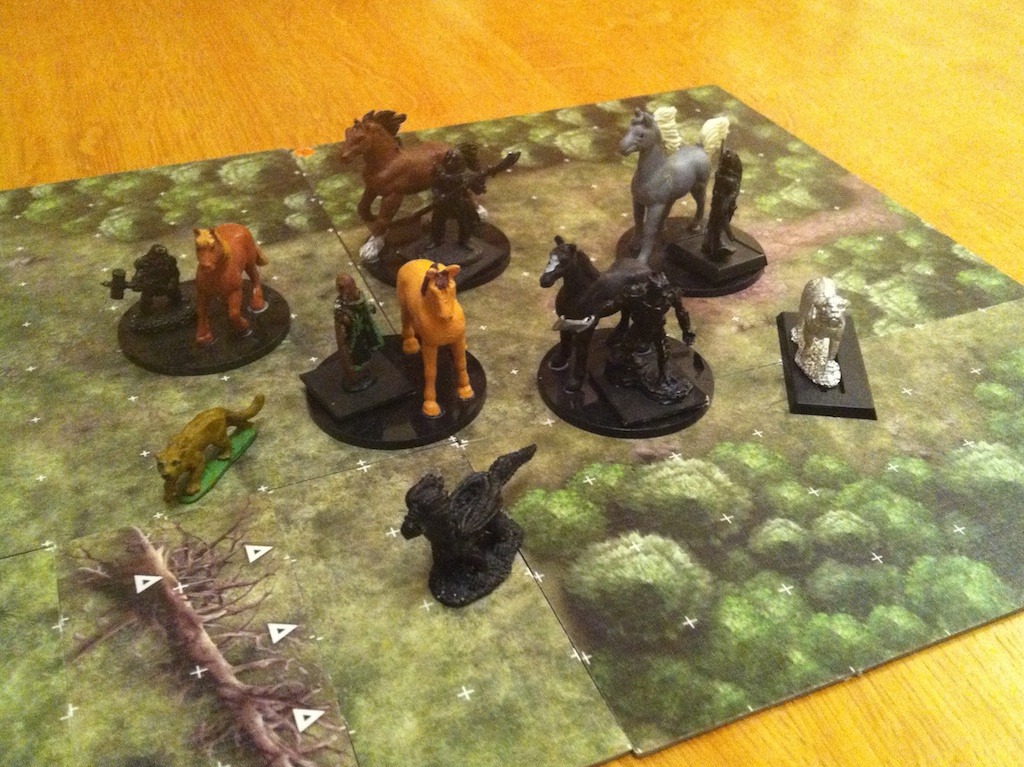
Both of them are animal lovers – in real life we have cats, rabbits, guinea pigs and horses – so when it came to rolling up characters, both of their primary characters ended up as a Ranger Beastmaster! My daughter plays Shannaira, an eladrin with ‘Tawny’ the panther, and my son Torrin the dragonborn with ‘Drakkar’ the drake. As well, the party has an eladrin wizard originally rolled up by my wife (even though we can’t get her to actually play…),  who has a pet war-dog, Phyias (you can see where they get it from…)!

Recently the party have had a bit of downtime (of sorts) in Fallcrest, and as mentioned, the first task on the list was to go and buy horses … so the group now includes 5 riding horses, and a major quest is on to find enough gold to come back and purchase a Fey warhorse. No stronger motivation for adventuring is required!

The Menagerie comes to town...

To be honest, sometimes the menagerie can cause things to get a bit bogged down, as the kids focus on the minutae of their animals’ actions, but it’s generally a price worth paying. Some of the best role-playing snippets come directly from this, as you can see from game play snippet above. The beast companions, especially, are role-played with as much investment as the characters themselves.

Combat is interesting as well; the two have quite different approaches to managing this. My son is pretty fatalistic, and Drakkar will charge into combat alongside his master with little regard for safety (“I can always raise him if he gets killed …”). Tawny however, is treated more carefully; she’ll get into the fight, but as soon as she’s taking damage steps will be taken to remove her from the critical action!

Lessons learned: 

  • As an [adult] DM, sometimes the animal related distractions can be a bit involved. I’ve learned to roll with it though, as it clearly forms a key part of my kids immersion in the story and encourages role-playing. Anything that does that must be a good thing, right?
  • Adventure hooks are easy when there are motivations driven from the characters’ (players’…) desires.
  • There hasn’t actually been an animal death yet, but I know I will need to tread carefully here …
  • Draw the line at a giant Scuttling Centipede as a pet .. 🙂

Until next time,

TolrendorDM

Posted in Columns, DM for Kids, Roleplaying with Kids | 5 Comments