December Update

It’s been a while since I did a beginning of the month update, generally because I like to highlight the upcoming posts, and to be brutally honest, there hasn’t been enough forward planning in recent times to support this! 😦

November was a good month for TolrendorDm’s WorldĀ – we managed to have our busiest day ever in terms of hits, following the publication of the second part of the Midgard Campaign Setting review, and we passed a nice milestone in terms of overall hits. The absolute numbers are still pretty small compared to some of the big blogs out there, but I’m still pleased that we’re getting some traffic.

So what’s up for December? Well, as usual, the details are on the Content Calendar page. I’m hoping to get another two posts of the Midgard review completed – this setting book is such an interesting read; I’m very keen to share my views on it. RPG Tech talk is intended to make a re-appearance after a couple of months off – after some inspiration from a book I picked up recently, and more, of course…!!

To a steal a (Chief) kobold’s phrase: Onward!! šŸ™‚


Posted in Miscellaneous | Leave a comment

Map of the Month: Mapping Worlds

This month, take a look at another great site for fantasy cartographers: Mapping Worlds, by Swedish mapper Pär Lindström. On this site he showcases a number of his maps, especially those of his fantasy world of Etrakien. You can find  large-scale overland maps, regional maps, and especially stunning city maps!

This site is an inspiration for me asĀ PƤr uses CC3 and the add-ons City Designer and Dungeon Designer a lot – before taking them into Photoshop and really taking them the extra mile. He also has some excellent tutorials on some of his techniques.

PƤr is well-known also on the Profantasy website: his posts here are also cross-posted onĀ the Profantasy blog if they concern CC3 etc, and he is extremely active on the forums. As well, he is the artist behind two beautiful ‘hand-drawn’ overland styles that have been developed as part of the Cartographer’s Annual; one way back in 2009, and the other about to be released in one days time

Check it out – this is fantasy mapping at its best! šŸ™‚

Posted in Cartography, Columns, Map of the Month, RPG Technology | 3 Comments

DM for Kids: No RPG Slots!

No D&D for the last couple of months! 😦

A combination of in-laws and other relatives staying with us most of the last 3 months; my son starting his first year at secondary school in September, with all the acclimatisation and homework that involves; me travelling for work every other week for the last two months (as least it feels like that…); and the ever increasing menu of sporting activities that both kids are committed to in the weekend (including multiple weekends away show-jumping for my daughter); well it all leads to the D&D slot getting squeezed out of the picture…

This is of course disappointing, but at least the kids and I have still been managing to get a few fantasy ‘fixes’ in:

The first is the Merlin TV series, showing on BBC One in the UK at the moment. This is a great fantasy series, with lots of D&D-like features: knights and battles, witches and wizards, dangerous quests and mythical monsters! It’s been a family favourite (including my completely non-gamer wife) for a number of years, so we’re quite upset at the announcement that this is to be the series finale, although I’d had my suspicions given some of the fore-shadowing of Arthur’s death (at Mordred’s hand) that we’ve had glimpses of. All good things come to an end I guess … and we can always start again from the Series 1 DVD šŸ™‚

When my daughter (and wife) are off competing horses, my son and I aren’t allowed to watch Merlin! šŸ™‚ We have to wait until the whole family can watch together! The solution? A game of Castle Ravenloft! This is a great way to spend a couple of hours, with never the same results. We’ve played twice recently and the first time we got roundly defeated by some (pathetically low level…)Ā monsters; the second time we triumphed, although one more round and I think we’d have gone down. It’s a good D&D ‘fix’ alternative…

Who remembers this series? My kids are young teens now, but they still love being read to – it’s just that the stories have changed a bit! For the past year or more, I’ve been reading them installments from the Belgariad 5-book saga … and we’re now approaching the final climax where Garion (the main protagonist) gets to fight the evil god Torak. This series has all the trappings and tropesĀ of classic fanstay – and snappy intelligent dialogue and hilarious stereotypes and characterisation all the way through that really appeals to my kids.

And of course, its only another couple of weeks until this comes out – required family viewing!! šŸ™‚

So whilst it’s definitely a bad thing that we’ve haven’t been able to schedule a proper D&D session, you can see we’ve had plenty of fantasy related fun instead.

Still, roll on the Xmas holidays – I’ve got definite plans for a role-playing binge – the Amber Tower campaign is starting to hot up and there’s plenty of adventure to be had …

Posted in Columns, D&D Nostalgia, DM for Kids, Roleplaying with Kids, The Amber Tower Campaign | 8 Comments

Midgard: Campaign Setting Review – Part 2

As I said in the first part of this review, this setting book is big! 300 pages of fairly small font text, 7 major regions, 2 RPG rulesets! My first time through was really just a quick flick, which was almost overwhelming šŸ™‚ Now I’m going through each chapter in a detailed and very enjoyable slower read – there is just so much information to take in! This post covers the first two ‘regional’ chapters of the book: The Crossroads, and the Rothenian Plains.

Chapter 3: The Crossroads

The chapter opens with a full page image that will be familiar to many readers of Kobold Quarterly and other Kobold Press publications – a city watchman walks down the middle of a street in the Free City of Zobeck, his lantern casting light only a few feet around him; whilst in the shadows, the denizens of the night are work …

In fact, this is one potential issue with this chapter – as the region centred around Zobeck, the initial starting place of the Midgard Campaign in print, much of the material here has already been detailed in other Midgard books: The Zobeck Gazetteer, the Imperial Gazetteer, the Iron Gazetteer and Tales of the Old Margreve all describe this area in some detail, and of course there have been many articles in Kobold Quarterly magazine. I even found a passage or two that were lifted straight out of previous articles. Some might find this less than ideal, but I don’t have any problem with it. Given the importance of this region in the lore and geography of the setting, it would be impossible to have skipped it.

In any case, there is still plenty of new material in the chapter, such as the Magdar Kingdom, Perunalia, and Krakova, all detailed for the first time (to my knowledge). Each of these lands has a distinct culture and style of rule, and the writing brings this out strongly. There are strong eastern european overtones, and lots of detail about trade and warfare in the region. Each nation has a distinctive military tradition, and a lot of emphasis is given to the details of their troops, and their strategic castles and strongholds. There is also a complete section on the mercenary companies in the region. As a gamer with a strong interest in military history, this hits the spot, and reminds me of the original Greyhawk setting.

The artwork is fantastic throughout, with a detailed regional map, a city map of Zobeck, and a number of full colour illustrations, some half page. Each region or nation starts with a side-bar and heraldic arms.

Ā Chapter 4: The Rothenian Plain

The previous chapter was definitely a very strong start to the sevens regions of the setting; in contrast, Chapter 4 seems a bit disjointed. This may partly be the geography, which is basically the wide plains of the east, roamed by nomadic tribes, with a few kingdoms or realms scattered around the extremities.

There is some very interesting material here: Baba Yaga wanders the region, the demonic gnomes of Neimheim, Vidim with its tengu population, the silver dragon ruler of Domovogrod, and the intirgues of Demon Mountain. They just seem to be a bit ‘plonked on the map’.

However, a significant portion of the chapter is given over to descriptions of the nomadic races: the Rothenian centaurs, the Windrunner elves, and the human Kariv. This is good stuff – the cultures are clearly drawn, and are interesting twists on the standard D&D tropes. Even the Kariv are not your standard eastern steppe nomads, but have a little of the gypsy in them.

The chapter rounds out with a couple of pages of ‘equipment’, based of course on the races and cultures described earlier. I’ll be honest, in a setting product, I’m a flavour guy, so don’t take a lot of notice of the ‘crunch’, especially in this case as it’s Pathfinder RPG based and my campaign is 4E. However, I like how its distributed in the book – each chapter has a section given over to more meaty content, but it varies in topic; for example in Chapter 3 it was information on travel and trade in the region; here it is weapons and poisons found on the Plains. Useful and focussed, without being overwhelming.

South and West …

is where we head next, into the lands of the Dragon Empire, and then westwards to the intrigues and petty warfare of the Seven Cities. I’m certainly enjoying the ride so far, and hope you stick along!

PS I’ve already posted about this, but I have to say it again, as I’ve been writing this part of the review with the physical book alongside me. This product is stunning! The previous post was based solely on the PDF, and that’s lovely too, but you don’t quite get the full impact as with the beautiful hard-cover book.

Posted in Midgard Campaign Setting, Reviews, World Building | 8 Comments

RPG Blog Carnival: Game Writing…

This month’s RPG Blog Carnival is hosted by a blog I hadn’t come across, before, Triple Crit. The subject is Writing in RPGs, a really interesting topic and one that really suitsĀ the blog, which is packed with articles and tips on writing. It’s certainly one I’ll be following in the future!

One of the key reasons I started this blog was to stimulate more regular writing, with the hope that this would also result in more attention to the needs of my campaign world, Tolrendor! I’ve been running a 4E D&D campaign in this setting for my kids, and that has inspired me to get back into my world, updating it to the new ruleset. Ā So what are the types of writing I use and enjoy in the RPG hobby?

Long before I discovered RPGs in the early 1980s, I was an avid consumer of fantasy fiction, stimulated by my father reading us the classic Narnia series and the Hobbit around the dinner table. This in turn got me hooked on world-building: drawing my own world maps and describing the nations, creatures, and armies (especially armies – war gaming and military history being my other hobbies at the time!). This lead onto attempting to write my own stories, although I’m not sure I ever managed to persevere in this long enough to finish anything!

Eventually, along came D&D, and pretty quickly I became most interested in DMing. This was heaven – I got to draw maps, and write – and these have always continued to be the most important parts of the hobby for me. I do enjoy playing the game, but in many ways the endless hours spent creating TolrendorĀ are the real pleasure. My D&D inspirations quickly became the World of Greyhawk and the Forgotten Realms boxed sets, and I set out to craft a world as detailed and complete as these settings (hmm…). Back then, it was all handwritten notes, which I still have, and am in the process of updating with modern technology and rules. My goal is to one day have a full Gazetteer of my world – but of course I’ll never make it, as there’ll always be more to write!

I also love the formulaic type of writing used in putting a cool encounter together, especially using the 4E style. There is something very satisfying in producing a well-crafted write-up, that gives dramatic flavour to the up-coming combat or interaction, but then follows with the concise but complete information needed to run the encounter effectively. Its true that I probably go a bit overboard in this area šŸ™‚ Lately I’ve been trying to slim it down in order to reduce my prep, but given the time …

Another favourite writing mode is campaign history – I’m a sucker for this in any published setting, and it’s one of my favourite types of writing as well. In Tolkien’s Lord of the Rings saga, one of my most read and re-read sections was not the story, but Appendices A and B, which painted a picture of the vast sweep of Middle-Earth history down the ages of the world. This was the inspiration for much of my ‘historical’ writing about Tolrendor; another was the ‘Times Atlas of World History’ – obviously connecting my love of maps and writing!!

I still enjoy fiction writing, and have attempted over the years a few short stories and (beginnings of…) novels set in my world, but to be honest I do find it more laborious than RPG writing. Maybe this Carnival topic will inspire me to dust off my efforts and start afresh šŸ™‚

So you see, I could quite happily spend day after day buried in my world, crafting my historical lore, compiling my Tolrendor Gazetteer, constructing adventures, and telling fantastic tales … for me the RPG hobby revolves around writing!! šŸ™‚

Posted in RPG Blog Carnival, Self-publishing, Tolrendor Gazetter, World Building | 2 Comments

Wizards Watch: One Tale Ends…

Wizards Watch LogoSad news this week that Kobold Quarterly is to stopĀ after more than 5 years of publication. Thankfully this only means the actual quarterly magazine, not the excellent PRG products published under the Open Design/Kobold Quarterly (and now Kobold Press) banner. Wolfgang Baur writes emotively about this decision, which has come about simply because he and his wife need a break from the workload. Its a massive shame, as KQ was one of the only professionally produced RPG magazines not tied to a specific game company, but on the other hand it is completely understandable. Kobold Press is becoming one of the best and most dynamic RPG companies around, with an ever-expanding product line, and I’m sure the kobolds are still pretty busy in their mines!

On that note, I’ve just received my hard-cover Patron Edition (No. 130/200!) of the Midgard Campaign Setting – a product I’ve begun reviewing, based on the PDF. I sayĀ just received, but I really meanĀ just opened!Ā Can you believe my wife stuck it in a pile while I was away on business … and only just remembered to tell me about it! šŸ™‚ I had been about to contact the kobolds and see if their courier was lost!

Anyway, the key point is that I mentioned in my initial thoughts about the product how good it looked, and that was based on the electronic version. Well, all I can say is that the print edition really confirms this! The art work and layout look stunning, especially the full page spreads introducing each chapter. Its a proper A4 (roughly) size tome, with stitched binding and a bookmark ribbon. Quality all round!

KQ may have come to an end, but Kobold Press rolls on. Wolfgang, thanks for the great magazine, but I look forward to more great RPG products in the future!

Posted in Columns, Wizards Watch | 1 Comment

Midgard: The World is Ready …

As many of you will know, Kobold Press (formerly Open Design/Kobold Quarterly) recently launched a new major product: Midgard Campaign Setting. This is a full fantasy world based on Wolfgang Baur’s personal campaign, which we’ve been lucky enough to share snippets of through the pages of Kobold Quarterly and Open Design products over the last few years.

I am very proud to have been a supporter of this and a number of Midgard products through Open Design’s patronage model (which was well established before Kickstarter became all the rage – in fact I believe this product was the last Open Design project before they too got on the Kickstarter bandwagon).

I’ve been avidly devouring the material since I received my PDF copy, and wanted to share some of my impressions on this blog. At almost 300 pages of pretty densely packed material, this is way too much for one post – so I’m going to make this into a mini-series. So here goes:

First Impressions:

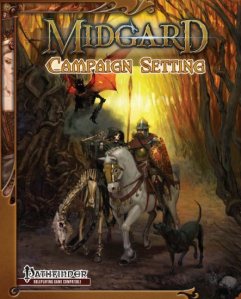
This is a beautiful product! The cover (as per the image above) is a marvellously evocative piece (see here for the artist’s comments) inspired by a medieval etching. The border panel around three sides is used throughout the book on the right hand page in a partly transparent parchment style, providing a slightly darker border to the main page, and re-appearing in the burnished gold colour bordering a glorious full page colour artwork at the start of each chapter. The ‘panes’ in the border allow a glimpse of another image, such as a map.
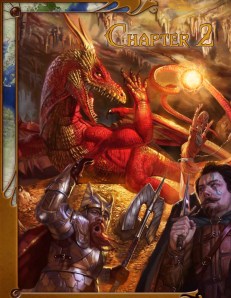
The text is a nice readable font, if perhaps a little small, and most of the headings and banners are shades of brown and gold, with evocative little images throughout e.g. a World Serpent icon for chapter numbers, and a set of gears (the icon of Rava the Gear Goddess) surrounding each page number. Sidebars are highlighted by a darker parchment background (with a subtle pattern of decorative swirls), and along with interior art/maps are ‘attached’ to the page with picture corners. The main cartography is by Jon Roberts, which is as awesome as usual!

Overall the book consists of two introductory chapters (overview and player character info) followed by seven chapters each exploring a distinct region, and finished off by a chapter on the deities and religions of the world, plus appendices (covering use of the setting with the AGE system, random encounters and further reading).

Welcome to Midgard!

The first chapter provides an overview of the setting, from an initial page highlighting seven ‘secrets’ that make the setting special, through a brief history, information on the cosmology and calendar, and onto lore (and game information) about ley lines, the magical rivers of power which infuse the world of Midgard.

I remember an early comment on the Open Design forums (Patrons are able to see and contribute to the brainstorming and design ideas of each project) where Wolfgang made it clear he was only interested in historical information where it stimulated current adventures, and this chapter delivers here. In only five pages (including a couple half-page images), the entire history of the setting is covered in evocative language which gives an overview of the long ages of the world, but still littered with specific concepts and hooks which I’m sure will be picked out and developed in the regional chapters.

The second chapter discusses the races of Midgard, especially those from which are drawn the main heroes (player characters…) of the world: Humans, dragonkin, elves and elf marked, dwarves, gearforged, kobolds and minotaurs. The information here is tight and focussed on how the cultures of these races are portrayed in a Midgard setting. Game information (Pathfinder Role-playing Game compatible) is kept in side-bars. The gearforged, a race of mechanical bodies and living souls, is a Midgard specific race that looks a huge amount of fun to play (“sorry guys, need to oil up before we can move out …”). The chapter is rounded out by a set of Midgard specific feats and traits allowing you to give regional flavour to your characters.

The overall impression (which Wolfgang freely calls out in his foreword) is a world conceptually drawn from Germanic/Slavic/Norse mythology more than the traditional western European sources, but with many twists and additions. There also is a slightly dark feel to the setting, for example there is a sidebar on ‘Human Corruption’, whilst the cantonal dwarves are portrayed as arrogant and militaristic, regularly raiding the surrounding lands and keeping ‘thralls’.

To my reading, there is a slight D&D 4E flavour – from the prescence of dragonkin (a Midgard twist on the Dragonborn race), tieflings (product of the corrupted magocracies if the Wasted West), the creation myths, the ‘withdrawal of the elves’, and the general ‘civilisation is fading/points of light’ feel. Now I fully realise that these ideas are not original or exclusive to 4E, but it is my understanding that Wolfgang was playing 4E in his home campaign when the project kicked off, so maybe some of these ideas in the setting reflect that.

In fact one of my only disappointments about the whole product is that it is not 4E-based. I’m not complaining, as it was a completely democratic vote amongst the patrons at the beginning of the project as to which settings would be supported, but I’d love to see this product in 4E colours šŸ™‚ Maybe a supplement will be released in the future (please…)

Where next…?

Why, we’re at a crossroads … quite literally, as Chapter 3 documents the heartlands of Midgard, the Crossroads region which includes the Free City of Zobeck, where the tale of this world in print began. We’ll take a look here in the next mini-review …
Posted in Midgard Campaign Setting, Reviews, World Building | 6 Comments

Wizards Watch: An Admission

Wizards Watch LogoOk, Ok! I’m one of the eighty-five thousand plus people that have downloaded the DnD Next Playtest material, according to Mike Mearls himself (who should know…)

Thing is, I have to admit that I haven’t actually played it!

And the real truth is, I don’t think I’ll be playing it anytime soon.

This is nothing to do with the playtest materials themselves, or in fact any negative views about the next edition of theĀ game. Quite the contrary, I’ve been interested in theĀ downloads up untilĀ now; have quite likedĀ what I see, and have been reading all the updates andĀ comments. I’ll admit I haven’t been hugely impressed with the adventures that have been chosen to accompany the materials. Although they are clearly based on classics, and seem to have been chosen to test theĀ early ‘Basic D&D’ feel the design team are clearly striving for, Ā the free-form nature doesn’t seem to me best suited to the requirements of a playtest. But that’s a minor complaint overall.

I have tried to get enthused about starting a DnD Next Playtest several times, and even started re-doing the maps of the Caves of Chaos. But it hasn’t happenned. I think there are two main reasons for this:

1) All of my D&D play is with my kids. Although the DnD Next rules look like they’ll be great for this eventually, at the moment there’s a bit too much flux for a kids’ campaign I think. They’ve embraced 4E, especially the races such as dragonborn and eladrin which may not even exist in DnD Next, and they’re both playing Beastmaster Rangers. The ‘powers’ structure of 4E is pretty familiar to them, and seems to work well for our game. I don’t really want to pitch them into another set of classes and rules temporarily.

2) Realistically, we don’t get nearly enough time to play D&D anyway, given the school, sports, work etc commitments that a typical family with 2 near-teen kids seems to have! So when we do get time, I want to play, not playtest, and there is so much 4E material available to use, right at the moment, I don’t want to be putting the effort into trying to run DnD Next adventures with a relatively small amount of material (or at least a significant amount of re-skinning).

So that’s where I’m at, which also means for the forseeable future, this blog will remain firmly concentrating on 4E matters. To me, there is a huge amount more life in the current edition – one day I’m sure DnD Next will be ready, and I’ll still contribute where I can to the process – but in meantime I intend to keep on creating, DMing and playing as much as possible with what I’ve got šŸ™‚

Posted in Columns, DnD Next, Roleplaying with Kids, Wizards Watch | 5 Comments

RPG Blog Carnival: Playing in Established Settings

This month’s RPG Blog Carnival is over at Dice Monkey, and takes on the topic of RPG play in established settings!

So what do we get out of established settings that make them appealing, or not!? Well the first answer is perhaps shared knowledge. All you DM’s out there know how hard it can be to get your players to be interested in the little details you’ve created for your world, over and above crushing the next monster and stealing its gold; so if there is a shared base of knowledge because the setting is widely known, this can help tremendously – the DM does not have to expend as much energy painting a picture of the dazzling attractions of the city at the end of the dangerous trail when that city is for example, Waterdeep of the Forgotten Realms. Chances are that at least one player has read some of the gazillions of novels, or played with other groups in that world. The Star Wars setting is perhaps the ultimate example of making use of this – taking place in a well-defined setting that almost every gamer (and most non-gamers) worth his salt knows well, thanks to the two generations of world-renowned films!

Another attraction of a shared setting is the possibility of interacting with a well-known story. Who wouldn’t want, as a player, to be part of the War of the Ring in Middle-Earth, or fight the Galactic Empire across the galaxy, or indulge in the politics and violence of the Game of Thrones? As a DM as well, settings based on fantasy literature or media provide the attraction of setting your own tales in amongst the famous stories that everyone knows and loves (!?). Some settings have been entirely and deliberately based on this premise, for example the Dragonlance series published by TSR in the 1980s was a grand Adventure Path that explored the world of Krynn alongside the story told in the best-selling novel series by Tracy Hickman and Margaret Weiss. In this case, the intention was that players would even use the same characters as the novels. I remember DMing this series and enjoying it tremendously – I even think I banned my players from reading the novels so they wouldn’t obtain spoilers! Another time, I ran a series of adventures based around the original Icewind Dale novels, featuring Drizzt, Bruenor Battlehammer et al, some of the most famous cross-over RPG characters in history.

Other famous TSR (and now Wizards…) settings such as Greyhawk and the Forgotten Realms, and modern offerings such as Paizo’s Golarion and Kobold Press’ Midgard are intended as shared ā€˜sandbox’ settings, providing background material and adventures to help the DM, and possibly a common setting for organized play programmes, but with no expectation on the actual stories and adventures that a particular group will run. The wealth of material available here can become almost bewildering, and this leads to one of the problems associated with such settings: canon! For example, aĀ setting such as the Forgotten Realms has now been published as a core setting in four versions of Dungeons and Dragons, along with countless novels, adventures and sourcebooks, let alone the years of organized play in the The Living Forgotten Realms! There can hardly be a D&D player alive that hasn’t heard of the setting and its most famous characters, and a significant percentage must have played in the world. What happens then when a DM’s own story, set within the Forgotten Realms, goes agains the perceived ā€˜real’ history of the world as per the published works. Is that allowed? How do players handle that? šŸ™‚

So where does TolrendorDM stand on this subject? The truth is, I’m a sucker for settings! World-building, with all that entails, is the biggest source of enjoyment that I get out of the game. Up until my hiatus from the game in the early 1990s, I’d probably bought almost every setting published by TSR: Greyhawk, Forgotten Realms, Krynn, Dark Sun, Planescape, Lankhmar… the list goes on. Since coming back into the hobby with 4E, I’ve been more judicious. I still however, had to have the 4E Forgotten Realms sourcebook, and bought the Dark Sun books because I liked the way they were bringing out the specific flavour of that setting with 4E mechanics. Wolfgang Baur’s Midgard Campaign Setting also encompasses a number of projects I’ve been a backer on.

But in reality, I seldom actually play in these settings. The clue is partly in the name of this blog. Primarily, in all of my gaming, I’m the DM (and chief world-builder) of Tolrendor, my own personal setting, ā€˜established’ now for almost 30 years šŸ™‚ Over time, it has changed and morphed according to my gaming needs, and I borrow liberally from other settings to enrich my own ideas. Right now, my Heroic Tier 4E campaign for my kids is based in the Nentir Vale mini-setting, as it was a quick way to get started with a rich town and surrounding campaign area – but the region is fully integrated into the northern regions of my own world. This works best for me I think – I get the benefit of the published material, but I get to pull it apart and use the information I want to without feeling like I’m losing my creation šŸ™‚

So, there’s my contribution to the Carnival – I look forward to digesting all the other great ideas out there on this topic!

Posted in D&D Nostalgia, RPG Blog Carnival, World Building | 1 Comment

Midgard Goodies

This post almost made it as my Tech Talk column of the month, or my Map of the Month … but in the end it stands on it’s own šŸ™‚

The Midgard Campaign Setting is the upcoming product from Open Design (now Kobold Press)Ā that brings the whole world of Zobeck to your gaming table! I admit to a certain amount of bias, as I’m a backer of this project, and have been (via Kickstarter) for a number of recent Open Design/Midgard projects, but I can’t think of any game design company at the moment that has as much verve and momentum as the ‘small but fierce’ kobolds lead by Wolfgang Baur!

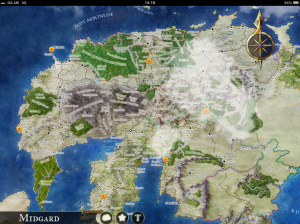
Even so, it was a surprise to see them coming out with an iPad app! The Midgard Atlas is a simple little app that brings theĀ splendourĀ of Jonathan Roberts cartography toĀ your tablet – along with clickable icons of some major cities that bring up a zoomable city map, and even some drifting clouds šŸ™‚

All in all, its a neat little app. There is no background information, so its little more than a gimmick from an actual play perspective, and some people might find the $3.99 price a bit steep on that score (only compared to the content of other apps on the store – I certainly don’t think its an unreasonable price), but it’s a cool little gimmick, and worthy of the kobolds!

It will be interesting to see how (and if) this develops once the campaign setting is out!

Posted in Cartography, RPG Technology | 4 Comments