The Cartographer’s Annual Challenge: January 2013

I think it’s obvious from this blog that I love the awesome Cartographer’s Annual from Profantasy Software! However, too often I download and admire the new style, but don’t get round to actually using it in my mapping!

So, a few weeks ago I (perhaps foolishly…) set myself a mapping challenge for 2013. My goal is to use each issue of the Annual in the month that it comes out. The map however, can’t just be a random ‘play-around’ with the style, my mapping time is too precious for that! No, the intention is to create a meaningful map for my world (Tolrendor) or my 4E campaign (The Amber Tower). 

So, a bit of a dilemma when the first issue for the 2013 Annual turned up – and it was a ‘Investigation Props’ style aimed at modern/horror/sci-fi games!! Hmm, how to turn that into my first ‘challenge’ effort …

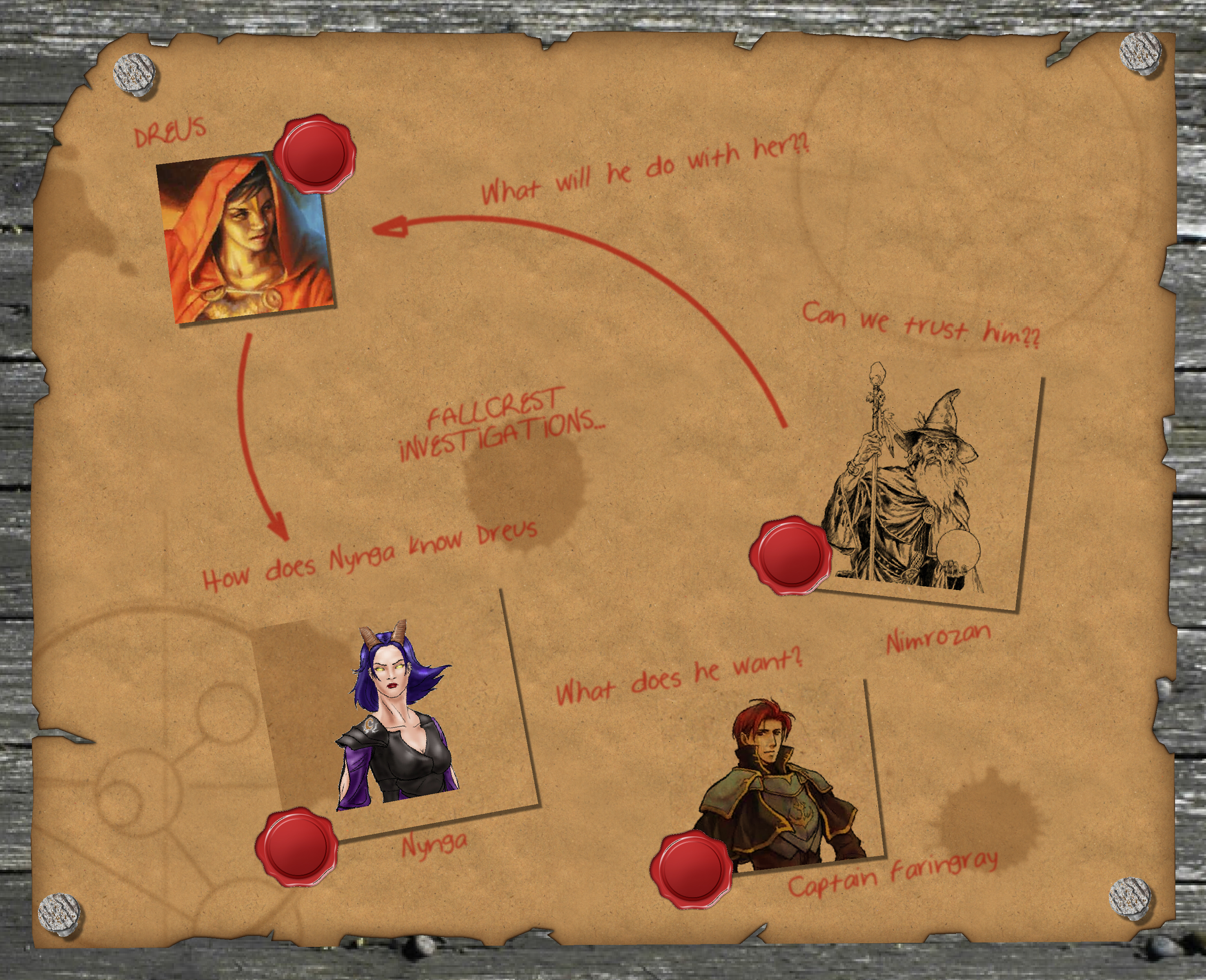
Well, as my D&D campaign progresses, the number of NPCs and rumours etc that the kids are involved with is increasing, and often they forget some of the details (especially when we don’t get to have sessions as often as I’d like…). I’ve been using a technique from Chris Perkins ‘DM Experience’ column ‘Previously in Iomandra’ to recap at the beginning of each session (if you’re not reading this column, you should be, regardless of your RPG of choice!), and thought a graphical representation as a handout might help! So here is my effort (click on the image for full-size view):

FallcrestInvestigations

Of course, as my campaign is a D&D one, I decided that white- or cork-boards didn’t really fit my needs, so after using the style to create the basic handout, I added a ripped parchment background (from a previous Annual issue) as well as some more ‘medieval’ props like wax blobs to hold the images on, nail-heads etc! Hope you like it!

Now that I’ve got the basic image template, my plan is to update this for each session as a prompt to the kids of all the information they’ve gleaned!

Posted in Cartography, Columns, The Amber Tower Campaign, The Annual Challenge, Tolrendor Gazetter | 4 Comments

DM for Kids: Back in the Saddle (literally…)

RPGKidsLogoIn my last DM for Kids column I lamented the fact that scheduling D&D sessions was not happening nearly as frequently  as I’d like! However, my intention was to rectify that over the Christmas holidays …. and I’m very happy to say that we succeeded!

We had two great sessions: finishing off a short adventure called Den of Dreus (from Dragon Magazine 179, somewhat modified) in the first, and some down-time (with complications…) back in Fallcrest in the second.

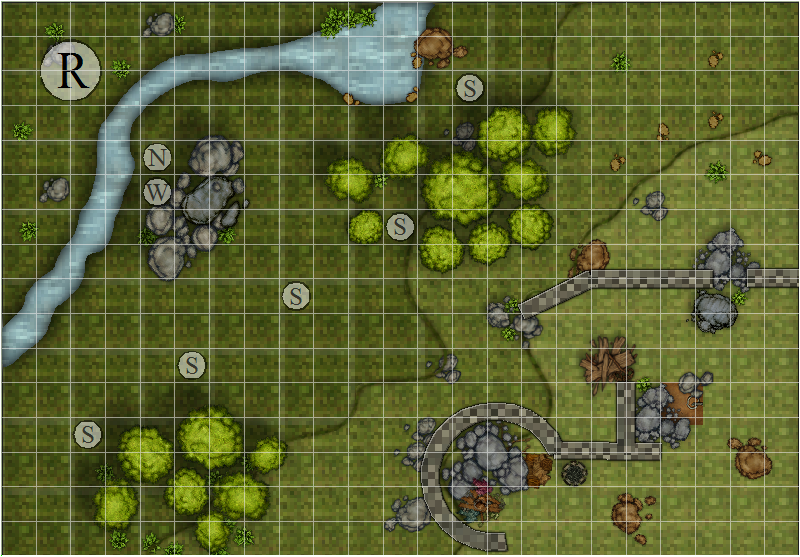
The final encounter in the adventure had the party eagerly leaving the dungeon with the evil wizardess a captive, and the magical tome they had been sent to retrieve safely in their possession – only to realise a small force of skeletons was lying in wait outside, lead by a tiefling necromancer, who was also intent on taking possession of the tome!! Battlemap (drawn with Campaign Catographer’s Dungeon Designer add-on) below:

D4_Kill_The_Messengers_WithTokens

Surprisingly, the kids were more interested in escaping than fighting, and tried to sneak to their horses and ride away. Obviously however, their captive saw her opportunity, and just happened to trip and fall with a scream, thus alerting the skeletons, who closed in to attack!

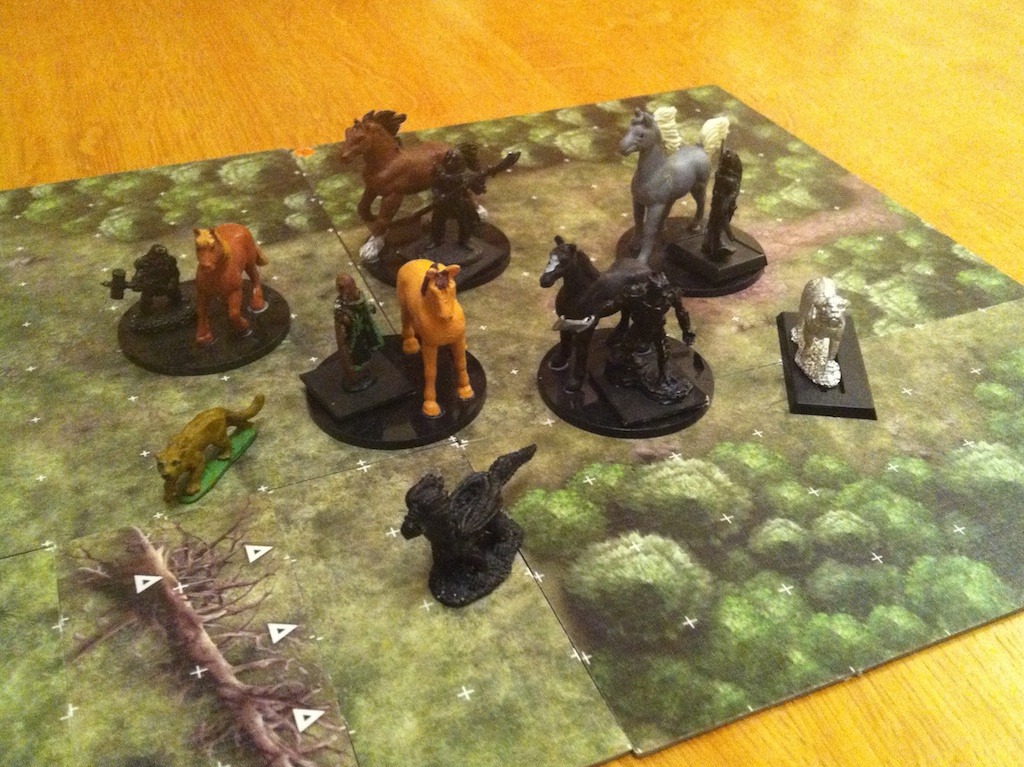
A bit miffed that their plan had been foiled, the kids still had their characters leap intoBlog_Photo_2012-01-24_001 their saddles, and what followed was a memorable combat – the first time they’d actually had the opportunity to fight on horseback! In actual fact, their plan was still to ride away with the prize, but a couple of judicious Grasp of the Earthen Grave spells from the necromancer took care of that!

At this point, the kids discovered that if they had to fight, doing so on horseback was actually a lot of fun … and destructive … resulting in the skeletons being quickly dispatched. The necromancer saw the way things were going and fled the field … only to re-surface back in Fallcrest a couple of days later …

We’d missed gaming a lot, so it was great to get ‘back in that saddle’ as well. The challenge now of course is to ensure that we get D&D properly back on the family schedule for 2013!! To help with this, I’ve been making changes to the way I do my prep … more on this next time!

Posted in 4E D&D, Cartography, Columns, DM for Kids, Encounters, Roleplaying with Kids, The Amber Tower Campaign | Leave a comment

Problem Solving the Gandalf Way…

Check this out. Couldn’t resist linking! 🙂

Posted in Miscellaneous | Leave a comment

Midgard: Campaign Setting Review – Part 4

midgard_coverThe fourth part of my review series heads westwards into (very) strange magic-afflicted lands, and then north to the remnants of the great elven empire. Once again, prepare for the marvellous and the unexpected along the ride!  You can find the rest of the series here, here and here!

Chapter 7: The Wasted West

Ok, so this chapter is definitely strange, with a capital S! The Wasted West is a region blighted  by an ancient arcane war of unimaginable power, ostensibly against the WastedWestMap‘imperialism’ of the elves, but carried on between city-states after their retreat from the world with hugely destructive consequences. The outcome is a wide region blighted by ancient ‘Old One’ monstrosities from another world, drifting across a desert landscape in a magical ‘slumber’, with a few battered remnants of the once powerful wizard-ruled cities and realms scattered around the edges.

For my tastes, this is all possibly a bit too much on the weird side. There are heavy overtones of Cthulhu, 4E’s Far Realm, and even a post-holocaust vibe. In Wolfgang’s own terminology (from his newly published Kobold Guide to Worldbuilding, an offshoot of the Midgard project), this is definitely towards the ‘wild-eyed wahoo” style of fantasy.

However, please don’t let my (I’m typically a low/medium fantasy guy) impressions put you off here – there are some fantastic ideas in this chapter. The pick of them for me has to be the White Knights of Bourgund – where every knight is backed by a mage bonded to his/her armour, and able to cast spells remotely through it on telepathic command. How cool is that! As is often the case in Midgard however, nothing is quite as it seems – the bonded wizards are effectively enslaved and spend their lives in a tower ‘serving their knights – a situation ripe with the seeds of resentment and betrayal 🙂

Elsewhere in this region, we have ancient mages, barely human after centuries of manipulating the ley lines that pollute the area, and calling forth dark powers; haunted giants, sentient (and hungry) jungles; a city of potion makers in a swamp; ‘Old One’ worshipping goblins, and much more! I’ve actually read this chapter front-to-back several times now, and despite my initial thoughts, it’s really growing on me!

There is also quite a lot of rules content in this chapter: magic effects and arcane storms in the Wastes; the Armour Bonded Mage archetype (from the White Knights section), a fantastic table of potions side-effects; ghostly encounters, and rounded out by an ancient spellbook, which includes a number of new spells with the flavour of ancient decayed magic.

Chapter 8: Domains of the Princes

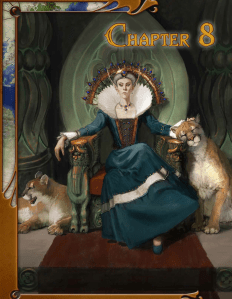
MidgardChapter8After the weird but wondrous Wasted West, there seemed a slight danger that this chapter would appear a bit humdrum. After all, this region is the remnants of the ancient elven empire, and that’s a topic that’s been covered in numerous settings, right?

Not so in Midgard! For a start, the ‘remnants’ of the empire are still ruled by an elf (The Beloved Imperatrix), and she’s been on the throne a long time … so long that virtually all of the major nobility are related to her in some way. As she gets older and older, the political implications of this grow larger – and this atmosphere is well portrayed in the book. Most of the key figures of the Imperial Court are described, along with their relationships and political allegiances.

Secondly, almost exclusively, the major houses of the realm still have access to the fey roads, magical pathways through the shadow realm that can be used to travel across the empire much faster (and more safely…?) than by traditional means. An interesting section covers the origins of these roads, as well as providing an incantation for their use. The Imperatrix uses these roads to control the realm, including moving her court between the three main cities (the Great Procession) every three years.

The chapter continues with a description of the major cities and baronies. I love the Germanic ‘Holy Roman Empire’ feel to this region, both in the names (Hirschberg, Bad Solitz, Salzbach etc…) and in the vast variety of holdings, noble houses and titles. There is a great section on granting a barony to your player characters, and the possible complications and adventures that this might bring to your high level party 🙂

Finally, the chapter covers the great forests that were once the heart of the elven empire: one of which is still inhabited by ‘exiles’ i.e. elves that did not leave the lands when their kin retreated from the world many centuries ago; and the other totally abandoned and now essentially a dangerous hunting ground for ancient treasures and magics. One thing I like about this whole concept is that Midgard’s elves are very much not the ‘Tolkienesque’ elves typical in D&D, but are rather much more ambiguous – indeed they are the fey of European mythology – alien, complex, and perilous – adventurers beware!

To the Far North …

Our journey draws to an end, with only two chapters still to cover. But if you would continue along the way, pack your fur cloak, and your sword, because we must take ship now, headed for the cold and unforgiving Northlands…

Posted in Midgard Campaign Setting, Reviews, World Building | 4 Comments

Map of the Month: A(nother) view of the Havenscoast

MapoftheMonthLogoIt’s been a while since Map of the Month was some of my own work, rather than someone else’s! It’s a good feeling 🙂

This month’s map is yet another view of the Havenscoast. You can find my previous maps of this area here (original handdrawn) here (hex map re-drawn in Campaign Cartographer), here (player ‘handout’ style map), and here (Jon Roberts overland style from the Cartographer’s Annual). As you can see, it’s one of my most mapped areas! 🙂

The style used in this effort is also from the Cartographer’s Annual: the December 2012 issue. It was designed by Pär Lindström, whose site I showcased in November’s Map of the Month column. I really like this style: the various bitmap fills blend in together so well, and the whole image has a hand-drawn and coloured look. It may well become my default style for Area Maps (see here for an explanation of my mapping organisation!). The only things I didn’t like about the style were: the farmland fill didn’t seem to quite work for me – a bit blocky, and there was no symbol for a (non-evil) castle or fortress. But they’re minor points; overall I am really pleased with this map (click image for larger view). Also, if you want to find out more about the region, have a look at this post.

Area Map B4 Annual Dec 12

Posted in Area Map B4: The Havenscoast, Cartography, Columns, Map of the Month, The Havenscoast Project, Tolrendor Gazetter | 4 Comments

2013: Onwards!! Aspirations for the New Year…

Well a Happy New Year to all; we seem to have decided there is still life after the Mayan calendar, which is good to know, as it means more gaming time! 🙂

Anyway, as I mentioned in my last post, we’ve looked back, so now it’s time to plot the course forward at TolrendorDM’s Blog for 2013. I’m sure it’s a common aspiration to say: “I want to post more, and increase readership!” The question is: how to achieve it!? 🙂

Well, last year, I used my five regular columns as a way to plan my posts and get a regular 4-5 posts per month. This certainly worked to a certain extent, but I did find a few issues. For example, I perhaps became constrained a little in thinking about posts in terms of the columns, so if I was struggling to complete a particular column one month, the end was result was I didn’t post at all!

So going forwards, I’ll looking a bit more flexibly at this. The columns have been going well from a content perspective, so will certainly continue, but I’ll be less concerned with fitting a post ‘idea’ into one theme – if it fits, great, if it doesn’t, just post 🙂 The goal is more posts, not just more columns!

Some other ideas include:

cartographerannual13_logoMore Maps! The Map of the Month column has been going strong, with a mixture of my own work and highlighting the awesome work of other fantasy cartographers. Of course, this will continue!. But I want more! 🙂 Every year, I subscribe to the excellent Cartographer’s Annual from Profantasy, but it often takes me a long time before I use any of the monthly styles. So I’m setting myself the Annual Challenge: To produce a map related to Tolrendor using each month’s pack for the whole of 2013! So look out for something using the January 2013 pack in the coming weeks … hmmm.

midgard_coverMore Midgard! This blog is a major fan (and patron) of Kobold Press’ Midgard Setting, and my ongoing series reviewing the Campaign Setting book have been some of my most successful posts. In 2013, there are more Midgard products arriving, such as the Legends of Midgard, a whole series of adventures for the setting, so I’m sure I’ll be taking a close look. Expect also some posts on how the setting is providing ideas and inspiration for my own home-brew world of Tolrendor.

More Content! I mentioned in my review of 2012 that I was a bit disappointed in the TolrendorGazetterBannerrelatively small number of Content Corner columns I achieved. With hindsight, I think I set myself topics which were too large to achieve design, writing and layout in the couple of weeks available if I were to achieve a monthly post. So in 2013, I’m going to concentrate more on smaller snippets that will amalgamate over time into a larger ‘publication’. The main theme will still be the the ‘Havenscoast Project‘, but other topics will also crop up!

More Gaming! This is definitely a New Year Resolution! I mentioned in a November post that, especially in the second half of the year, gaming sessions were scarcer than RPGKidsLogohen’s teeth! Well, the holiday period certainly helped rectify that, and I mean to continue! Scheduling problems have been the main issue, but if I’m honest with myself, I also wasn’t keeping up with any regular prep, which sometimes meant an available slot didn’t get capitalised on because I wasn’t ‘ready enough’! I’ve been making some changes to my campaign notes and session planning, so I hope that helps!  Of course, more gaming hopefully means more ideas for my DM for Kids column!

Wow! All those plans, and many more to come I hope! I’m certainly looking forward to writing for Tolrendor DM’s Blog in 2013. You’re all welcome on the ride …. 🙂

Posted in Cartography, Columns, Content Corner, DM for Kids, Map of the Month, Midgard Campaign Setting, Miscellaneous, Reviews, Roleplaying with Kids, RPG Blog Carnival, The Annual Challenge, The Havenscoast Project, Tolrendor Gazetter | 3 Comments

2012: A Year in Review

It’s that time of year again, i.e. the end! Time to look back, because soon we’ll be looking forward! As ever, it’s fun to look back to the start of the year and see whether any of my targets where met!? 🙂

My main target for 2012 was to achieve an average of 4-5 posts a month, small by the standards of many blogs I know, but hopefully sustainable! So did I achieve it? Well, I managed 4 or more posts in 9 of the 12 months, and no months without any posts, so that is at least positive. Also, by concentrating on producing posts in my ‘columns’, I feel that the subject and quality of the posts has been higher. Although I certainly didn’t achieve a post in each of my columns every month, there was a reasonable selection throughout the year:

Wizards Watch Logo Wizards Watch was my most productive column, with 11 posts during the year. The majority of posts were on the subject of DnDNext, which of course has one of the major topics in the D&D world this year. Truth to be told, I’m no longer really following along as closely as I was, as I’m concentrating on my 4E kids’ campaign: Wizards Watch: An Admission.

RPGKidsLogoMy DM for Kids column started off with a bang with a couple of posts I was really pleased with: The Menagerie, and Session Props, but faded out a little later in the year, mainly due to the fact that we weren’t playing!! Definitely something to improve for next year…

I guess the column I was most disappointed in was Content Corner, as it was probably theContent Corner Logo one I most wanted to get going regularly, but in the end I only managed 5 posts. The ‘Havenscoast Project’, a 4E Gazetteer of a region of Tolrendor, was intended to be the main subject, but I also published a fun ‘Buying Horses‘ skill challenge, a short delve ‘Rats Below‘ and some nasty Fey Spiders! I certainly found that trying to rush design and publication of worthwhile content is hard!! If I’m going to do better next year, more forward planning is required!

MapoftheMonthLogoMy fantasy cartography column Map of the Month tends to be the most popular on the site in terms of visitors. I had a mix of posts, some showing off my own work, such as this map of the Havenscoast region, as well as highlighting some of the great mapping sites on the internet e.g. here, and here … and many others!

RPG Tech Talk was a lot of fun. I ended up posting 8 times during the year, and covered aRPGTechTalkLogo varied range of topics: PDF encryption, the iBooks format for RPGs, the Tech Gametable, and campaign note-taking using Microsoft OneNote.

On other subjects, I participated in a couple of RPG Blog Carnivals, always good for getting a few more links into the site. I like these, as the subjects are often a bit outside the area of my typical post, so add some variety!

midgard_coverHaving participated in a number of Kickstarter/Patronage projects with Open Design for the last couple of years, the highlight release this year was the Midgard Campaign Setting. Having really enjoyed this product, I decided to do a multi-part review, which is still ongoing (so far, here, here and here…) – it’s a big book after all! This series has generated a large amount of traffic to the blog, co-inciding with my best ever day in terms of hits.

In terms of traffic, 2012 has seen considerable growth – more than twice as many views as  2011, with four of my best ever months coming in the last six – the best ever being this month! In absolute terms, still pretty tiny, but definitely the right trajectory, and given my limited posting targets, I think all I can expect! 🙂

So overall, TolrendorDM’s Blog has had a good 2012, in my opionion 🙂

See you next year for more gaming content, comment and fun!!

Onwards!! (as Wolfgang would say…!)

Posted in Columns, Midgard Campaign Setting, Miscellaneous, RPG Blog Carnival | 1 Comment

Merry Yuletide from TolrendorDM

oakkingAcross the northern hemisphere of Tolrendor, the mid-winter holiday of Yule has been celebrated for years beyond count. From this day onwards, the nights shorten, and the spring thaw will eventually follow. Many say it represents the time when Baltur the Lawmaker enforced the discipline of seasons on the wayward Sun Lord, ensuring that the world would have respite from endless winter. In any case, at this time of year, the constellation known as the ‘Scales’, which is closely associated with the god Baltur, blazes brightly in the northern sky. Weather permitting, it is easily visible in any of the lands north of the Inner Sea.

In the cold northern regions, the celebration of Yule marks the last feast before the months of hardship, as deep winter continues its hold on the land, and spring, although heralded as the days lengthen, seems still an age away. The holiday lasts three days: on the first, people gather in extended family groups and exchange gifts, often hand-crafted items made from leather and wood; the second day is a religious day, when local  communities gather in their holy places, and their priests and shamans make offering to the gods and spirits, beseeching them to grant safe passage through the coming months. On the third day, wrestling and mock-fighting bouts are held, following by a mass feast where the best livestock are roasted over huge fire-pits, and copious quantities of ale and spiced warm mead are consumed. 

In the lands around the Inner Sea, where the climate is more forgiving, Yuletide is a season of great parties and tourneys. In Lorondor, the king hosts the Grand Yuletide Tourney every year; knights and paladins from across the kingdom and many other lands journey to compete in five days of jousts and melees. The overall winner receives the title of Yule Champion, which in some years has even resulted in the bestowing of lands and title. Great feasts are provided daily for all citizens, and the queen hosts a Grand Ball on the final knight of the tournament for the great nobles and knights of the realm. 

Yuletide is also a season of peace, partly because it is often impossible to carry out a campaign of war past this date due to the weather. Treaties often come into force on this date. 

Wherever you are, whoever you’re with, whatever your reason to celebrate, TolrendorDM’s Blog wishes you a happy and peaceful holiday period! 🙂

Posted in Miscellaneous, Tolrendor Gazetter, World Building | Leave a comment

Midgard: Campaign Setting Review – Part 3

midgard_coverAnd so onto Part 3 of my review of the Midgard Campaign Setting. (You can find the previous posts here and here). This time, we cover Chapters 5 and 6. These are, at least to my reading so far, possibly the most interesting regions, and certainly are a twist on standard fantasy fare. What are you waiting for then, climb aboard the wagon, this caravan is heading south!

Chapter 5: The Dragon Empire and the South

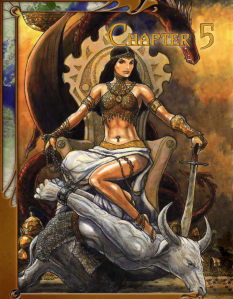
When the chapter begins with a full page image like the one shown on the right, what’s MidgardCampaignChapter5not to like! An evocative image, and certainly one which leads you straight into the main flavour of the region: an eastern empire with the taste of decadent Persia or Arabia, with the added pungent spice of dragons, sprinkled liberally!

The Mharoti Dragon Empire is an empire literally ruled by a cabal of ancient dragons, where the nobility is made up of lesser dragons, drake and dragonkin (Midgard’s equivalent I guess to 4E dragon born), and humans and other ‘normal’ D&D races are subservient. The exception of course, is the (current) Sultana, a human with dragon-blood, who is allowed to rule because its a chore the draconic overlords would rather not bother with!

All this makes for a land teeming with adventure possibilities. Dragons of course, always want more treasure, so the Mharoti is necessarily an aggressive expansionist empire, with lots of hooks for military style campaigns. There is a side-bar describing a typical Mharoti army, made of all sorts of fantastic sounding troop types, including dragonkin cavalry, elementalists and fire dragons. Great stuff, which makes me want to break out the wargaming table, let alone run an RPG!

The chapter provides an in-depth description of the various ‘castes’, from the lowly humans, dwarves etc, to the citizen kobolds and dragonkin all the way to the eight Morza, the original ancient dragon lords. Each of these is described alongside the province they rule, as well as a section on the capital of Harkesh. Lots of material here for political intrigue-based adventures.

But there’s more! The chapter also describes a number of other states. From the slaver city-state, the Despotate of the Ruby Sea to the Egyptian inspired River Kingdom of Nuria Natal, the Free City of Siwal and Ishadia in the deep south, this region is ripe with exotic locations and flavour. A sidebar hints at the ‘Kingdoms of Gold and Salt’, ancient lands far to the south, which cry out for another source-book in the future 😉

Keeping with the exotic, the chapter rounds out with some crunch: strange trade goods found in bazaars, magic items and curiosities, and a section on Dragon Magic.

Chapter 6: The Seven Cities

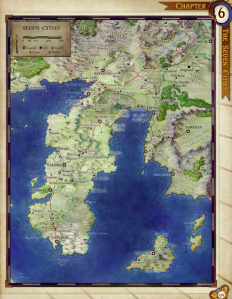
MidgardCampaignChapter6If the inspiration for Chapter 5 is the eastern lands of history and fable, then Chapter 6 is straight out of Machiavellian Renaissance Italy! Centred on a large peninsula jutting out into Midgard’s inner sea, the region presents seven distinct city states, bound together by geography, shared history – and of course, war and intrigue!!

In the Seven Cities, war is portrayed as a religious requirement; most of the cities pay homage to Mavros the God of War. The chapter starts off with a whole section on the regional approach to war, bound by many rules and customs, which prevent wholesale destruction, and is mainly aimed at raising the ‘status’ of generals and captains, making fortunes for the mercenary companies who are the main protagonists, and finally of course, wringing some political concession out of the enemy.

The remainder of the chapter covers the city-states themselves, each of which has a distinctive style: from the self-styled Imperial Valera, to the druidic Duchy of Verrayne guarding against the western wastes; from the Oracle-ruled state of Kammae Straboli to the maritime power of Triolo, and others besides. This is a mainly human area, but also has a significant population of minotaurs, including a whole island ruled by them.

There is not much crunch in this chapter, save a few snippets presented as side-bars (such as the drug Requiem found in Kammae Straboli), but this is more than made up for by the sheer amount of ideas presented here! One thing I did notice however, is that in one of the few obvious editing errors in the whole book, this chapter has been missed completely out of the table of contents! Its definitely worth searching for however 🙂

Westwards again…

I found these two chapters a great read – they are so full of ideas and twists on historical and fantasy sources, that my mind was racing as I read, thinking of adventures, or planning how I might steal ideas for my own campaign – and that is surely the main goal of a campaign setting!

Next, prepare for the journey to turn rather weird, as we head to the Western Wastes and beyond.

Posted in Midgard Campaign Setting, Reviews, World Building | 5 Comments

RPG Tech Talk: Taking Notes

RPGTechTalkLogo

I recently picked up a book Never Unprepared: The Complete Gamemaster’s Guide to Session Prep. An interesting read, and one which I’m sure will bring some changes to my game prep activities. The link to this column, however, is that there was a chapter devoted to prep tools, which discussed the use of Microsoft OneNote as one possibility for this.

If you’re anything like me with your role-playing campaign, organisation of your campaign and game notes becomes a bit of an obsession!? Your adventures, NPCs, locations, maps etc or have to be catalogued in a manner that makes sense (to you, if no-one else…), and hopefully, makes your actual game at the table easier. Sound familiar?

In the old days of my Tolrendor campaign, well before there were even widely available word-processors for home computers, let alone ones that offered a WYSIWYG option, ring-binders and dividers was the only way. I’ve posted before about my complicated mapping system, and written notes were no exception.

Nowadays however, the computer comes to the rescue, especially in the sense of being able to hold (and carry about) a huge amount of information. But is it any better organised? I started using Microsoft OneNote a couple of years ago, when I first got back into gaming with my kids. This application has been part of the Office suite since 2003 (I believe), but it seems to be very much the forgotten cousin. I’m surprised at this, as its actually a really useful tool.

Essentially, you create pages of data, where a page is essentially a collection of snippets of information – text, screenshots, imported images, files etc. However, it’s the ability to organise your pages that makes it great for my purposes. The hierarchy is Notebooks,
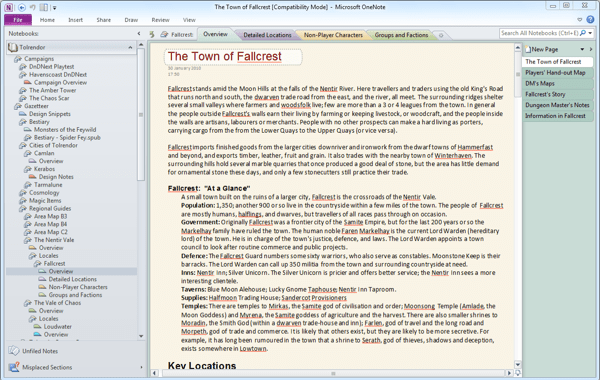
OneNoteScreenshot1.pngSection Groups and then Sections, which contain the actual pages (and in fact you can also have sub-pages). This allows me to create and organise all my campaign notes in one place. In the screenshot, you see my main Tolrendor Notebook, with top level ‘Campaigns’ and ‘Gazetteer’ section groups, and so on … down to the pages and sub-pages that comprise the actual entry for the Town of Fallcrest Overview. You can also see a number of sections pertaining to Fallcrest, including Detailed Locations, Non-Player Characters and Groups and Factions. Each of these sections has its own page structure.

You can also create hyperlinks between different pages, and also search pretty efficiently. One neat trick is that you can embed PDF files as a series images (per page), and the text in the PDFs is then searchable. Tools for highlighting and annotating your information are also available.

One thing I definitely like is that there is no massive complex library format; rather the whole notebook is contained in a folder-based structure. Each section group is a sub-folder, and each section is a OneNote .one file. This has several benefits. First, there is not one massive file that you’re completely dependent on, and if it gets corrupted, then bye-bye notes! Second, I find it convenient to store any other files that relate to your data in the same folder structure, rather than separate locations. And thirdly, it makes it very simple to sync your whole set of notes via Dropbox (or some other cloud service) without any specific functionality in the app itself. I can quite happily work on my campaign on my laptop while I’m travelling, and have it automatically appear on my home computer on my return.

Sadly, no application is perfect! 🙂 A few things about OnNote frustrate me, although not enough to stop using it! As it is designed for note-taking, there is only limited control on the layout of individual pages. That’s great for quick editing, but a pain if you want to print your notes out in a presentable manner. It would also be great if there was more native support for PDF documents e.g, if you have a PDF embedded in a page, it would be useful if it could support paging through the document in-situ, rather than having to either embed it as images (which looks ok but I’ve noticed does hugely inflate the .one file size) or an icon, which means it launches in a separate app.

Another limitation is its handling of embedded files – to show these on a page, the app actually embeds them in the .one file. From there, you can open and edit them, but the actual file is hidden from you. I really don’t like that – call me paranoid, but I like the ability to physically see my files on disk, to rename/version them etc! Given that other Office programs support linking to files, and in-place editing, I’m a bit surprised at this lack.

In summary, I like Microsoft OneNote, and prefer its free-form functionality to any of the RPG-specific applications I have tried. But it’s certainly not the perfect solution.

So what do I want?

Well, the one aspect that frustrates me the most is the inability to create something once, but use it in multiple places. For example, I may have written a great city introduction in one section of my notes, but when I create a PDF layout of a regional guide, or need a side-bar of information in my game session notes, I want to be able to use the same piece of text without copy and paste, or complex back and forth linking. Of course, I want the freedom to be able to edit the text to suit the new requirement, and to be able to specify whether the changes override or branch the original.

The essence is that I’d like to be able to treat my writing ‘snippets’, my images, my maps etc as individual assets, and be able to re-work and combine these in many different ways without losing the source information. The closest analogy I can think of is the content management systems used by news and magazine publishers, where journalist and writers submit copy, photographers and artists upload their images, and these are combined into various formats (newspaper, magazine, webzine etc) by layout specialists and graphics designers.

Sounds cool, right? Maybe one day … 🙂
Posted in Columns, RPG Tech Talk, RPG Technology, Self-publishing | 9 Comments