Wizards Watch: De Planes, De Planes

Wizards Watch Logo

I’ve been musing about the subject of this article for sometime now, without it coming to the boil! Finally I’ve managed to collect my thoughts on this, so here goes! 🙂

The original trigger was Chris Perkins’ editorial in Dragon 414 , back in August 2012, announcing a month of Dungeon and Dragon content with a planar theme. An excerpt from the article caused quite a lot of internet chatter at the time: “D&D is not truly D&D without the Great Wheel,…

Plenty of people were immediately raising the roof after this quote, saying it implied that 4E, because it does not have the Great Wheel cosmology, was therefore not DnD!! I’m quite sure Chris, who had been sharing details of his long-running 4E campaign through his superlative Dungeon Master Experience column, meant nothing of the sort, but the article was interesting nonetheless for its viewpoint on how DnD Next might treat the question of cosmology.

Then later, in November 2012, a Wandering Monster column by James Wyatt was published on the topic of the ‘fey’, and posed the question whether the Feywild was really a necessary concept, despite admitting that it was one of the more popular innovations in 4E. This column is more about getting a feel for how people perceive the iconic monsters of D&D, but certainly it gave some insights into how the design team for DnD Next is thinking.

Finally, with this week’s Legends and Lore column, Mike Mearls has given us some fairly clear indications as to where the new system is going. Planescape and the Great Wheel are seen as the default cosmology, the distinct Elemental planes return, albeit with some changes to make parts of them (the border planes) more hospitable to adventuring. Meanwhile, the 4E Shadowfell (although renamed back to the Ravenloft setting) and  Feywild are presented as borderlands to the negative and positive energy planes respectively. Even Spelljammer gets a mention!

So what is TolrendorDM’s view on all this? Well at first glance, I’ve got no major issues. Planescape and Spelljammer were two concepts I loved in AD&D, and it’s good to see them potentially making a new appearance. I’m pleased also that the Feywild and Shadowfell have not been thrown into the 4E trash can – these concepts were great additions to the D&D cosmology in my opinion.

However my second thought is that in some ways the whole concept of a ‘default’ cosmology seems wrong – this is one area which I think should be quite distinct depending on the setting you are playing or creating. For example, Planescape has a particular slant on planar material (i.e. the concept of ‘ideals’ having real power, and the planes portrayed as a diverse and wondrous dangerous set of tourist destinations!). A cool concept, but it doesn’t necessarily fit a setting where the Greater Powers/Deities are depicted as remote from the petty concerns of the world.

A strong influence on the way I think about planar adventures is the Eternal Champion series by Michael Moorcock, in which the various planes and otherworldly settings tend to happen upon heroes in strange and unexplained ways. Here there is no (at least none that is explained) overarching meaning or connection between these strange places –  heroes simply reach them by accident or by seeking out legendary artifacts or beings. In some ways this is closer to the more abstract 4E concepts of the Astral vs the Elemental (Law vs Chaos?), within which disparate ‘realms’ appear under the influence of powerful beings.

In my Tolrendor setting, the cosmology is built around the 4E concept of the ‘Dawn War’, where the primordial Titans of creation (and Chaos) fought their great war  against the ‘Law’ forced upon them by the Gods, until finally a tenuous balance was achieved upon the intervention of the primal forces of life and nature. If and when my players (kids…) venture into the outer planes, there is sure to be a Planescape flavour (after all, Sigil is cool…), but I’m unlikely to apply the rigid concepts of the Great Wheel – to me, the planes should never make sense!

Overall, I think this is my point. I accept there must be some default concepts about the cosmology in the D&D system in order to define a ruleset around planar adventuring (Demons live in the Abyss etc..), but I don’t think it needs to be all encompassing or rigid – I want to be able to develop my own setting’s cosmology and mythology, drawing on published material as needed, but not feeling like I have to have a plane of interlocking gears inhabited by insectoid solids …

To be fair, this ‘toolbox’ approach is clearly identified as a key aim in Chris Perkin’s editorial from last year, and I think that is still what Mike is saying in the most recent article … time will tell!

And as for Spelljammer? D&D in Outer Space? The Return of the Giff? Bring it on … 🙂

Posted in Columns, DnD Next, Wizards Watch, World Building | 2 Comments

Wizards Watch: Deep Magic

Wizards Watch LogoI’m sure a lot of you have seen the latest Kickstarter project from Kobold Press: Deep Magic. It’s pitched as a setting-neutral tome of all kinds of magical goodies: new spells, class features, magical academies etc, for all types of spell-casters.

The original funding ask was $10,000 – but it blew through that in a matter of hours, and has continued to grow apace, with 38 stretch goals already achieved, and more to come. As I write this, the funding stands at almost $78k, with more than 1300 backers, and still 10 days to go!!

As with most Kobold Press publications now, this one is aimed at the Pathfinder Roleplaying Game, so you may ask, why am I interested? The answer is simple: cool products are cool products, whatever the ruleset – and this one looks extremely cool. Also, as readers of this blog will know, I’m a big backer of the Midgard Campaign Setting, and a lot of the spell lore will have its roots in, or be compatible with, this grand setting. I’m also expecting that one of the benefits of DnD Next will be easier sharing of content between various editions/branches of the D&D game, especially as the play-test rules have definitely gone back to the more traditional view of spells in the game – one which 4E, for all its good ideas, did lose a bit in my view.

So if this looks interesting, get involved! Let’s see if we can get to the point where Wolfgang simply has to say: “Sorry, I’ve run out of stretch goals!”

Posted in Columns, Midgard Campaign Setting, Wizards Watch | Leave a comment

Map of the Month: Profantasy ‘User Maps’

MapoftheMonthLogoMost of my mapping efforts so far this year have been sucked into my personal Cartographer’s Annual Challenge, so the Map of the Month column has been a bit lacking.

So instead, why don’t you check out the June ‘User Maps‘ blog post on the Profantasy web-site. This is a collection of some of the maps posted by the user community on the website’s forums over the past month. In June, I’m very pleased to see that two of my maps from this site made it into the post. But check out the others – there are such awesome maps posted every month that most of the time I’m surprised my examples even make the grade 🙂

You don’t need a login to view them (although you do if you want to post to the forums themselves) and you don’t need any Profantasy products either, as they’re posted in normal image formats. Below are the direct links for some previous posts; I’m sure you’ll agree there are a huge variety of wonderful maps created by the community:

May

April

March

February

January

Enjoy!!

Posted in Cartography, Columns, Map of the Month | Leave a comment

Cartographer’s Annual Challenge: June 2013

So we’re six months into the year, and that means the sixth entry in my personal Cartographer’s Annual challenge: to use every issue of the Annual in the same month for a meaningful map.

This months Issue is another overland style, a fun comic map style, inspired apparently by Sidekickquests.com (check it out…). However, as a style, it didn’t really seem to suit mapping in Tolrendor. Hmm, what to do for the Challenge then!!?

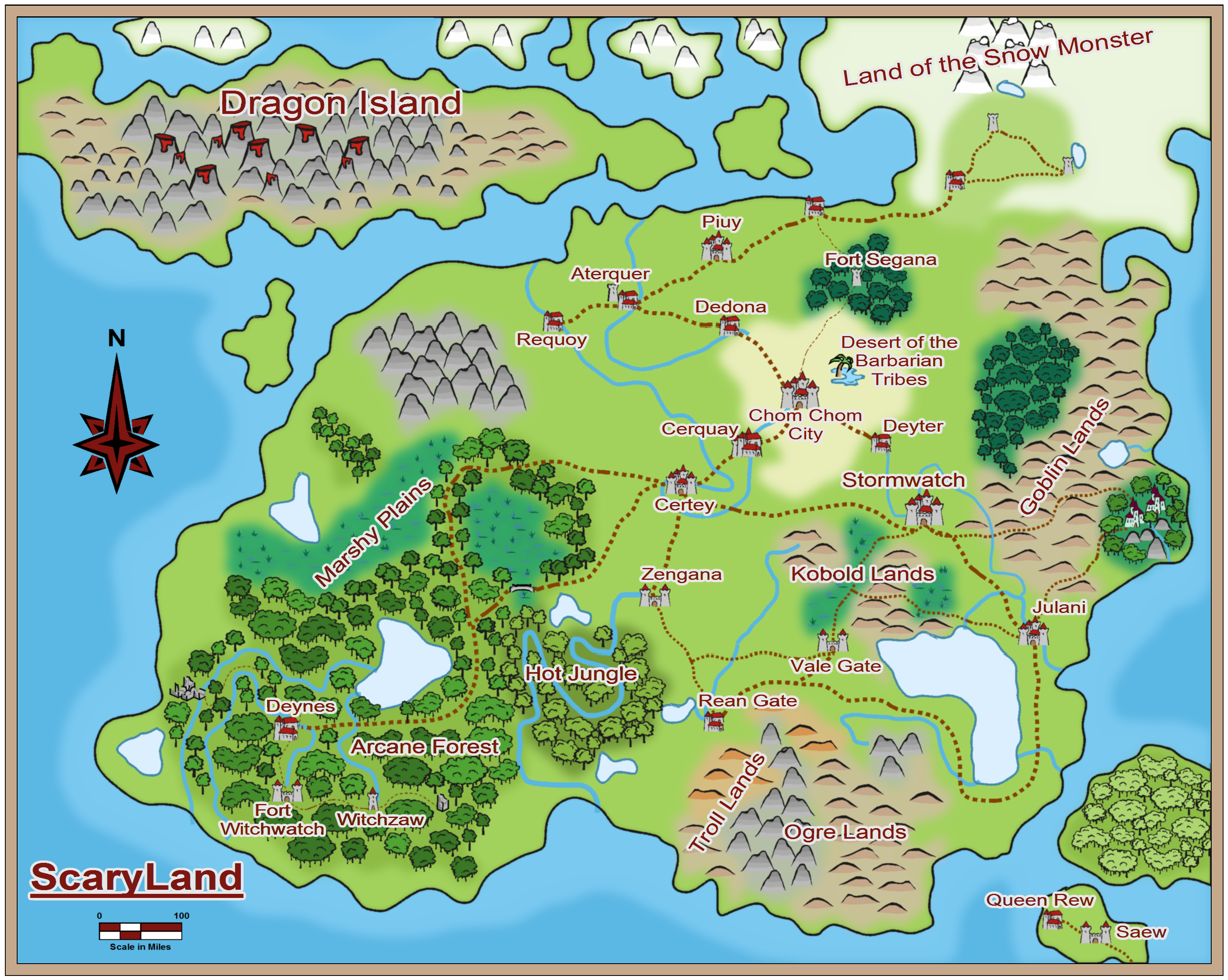
Well, some time ago, my son decided he wanted to try his hand at building his own world, and of course wanted to use the same tools I do i.e. Campaign Cartographer 3. Now CC3 is many (great) things, but what it isn’t is a program with a short learning curve! So I set him up with the Overland Hex map style from a previous Annual (July 2010 in fact…), as this made it possible to produce map simply by clicking in the hexes with the desired symbol, without too much dependency on more complex drawing tools. He really enjoyed this and produced a lovely map of ‘ScaryLand’!!

When I showed him the example maps from this month’s Issue, he thought they were pretty cool, so I offered to re-draw his world using the style. Here is the result:

ScaryLand Annual June 13The style was quick and enjoyable to use, with bright and bold terrain tools that blend in  nicely, and the comic symbols which are really fun to use. My only gripe would be: more symbols please!! 🙂 For example, there is only one style of tree symbols (although it comes in a nice range of single trees and copses etc). It would be really good to have some more options here, such as northern fir, or steaming jungles! The comic-style also cries out for some different types of buildings e.g. desert tents, eastern style cities etc.

With what’s there however, you can certainly produce a great map, especially as all the symbols have really nice varicoloured versions, so you can mix it up a bit (which is exactly what I did for northern forests and jungles!). I also found a few of the symbols from the standard CC3 Vector Colour style worked quite well (Marsh and Oasis symbols).

I even got an approval rating from my son! 🙂

Posted in Cartography, Columns, Roleplaying with Kids, The Annual Challenge | Leave a comment

RPG Tech Talk: Waiting patiently…

RPGTechTalkLogoIn my last RPG Tech Talk column I talked about Realm Works, the new ‘Campaign Information Manager’ being developed by Lone Wolf Software, who also make the Hero Lab character creation software. As a backer, I have access to the monthly updates for the Kickstarter project, which have been extremely informative both in terms of project progress, and some interesting technical information.

The key piece of news over the last couple of months has been that the Early Access release, which I’m really looking forward to, has slipped a bit, and we’re now looking at getting hold of it in June (hopefully…) rather than May. From my perspective, this isn’t a major problem – in fact it may dovetail nicely with the new DnD Next campaign I’m working on. It would be great to try out this software as I’m prepping for this!

A major component of the Kickstarter delivery is not so much the Realm Works client application, but the community ‘cloud’ which will allow content to be shared and published via Lone Wolf’s servers. There was an interesting discussion around the problems they have to tackle re synchronisation of content, especially when one of the key functions of Realm Works will be to load content, and alter it easily to fit your own campaign. So what happens when the publisher of that content updates the material – as the end user, you then need the choice to accept that update – or not if the changes would be clash with your own? Managing this with user-based granularity is definitely going to be a technical challenge 😉

At the outset, unfortunately, there are no plans to provide export/import formats for your data, or to have any sort of APIs for accessing the data via other tools, such as a Combat Manager, or a Virtual Table-top. Lone Wolf Development have clearly stated they do wish to tackle this sort of functionality, but it will be considerably further down the line. I certainly hope this does come to fruition, as I’ve said before, one of the main aspects of managing information is to do it once … and have it easily integrated into the other applications you need to use.

Overall however, the project seems to be shaping up nicely, with a few small (to be expected…) but none too-serious hiccups. What we (those lucky ones signed up for Early Access) get to see in the next month or so will surely need a few iterations to get into a final release version, but at least we’ll have it in our hands!

I can’t wait (despite the title of this post …)! 🙂

Posted in Columns, RPG Tech Talk, RPG Technology | 2 Comments

Cartographer’s Annual Challenge: May 2013

The May 2013 Annual issue was somewhat different than many, presenting a library of symbols intended for adding information and markers to your maps.

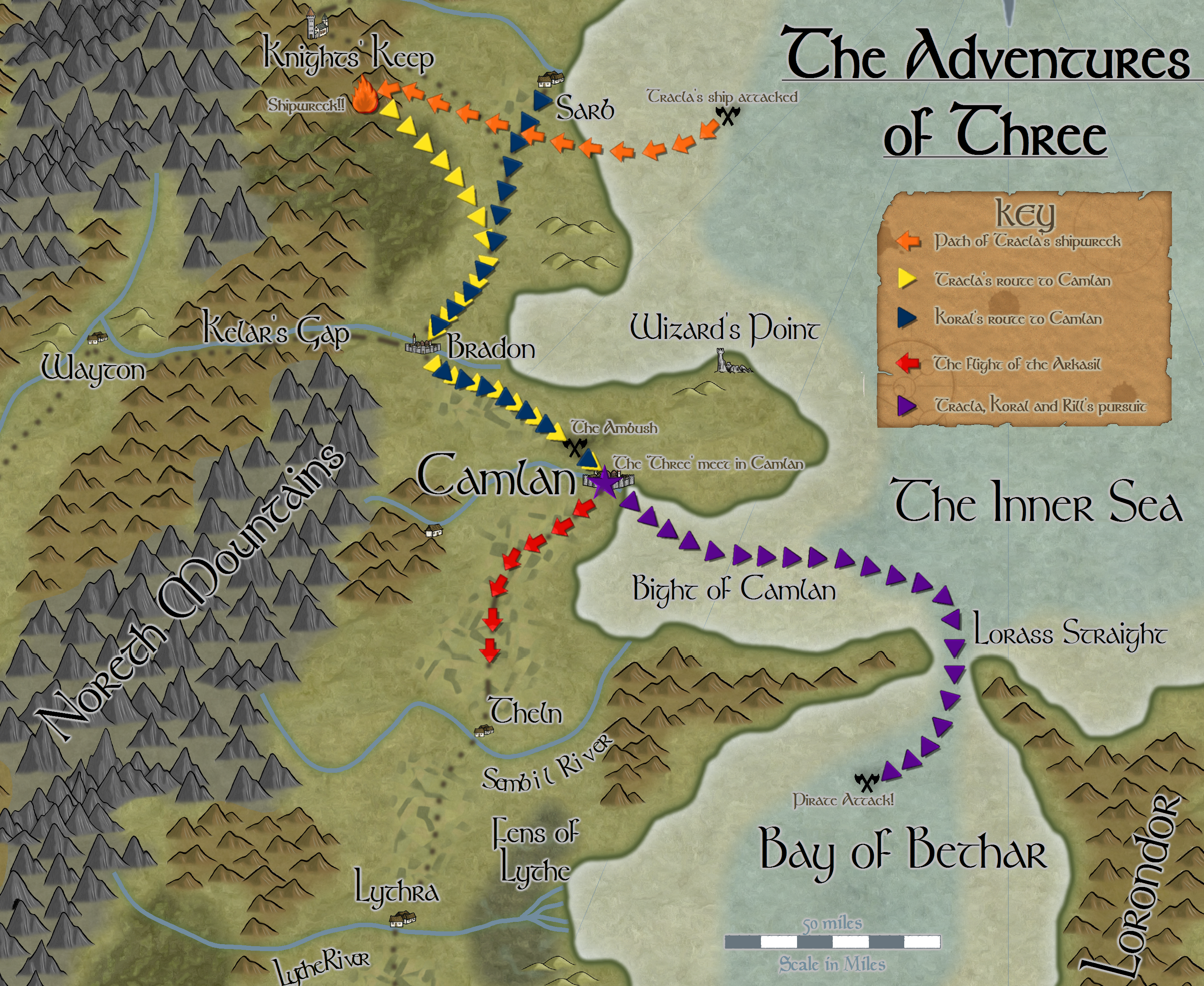
For this month’s Challenge entry, I decided to create a marked-up map showing the key travel routes and incidents from a fantasy story I have been writing for my kids. It is set in my world, Tolrendor, and initially centred around the Havenscoast region. Having lain neglected for quite some time, I recently finished off the first couple of chapters and read them to the kids over Easter … and now have strict instructions to keep on writing!! The story is deliberately episodical, and is pretty open-ended in terms of where the main characters will end up … I certainly have no idea 🙂

Anyway, here is the map, which is based on a previous view of the Havenscoast, with the addition of the mark-up and a key (click image for full-size version):

Annual Challenge May 13 - 2

This Annual issue packs in a nice set of symbols, which are great for adding all manner of extra details to a map. I can see the set being very useful for maps which are intended to show historical information such as military campaigns, large-scale migrations etc. As an added bonus, the Mapping Guide (which accompanies every Annual issue) has a useful tutorial on creating symbols and symbol libraries!!

Till the next Issue, keep up the mapping! 😉

Posted in Cartography, Columns, Fiction, The Annual Challenge, Tolrendor Gazetter | Leave a comment

DM for Kids: The Eyes have it!

RPGKidsLogoAs I’ve mentioned several times over the last six months or so, the Amber Tower campaign, my 4E game with my kids, has stalled somewhat. It’s not to say we’re not enjoying it, the kids are as keen as ever to play – it’s all down to scheduling!!

My daughter, now almost 14, is a keen competition show-jumper, so many weekends for her are taken up training, travelling and/or competing! My son, turning 12, has a number of his own sporting activities, so the overlapping slots are rare …. and generally taken up by the ever-present curse of homework! Weekday evenings don’t work, as I don’t get home from work in time for a session on a school night! Teenage family life; I’m sure many of you know it well! 🙂

In actual fact the real problem is getting all 3 of us together for a game; it’s much more likely that my son and I can find the time, as we’re not the ones tied up with equestrian pursuits! So…. I’ve been toying with the idea of starting a solo campaign just for the two of us … and… potentially running it as a DnD Next campaign…

Of course, the purpose of running a DnD Next campaign is at least partly to play-test and explore the new rules. In a solo campaign though, there’s clearly not much variety in the character(s) being run! 🙂 I could DM a series of one-shots with different characters for each adventure, but in my experience that isn’t very satisfying for kids – they tend to invest quite strongly in their characters, and enjoy storyline continuity.

So after a bit of brainstorming I’ve come up with a campaign idea that seems quite fun, and seems to tick a number of boxes:

  • It will be set in the Havenscoast. More specifically, it will centred around the Knights of Watch, the military order which guards the northern regions of the city-state of Camlan against the dangers of the Barrens, and the demon-wastes of Gorak. I’ve been itching to run some adventures in this region, and this area is ripe with possibilities!
  • My son’s main character will be a member of (or at least seconded to…) the ‘Eyes’, a sub-branch of the order which is deployed in scouting, espionage and ‘special-ops’ style missions. This will allow me to mix-up the ‘supporting’ NPCs, with a potentially different ‘cast’ for each adventure, in order to explore a greater range of character builds than otherwise possible.
  • Adventures will be based around episodic ‘missions’, each of which will be designed to gain one level. A single mission might still play out over a number of sessions, but progression will be relatively rapid, again allowing more of the new rule-set to be utilised.
  • In the event my daughter is also available for a session, and I’m not prepared for an adventure in the Amber Tower campaign, it will be relatively easy to drop her into the  game using one of the ‘character’ NPCs included in the mission.

Sound exciting? I think so! 🙂 Now I need to get brainstorming on the first adventure …

Posted in Columns, DM for Kids, DnD Next, The Havenscoast Project | 5 Comments

Wizard’s Watch: Subclasses!

Wizards Watch LogoMike Mearl’s latest Legends and Lore column touched on a topic from my previous Wizard’s post, here; namely the variability within the class structure possible to achieve the flavour of character desired.

As I said last time, I am impressed by the current incarnation of the cleric and rogue classes, which have specific choices (deity and scheme) that lead to substantially different flavour, and mechanics, over the course of the character’s progression. Other classes however, such as the paladin and ranger, seemed a little fixed in their options, with the only real variability seemingly available via feats.

So it was very interesting to read that the concept of ‘subclasses’ is going to brought in more strongly in future material, with potentially quite different powers/mechanics available to one subclass compared to another, whilst still retaining the core features of the base class. Feats are then used to add snippets of flavour that are not subclass specific. As an example, characters using different fighter subclasses e.g. Warlord and Gladiator might have substantially variable abilities (e.g. leadership vs. arena-fighting), but might both use a feat to become experts at two-weapon fighting.

I definitely like this approach, and indeed it seems like the only way the design can scale to match the huge spectrum of expectation from the community. Using this model, a player can chose a very simple 1e style fighter (choose Fighter with e.g. Warrior subclass, ignore background and specialty, press play!), or choose from a myriad of options, using class, subclass, specialties, backgrounds and feats to create the desired build in the manner favoured (expected?) by the 3E/4E generation.

Although in some ways I have to chuckle. 4E already provided this concept: class was essentially a top-level concept which you then built out in many different ways with the infinitely flexible system of powers and feats. 4E Essentials later added the simpler builds with less choice required (i.e. simple start-up), and yet was pilloried for somehow being a new game! Oh well, water under the bridge now I guess… 🙂

One question I have is how far they will take this in providing significantly different subclasses, especially for iconic classes such as the paladin and ranger. Currently for example the ranger is definitely pitched as a Druidic style spell-caster, whereas in my view there are many valid ranger concepts (e.g. Beast-master) which are not related as explicity to spellcasting ability. Its hard to see how a subclass could differentiate enough without substantially changing the core class concept. However Mike does makes it clear in his post that the current versions of these classes are draft, so I have some hope here 🙂

In any case, one thing is obvious. The flexibility of this class-subclass-specialty/feat model will definitely provide plenty of scope for DMs to build setting specific flavour into the character choices available to their players. This is important to me, and one aspect I think was strong in 4E, so its good to see it continuing in the next generation of the game!

I’m certainly looking forward to the next playtest release to see how this develops!

Posted in Columns, DnD Next, Wizards Watch | Leave a comment

The Cartographer’s Annual Challenge: April 2013

Just in time for the April entry!!

This month’s Annual Issue was a welcome return for one of my favourite cartography, Jonathan Roberts, who drew the beautiful overland maps in the Midgard Campaign Guide.

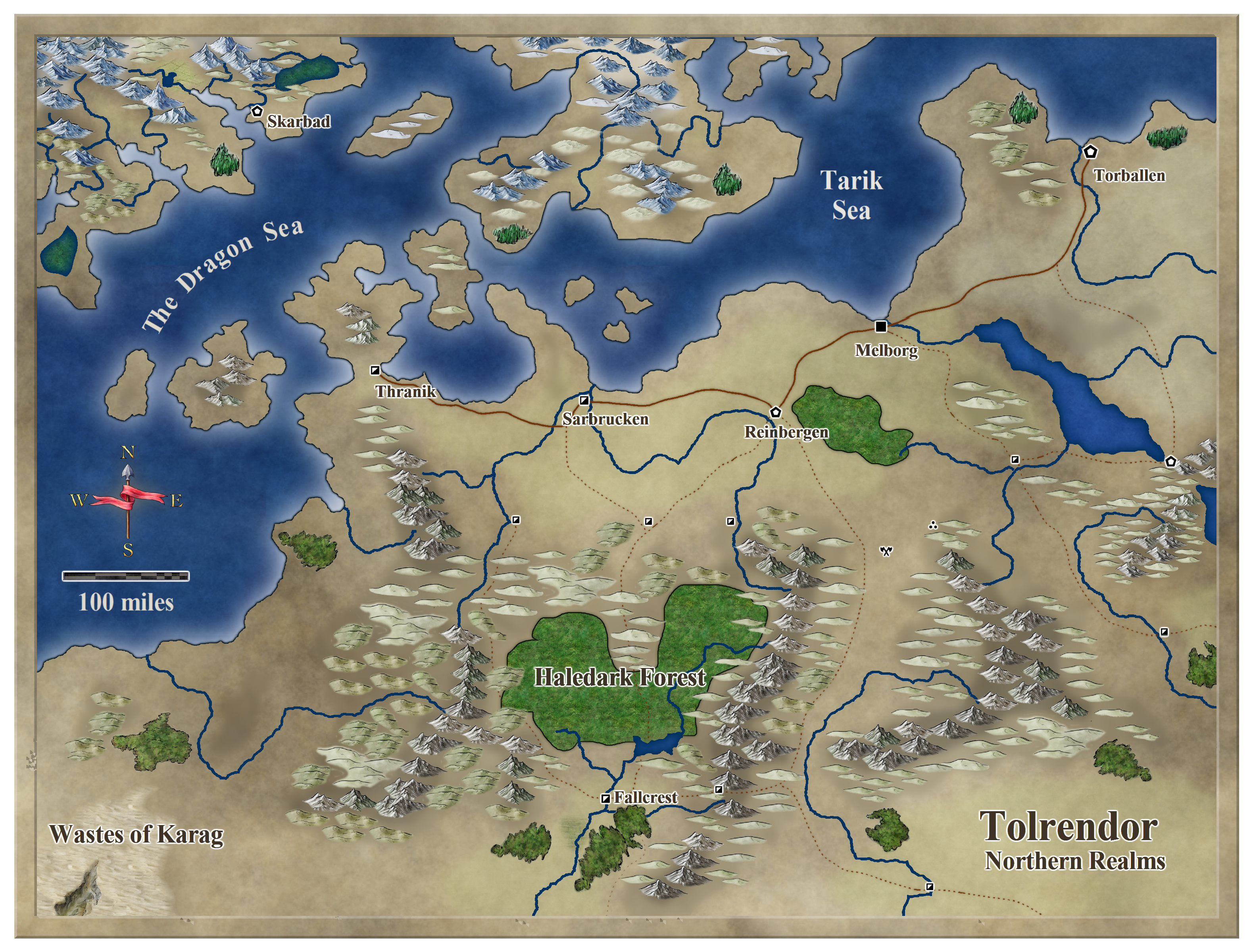
In fact, this issue was a style based on these very maps. I decided to map the same area as I did last month, as a comparison between the two. Here is the result:

Tolrendor - Northern Region - CA76

One of the cool things about the Midgard maps is their wealth of detail, but in a readable form, and this style emulates that well. As you can see, I still have a lot of detail to create and fill in, but its a good start.

So which style do I like best [between March and April]. Well, quite honestly I am going to sit firmly on the fence here!! The March style is really striking and quite different, but I have always loved the muted colours and symbol detail of Jon Roberts maps. In my campaign I would probably use the April style more, as its better suited to smaller scale regional maps.

As always, your comments are welcome! 🙂

Posted in Cartography, Columns, The Annual Challenge, Tolrendor Gazetter | Leave a comment

Wizard’s Watch: Embers Stirring?

Wizards Watch LogoWell, stimulated by some good vibes about DnD Next on a number of blogs I follow (here being one key example), I downloaded the recent Playtest packet (April 1st!) for the first time since about August last year. Things have certainly moved on a bit! After a good read  it’s clear aspects of the rules are taking firmer shape.

There is a lot to like about where the Playtest has got to. Advantage/Disadvantage for example is a new mechanic that seems to have stuck. It’s a neat way to provide a simple bonus for checks, and fits in nicely with game-play i.e. who doesn’t like to roll the dice 🙂 This will certainly suit my kids (at least when they have Advantage…) – I mean how often have they rolled low on a Daily power and begged to be allowed another roll?? 🙂

Specialties also look very promising, essentially a package of Feats that you obtain as you rise in level, and these being somewhat upgraded in Next to be more ‘substantial’ than the minor buffs in 4E. In essence, it looks like Feats are intended to allow access outside of class boundaries to some of the ‘flavour’ powers that help define your character. I like this, as it also gives a perfect mechanic for bringing campaign specific flavour into play. There has been a lot of reaction over the last couple of weeks following Mike Mearl’s columns on ‘Ability increases vs Feats’, but I won’t comment on this until more detail comes out!!

Backgrounds and skills also mesh nicely, and I like the mechanic that skills are simply Ability checks with an extra die – depending on the depth of the characters skill. Although  the skills are fixed, I think there is an opportunity here for extension based on specific settings as well.

If there’s one thing I’m not yet sure about, it’s the Class structure. The most significant part of your character’s make-up is controlled by class, and the designers seems to have gone down the route of fairly fixed class abilities and powers. For example, the new Ranger class is assumed always to be a spell-casting hunter. Now clearly, you can use Specialties to give your Ranger extra options, or to give your Fighter ranged weapon skills and tracking abilities i.e. non-spellcasting Ranger flavour, but I’m not entirely sure whether this will stack up against the myriad of options in 4E for example. I realise there will be lots of people that think this is a great idea, but there will be just as many who think this is not!

I like the options presented for the Rogue, where over and above the core powers of the class, a ‘Scheme’ is used to give different packages of abilities based on the type of character you want to play. Clerics also get a lot of variability based on the deity choice, which again will dovetail neatly with the campaign setting. It will be interesting to see whether other classes will be treated in a similar way as the design iterates.

For the rest (e.g. combat rules, monsters, spells, magic items etc) the Playtest now has a fairly extensive set of material that seems more than enough to run a full campaign. It seems, especially with spells and magic items, to more aligned with older editions. To me that is not necessarily a bad thing as in these particular areas I felt a little of the ‘wonder’ was lost in 4E as everything was fitted into the ‘power’ structure.

So where next then? Well, I said a while back that I would be sticking to 4E while the DnD Next Playtest matured, and that is certainly still true for my main campaign, the Amber Tower.  However, I’ve also been a bit frustrated with progress here, due to the few times the three of us actually get time to sit down and play! So I’ve considered running a little solo campaign in the Havenscoast with my son, and am toying with the idea of running this with DnD Next!

Hmm, decisions, decisions 🙂


Posted in Columns, DnD Next, Roleplaying with Kids, The Havenscoast Project, Wizards Watch | 3 Comments