RPG Tech Talk: ORP and the Die (or Dice…)

In the July RPG Tech Talk column, I talked about the concept of the Open Roleplaying Platform, or ORP. Briefly, this is the concept of a suite of software tools that together form a viable platform for computer assisted table-top roleplaying. A key feature of such a platform is that it is ‘Open’ ,and that multiple products could be offered to provide various components of the system, unlike the all-or-nothing approach of current products.

So what does this mean in practice? Well, let’s take a look one classic requirement (or use case, as we say in the trade…):

Rolling dice is a key component of any game, whether it is the simple classic six-sided die used in a game of Snakes and Ladders, or the combinations of polyhedral dice and ‘modifiers’ used in many table-top role playing games. In essence, dice are a tried and trusted method of introducing chance into our games.

In software terms, ‘rolling’ a die is pretty simple – simply producing a random number between 1 and n, where n is the number of sides. You can achieve that in at most a couple of lines of code in most modern computer languages. In roleplaying terms however, there are a multitude of modes in which such functionality might be used:

  • Dice roll entry: a gaming group might still want to physically roll their own dice (let’s be honest, this is one of the most enjoyable actions RPGs, as your damage dice clatter across the game table…), but they want to utilise computer tools for other aspects of the game (e.g. Combat and damage tracking). All they need is a simple utility app to enter the results of their roll.
  • Virtual rolling: in lots of cases you might want the software to hide the actual roll. For example, if you have an initiative tracking app, you might want simply to click once to roll initiative (including modifiers) for combatants in the encounter, and have them magically sort into the correct order!
  • Snazzy Dice Rollers: there are a plethora of lovely 3d dice rollers out there that can simulate the physics of dice rolling (e.g. check-out the Apple App store). You might want to use such an app on a iPad at your gaming table, but have the results automatically appear in your Combat Manager app.
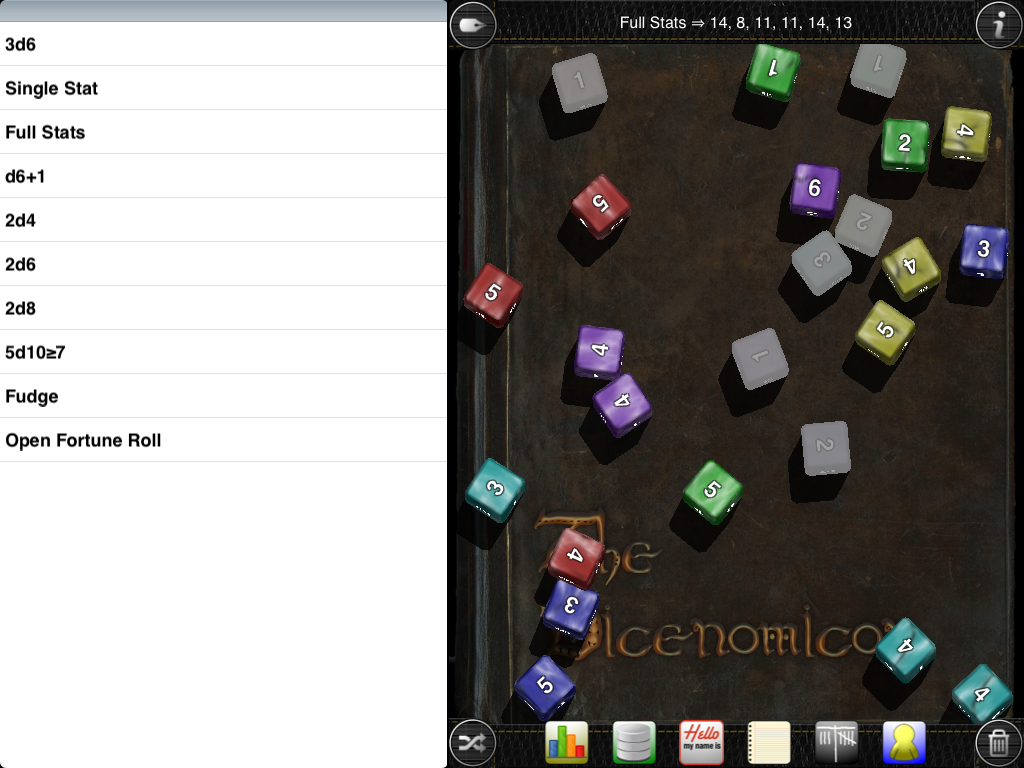
There are many more possibilities I’m sure, but I think you get the point: in each case,  what is required us consistent – the game rules require a die, or a group of dice, to be rolled and produce a result; however the how and where are markedly different.

In enterprise software, a service implies a contract to provide certain functionality, but allows for significantly different implementations to be provided that can be used seamlessly by a client application. So here, we have the concept of a Dice Service.

This is of course similar to the concept of the interface vs the implementation in object-oriented languages (C++, Java etc), but the key difference in enterprise software development is the potential to integrate service implementations across different  language and OS platforms, as well as different physical or network locations. It also allows flexible choices to be utilised in the client application. For example, a GM might want all the dice rolls for his monsters to be generated automatically, whilst all his players’ rolls are conducted via real dice rolls, with a smartphone-based entry app. Because the Dice Service contract provides identical results for the client app, regardless of which implementation is used, this can be easily provided as a selectable option.

Another advantage of a well-defined service model is the potential for the growth of a community of service providers. As a developer, my primary experience is in server-side enterprise software architecture using Java – I’m unlikely to turn my efforts to a 3d simulated physics dice roller – but there are plenty of developers out there who can (and have!). If they can be persuaded to implement the ORP Dice Service contract, suddenly there’s another great addition to the platform.

Next time, we’ll take a look at other potential services in the ORP!!
Posted in Columns, RPG Tech Talk, RPG Technology | Leave a comment

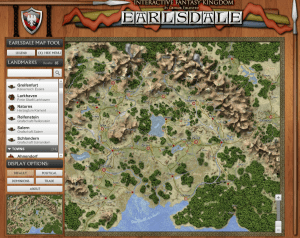
Map of the Month: Earlsdale Interactive Map

This month’s Map of the Month column is another call-out to one of the awesome maps that are available out there on the internet. Grimur Fjeldsted is a cartographer that may be known to CC3 users, as his site MapVentures is linked from the Websites link on the main page. Here you can find many great maps produced using the Profantasy suite of tools.

However, I just came across this site a couple of days ago and had to share it! It is a beautiful interactive map implemented in Flash, allowing you to pan, zoom, select various views (political, trade etc), as well as highlight key locations to display an information box. Very cool – and almost became my RPG Tech Talk column 🙂 Check it out by clicking the image below:

Posted in Cartography, Columns, Map of the Month, RPG Technology | 2 Comments

RPG Tech Talk: An e-Module Kickstarter

A few months back I talked about the potential of the new iBooks format for RPG publications – and in fact how I was a little underwhelmed by the iBooks Author software.

Well, now it seems that there is an interesting Kickstarter Project by Mike Bohlmann of bySwarm.com to try this out for real! There is a ‘Proof-of-Concept’ iBook that can be loaded to your iPad for a look at some of the interactive concepts that he intends to use – check it out! I especially liked the potential use of a widget displaying interactive web content using HTML 5! This opens up lots of cool possibilities.

Although I don’t use Pathfinder or the setting portrayed in the proposed adventure, I’m pretty sure I’m going to back this project as I can follow along with some of the technical ideas 🙂

Posted in Columns, RPG Tech Talk, RPG Technology | 1 Comment

Content Corner: Havenscoast Locales

Content Corner LogoIt’s been a slow couple of months on the blog front – a combination of work and summer holidays to blame – things just haven’t been progressing as I’d like! The ‘Havenscoast Project‘ is one such example; the last time I published anything on this was back in February!

Finally this month I have completed an update of the Havencoast Gazetteer, with an expansion of the original overview to include more detailed descriptions of the key map locations. I always love this part of a source-book – reading  the passages and then flipping back to the map often to locate them and get a feel for the world or region! This always generates lots of adventure ideas to float around in the back of my brain! All I can hope is that it has the same effect on my readers 🙂

Havenscoast Gazetteer PDF

Posted in 4E D&D, Area Map B4: The Havenscoast, Columns, Content Corner, Self-publishing, The Havenscoast Project, Tolrendor Gazetter | 12 Comments

DM for Kids: Holiday Packing

Yay, its the summer holidays, and the kids are now off school. We’re off on holiday at the end this week, and obviously we hope the weather is going to be such that beaches and swimming are the main order of the day, rather than role-playing games…

However, we live in the UK, and we’re off to Devon (in the south-west of England), so what is the chance of that?? For anyone reading this that has experienced the UK ‘summer’ so far, I think you know what I’m talking about (although having said that, today it’s 30 degrees…)! So it’s as well to be prepared for all seasons, and that means packing the games!

So, as a DM Dad, what’s on my holiday packing list for the wet weather?? We have a cottage booked, so I can take some kit – it doesn’t all have to be ‘TOTM’ 🙂

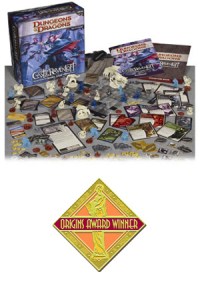
Apart from the ubiquitious pack of cards, and a few  standard favourites (Monopoly, Connect 4, Dread Pirates etc), Castle Ravenloft is definitely making it into the car. One compact box and you’ve got everything you need for a decent evening’s D&D like entertainment. Even my wife will have a go 🙂 As an added bonus, you get some minis and tiles that might be useful for a gaming session!

I’ve also promised the kids that we can get a few sessions of D&D in as well, as school and work scheduling over the last few months has definitely got in the way of our game. So, what to pack here, given that I’ll be a long way from my gaming bookshelf and standard tools. Luckily we’re in the middle of a dungeon delve which is already pretty well prepped, so I guess I’ll need:

  • Rules Compendium – all I need in a single compact volume! Anything that’s not here can be easily hand-waved if I can’t remember it!
  • Character sheets – don’t take up much space, and I still use the old off-line Character Builder for my kids’ characters, we can level-up on my laptop if required!
  • Dice – guess I could use a dice roller on my iPad, but nothing beats the phyiscal version, and after all, they don’t take up much space!
  • Minis – hmm, this is a tougher one – breakables alert! 🙂 However, we only really have the kids’ characters (and menagerie…) as actual figures, and I use tokens (generally printed on cardstock) for monsters, so should be fine.
  • Maps – I generally create my maps in CC3 and print them to scale for battle-maps. Obviously I won’t be lugging the colour printer on holiday! I could use tiles (in fact the current adventure has tile-based maps) but tbh I find them bulky and fiddly. My plan is to print the required maps out in advance, glue the sheets onto A2 paper, and take them rolled up in a tube.
  • Adventure info – all available already in the ‘Cloud’ (www.dropbox.com) and on my laptop (just must remember to sync before I go …).

All sounds great so far, but realistically I’ve only got a couple of sessions pre-prepped, so what happens after that? Well, I’ve been blogging about game table tech, so here’s my chance to try it out. My plan is to trial d20Pro to ‘share’ a battlemap and tokens. I also might need a few other tools to make this work:

  • Main laptop (Macbook Pro) already has on it all the tools, such as CC3, Microsoft OneNote (which I use for all my campaign information), Character Builder (offline version), token images, image editing programmes etc, to prep some more adventure! 
  • Second laptop – this is soley to run the player version of d20Pro!
  • Internet/Network link – to make this work the 2 PCs obviously need to be linked together. I’m also thinking about internet connectivity for my laptop, as the only tools I might need which are internet dependent is the 4E Compendium and Monster Builder. I’m thinking of getting one of these things!

Hopefully that should see us through a week of wet weather!! I’ll let you know later … 🙂

Posted in Columns, DM for Kids, DnD Next, Roleplaying with Kids, The Amber Tower Campaign | Leave a comment

Wizards Watch: Summer lull; Storm clouds gather…

Wizards Watch LogoThere seems to be a strange eerie calm around the RPG space right now. It’s not necessarily the sort of calm that makes you feel calm … its more the oppressive lull before the thunder booms and the lightning strikes in a sudden summer storm.

For example, as I mentioned earlier this week, Wizards announced the demise of their oft-delayed VTT project … and there didn’t seem to be the damnation bursting forth from blogland that you might have expected. This may be because lots of bloggers are off on their summer hols … or it might be that it was something most people were expecting … with 5E in the pipeline in the next 12-18 months, pushing forward with a 4E content-integrated virtual table seemed unlikely maybe?

Even on the 5E front, things have slowed after the mad rush in the wake of the DnD Next Playtest release. Hundreds and thousands of words have been written on blogs and other forums … but I think most people feel what’s currently out there has been dissected to death, and not much more is possible until more information has been released. I’ve even seem some comments complaining how long the next packet is taking! I think I read something at the time suggesting it would late summer before anything else was available widely – although I’m sure WOTC is planning a slew of updates and playtest sessions for those lucky enough to be heading to GenCon and other summer conventions. Patience is a virtue remember 🙂

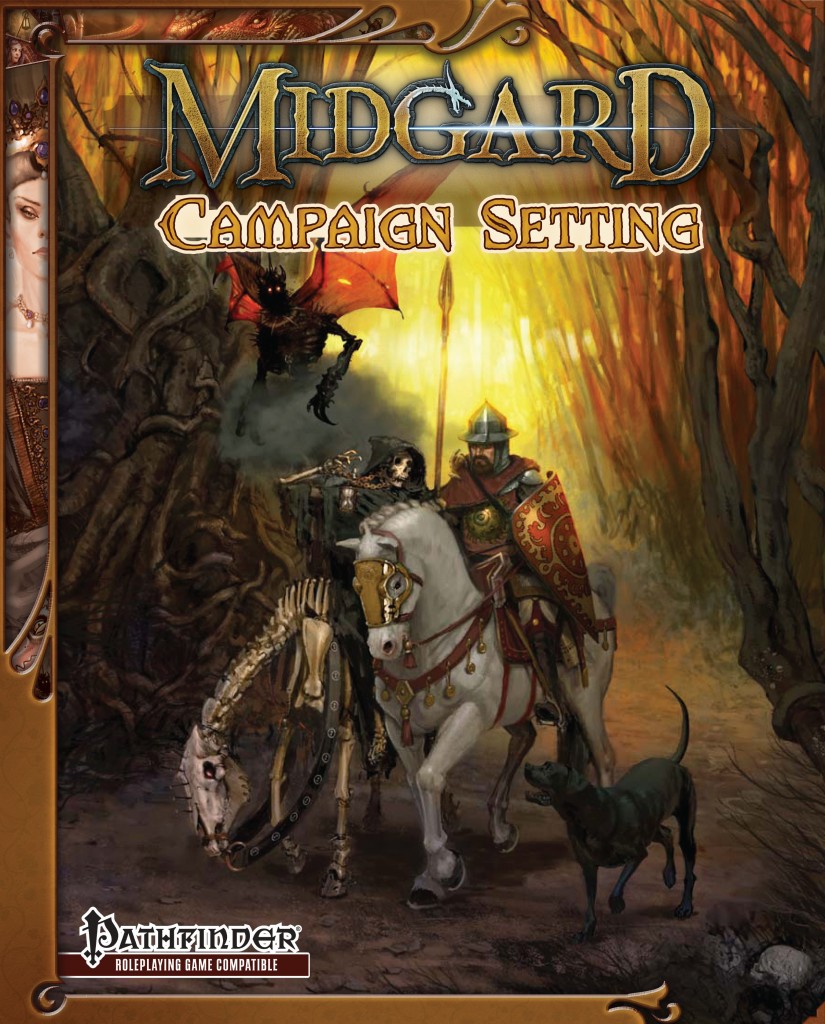
So is anything else cooking? Not much on in the 4E space from Wizards at the moment, although the Menzoberranzan setting looks interesting in August. However, IMO the most vibrant publisher around at the moment is Open Design. Wolfgang Baur and the Kobold team have a swathe of projects going on at the moment, most related to the Midgard Setting, which comes out in the autumn. I’m a patron (via Kickstarter) on many of these, and although I haven’t really been involved in the projects beyond opening my wallet, I’m really looking forward to these coming to fruition. Midgard looks to be brimming full of great ideas to fleece for my Tolrendor campaigns!

Unfortunately (for me), most of them are being published for the Pathfinder rules, with one great exception – funding has just been achieved for releasing the Midgard Bestiary for 4E! Yay! The project achieved its funding goal several times over, so there’s lots of extra goodies included. It looks like being a great example of 4E content outside the Wizards’ world!

Posted in 4E D&D, Columns, DnD Next, Monsters, Wizards Watch, World Building | Leave a comment

RPG Tech Talk: The Tech Gametable

Well, last week Wizards of the Coast announced via a DDI broadcast email that they would not be moving forward with their Virtual Table product past the Beta stage. The official line is that there is not enough interest in it to fully support. Its hard to say whether this is a) true that there was not enough interest, or b) a reflection that the qualities and features of the product were not enough to interest people, or c) because its integrated with 4E content that don’t want to be bothered pushing it with 5E round the (several) corner(s).

I never used the Virtual Table in a game – I logged on a few times and played a bit with the maps and tokens, but the simple answer is that I don’t have a remote group to play with, so it wasn’t that much use to me. And this I think is partly the crux of the problem – Wizards made a huge song and dance about the virtual table when they annonuced 4E, so I think they felt they had to put a product out, but really, is this a core product that everyone wants? I mean, I certainly don’t dispute that there are plenty of gamers out there that want to play remotely, but I’m also sure there is a much greater set of gamers whose main play experience is still a physical group gathered around the dining room table!

So in essence, whilst I fully support the concept of a virtual table, what I, and I suspect many other tech-interested gamers, want from my game tech is products that enhance the local ’round the table’ play experience. IMHO, it is this area which WOTC would have been better off trying to serve with DDI, simply because it is a much bigger customer group.

So what do I really want to see from Gametable Tech? Ok, you asked … 🙂

1) To use it anywhere

I’d love to be able to use game table tools anywhere I am, regardless of the quality (or even presence) of an Internet connection. This doesn’t mean there is no place for on-line tools or content, but when I go away to the holiday cottage, or the campsite (after all WOTC want us to be able to play 5E round the campfire!) I want to able to package up everything I need to use off-line. (Note – to me this is a major downside to Pazio’s new annoucement, even though the screenshots look neat…)

2) To be available on multiple platforms

When running a game using tech tools (e.g. computer based character sheets, mapping tools) I want the group to be able to participate regardless of the tech platform they own, and preferably I don’t want to see a group all hiding behind their laptop screens round my dining room table. So this means PC, Mac, Linux, iOS, Android, Smart TVs etc all need to be supported, and the apps running on them capable of being interconnected. Also, I want to be able to use the right tool for the job i.e. I don’t want a complete game information system on an iPad – have you actually tried working with large amounts of info, or swapping continuously between apps on a tablet (Dice roller -> Intiative Tracker -> PDF Viewer…)? It’s just not comparable to a window-based multi-tasking desktop OS! Now an iPad as a lightweight, tailored control console into a game management server, or a Android/iOS smartphone ‘connected’ character sheet, that’s something else entirely…

3) Enhance, don’t replace

Tools should add to the table-top roleplaying experience, not try to completely change it. What you want is to have tools that make the DM (especially!) and the players’ lives easier, thus leaving more time for the fun stuff – roleplaying. A classic example is dice rolling – now I’m certainly not against dice rollers in the right context, but most people I think like the physical rolling of dice at a table – so what’s really needed is quick ways to enter a dice roll so that the ‘math’ can be aided. Another real need is initiative/status tracking – I know there’s lots of options out there – but what I really want is one that integrates with player character apps etc so status etc automatically impacts potential actions. Too often I have the status in the initiative tracker, but fail to take it into account when the player or monster takes its turn, or forget to call for saves etc!

4) Content Integration

A key aspect for me is game preparation. Anything that can save the time spent preparing for the logistical aspects (maps, tokens/minis, stats…) of a game session i.e. over and above actually creating the story and the encounters. This was one aspect of the WOTC VTT that showed promise, as it was integrated into their DDI repository – but I don’t want to be constrained to a single vendor of content – I want to be able to select content of my own creation, or from multiple published sources, and have it available to the game session with minimal extra work. Am I asking too much? 🙂 🙂

5) ‘Best of Breed’ options

Most options out there today for tech enhanced gaming tend to be all-encompassing applications, combining all the tools they comprise into a single fixed package. What I’d like to see is a ‘platform’ concept, where different components could be slotted in to achieve the whole package – so you can have a selection of initiative/status trackers, and be free to choose the one that suits your play/DMing style the best … but that still integrates with whatever map/token movement app (for example…) you choose. Moreover, these tools should operate identically regardless of whether they are connected around a gaming table, or across the Internet.

Essentially, what I’m looking for is the application of some standards-based enterprise software capability to the RPG technology world – in fact we should give it a code name – lets call it the Open Roleplaying Platform, or ORP!!

I’m sure this will be the topic of future posts… 🙂

Posted in Columns, DnD Next, RPG Tech Talk, RPG Technology | 4 Comments

DM for Kids: DnD Next

Unfortunately, I just haven’t yet managed to start some DnD Next play testing with the kids, due to end-of-term school commitment, exams and work stuff. Definitely want to have a go as it does look like a ruleset well suited to gaming with children. This is important for me, as I’ve found 4E great with the kids, so I certainly don’t want to go backwards from here 🙂

Anyway, I was considering the play-test materials, especially the Caves of Chaos included adventure, and just how to present this in a kids’ session. As I’ve mentioned before, the kids love all the maps and minis we’ve been playing with, and would get quite thrown by being pitched straight into ‘Theatre of the Mind’ combat. So I decided I would go with battle maps, even though the initial rules don’t highlight this style of combat greatly. I’m also interested in how the rules as written play out with a battle map. For me, although I’m certainly very interested in, and am likely to be a big fan of the proposed tactical combat module, its important that the base rules work fine on a battle map!

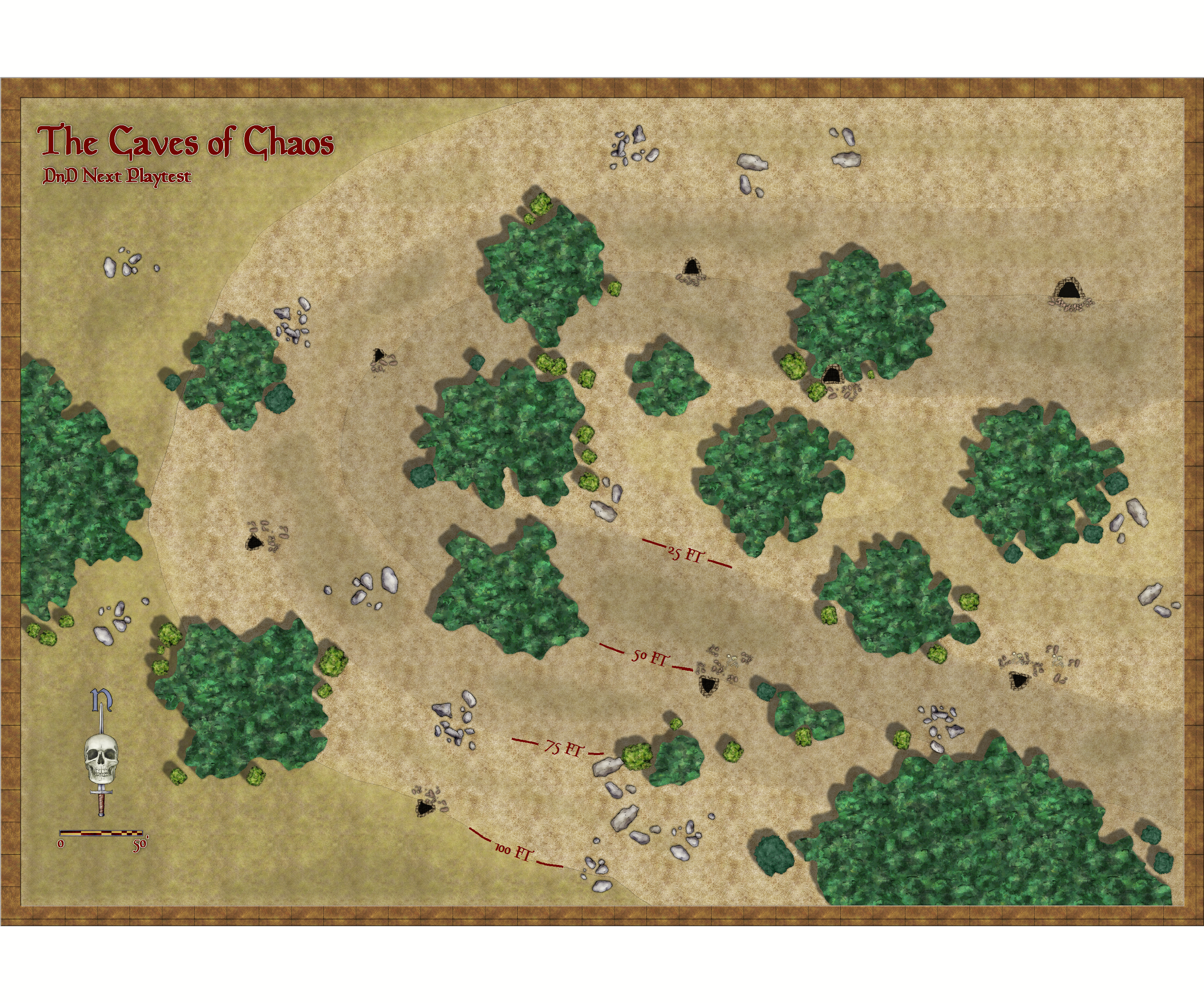
So, that decision made, I soon decided that the included old-style map didn’t really cut it for adventure maps … so of course I’ve started on my own. First up was a map of the valley itself to hand-out at the start of the game. I’ve done this in a more modern style using Jonathan Roberts Dungeon style for CC3. Hope you like it … battle-maps to follow 🙂

Posted in Cartography, Columns, DM for Kids, DnD Next, Roleplaying with Kids | 1 Comment

Map of the Month: Mount Arghuangeusk

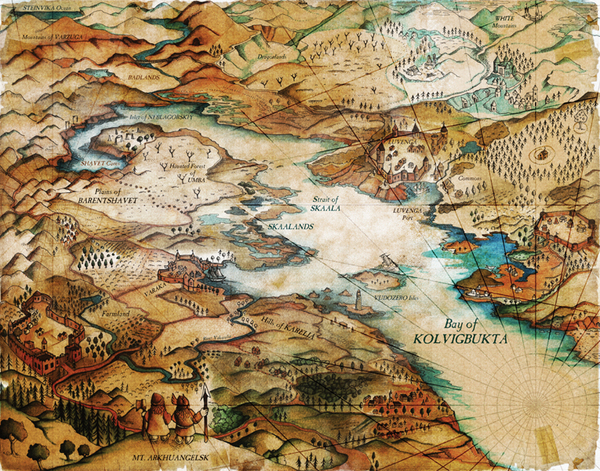
I love maps with a hard-drawn/painted feel, probably not least because such maps are waaaay beyond my own artistic ability. Recently I came across a tutorial in Digital Artist Magazine (a print magazine that is also available in the iTunes Newstand) on making an antique looking map.

The artist, Abigail Daker, has a small gallery on-line. There doesn’t seem to be any other fantasy maps on her site, but I love this one:

Mount Arghuangeusk

If you’re interested in the magazine tutorial its Issue No. 30!

Posted in Cartography, Columns, Map of the Month | Leave a comment

June Update

Well in May I managed to get mainly back on track with 7 posts! Of course, the big news of the month was the start of the DnD Next play test. Unfortunately I haven’t yet managed to get a Kid’s play test session going yet, so my involvement has been restricted to reading and re-reading. Currently I’d say I’m reasonably positive, but also looking forward to new playtest material which brings a bit more information.

I’ll have some posts up soon with my initial thoughts, and definitely need to get into the playing side. Hopefully this will kick off properly in June.

As usual, the Content Calendar has my proposed plans for the month 🙂

Posted in Columns, Miscellaneous | Leave a comment