As promised here, I am going to be delving deep into Tales of the Valiant over the coming months and look forward to sharing my excitement for this new entry into the Dungeons & Dragons genre. Let’s get started!
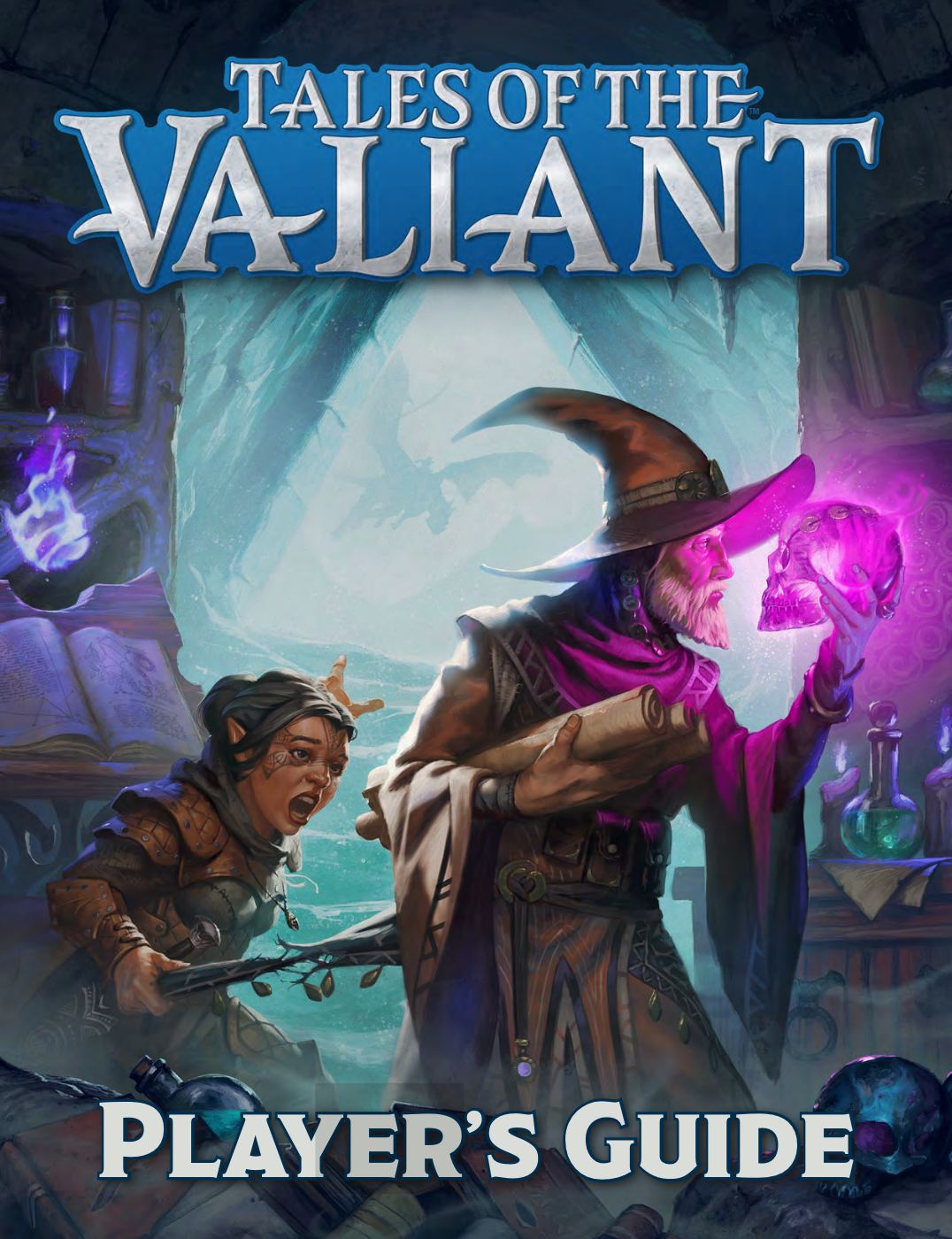
An Interesting Blend of Familiar and Distinct
The introduction to Tales of the Valiant (TotV) Player’s Guide is an intriguing mix of familiar tone and distinct branding. It sets the stage for the game as an “action-oriented roleplaying game” where “heroes shape the world,” emphasizing collaborative storytelling and high-fantasy adventure.
Yet, what is perhaps most notable about this introduction is what it does not say: it makes no direct mention of Dungeons & Dragons 5E or Wizards of the Coast (WOTC), despite being a clear derivative of the 5E system.
A Clear But Unspoken Lineage
Reading through the introduction, anyone familiar with 5E will recognize the DNA of Tales of the Valiant instantly. It explains the fundamental elements of play—Game Masters (GMs), players, character roles, dice mechanics, and collaborative storytelling—in a way that is structurally identical to 5E. Even the basic roll-a-d20, add modifiers, and compare against a DC mechanic remains unchanged.
The book does acknowledge its origins by referencing the Open Gaming License and System Reference Document 5.1 in the credits, but it does not explicitly position itself as a variant of 5E.
This omission is a conscious branding choice. By avoiding direct comparisons, Tales of the Valiant establishes itself as its own game rather than a D&D spinoff. In my opinion, this follows the post-OGL controversy trend, where third-party publishers are seeking independence from WOTC’s influence while still utilizing the framework players are comfortable with.
Key Similarities and Differences with 5E
Mechanics & Dice System
TotV retains the standard d20-based gameplay with advantage/disadvantage mechanics, ability checks, and saving throws. Nothing in the introduction suggests a drastic deviation from core 5E mechanics.
Collaborative Storytelling
Just like 5E, TotV emphasizes player agency, with GMs reacting to player choices and weaving stories dynamically.
The Setting—The Labyrinth
One notable distinction is the introduction of The Labyrinth, described as “infinite worlds linked by twisting corridors of magic.” This presents a multiversal approach similar to Planescape but unique to TotV. The explicit mention of settings like Midgard and the Dreadful Domains suggests Kobold Press is setting up its own “home base” for adventure, distinct from the Forgotten Realms-centric focus of 5E.
As mentioned before, this is one of the innovations of ToV that excites me the most.
Safety Tools
The introduction also highlights safety tools early on, an area that D&D has only recently started to address in official books. It explicitly discusses “lines and veils” and the need for collaborative agreements on potentially uncomfortable topics. This approach shows a clear intent to make the game accessible and enjoyable for all players.
Final Thoughts
The Tales of the Valiant introduction does a great job of setting up the game as its own entity, even though it is unmistakably a 5E-based system. The lack of reference to WOTC or Dungeons & Dragons is an intentional move that aligns with the current wave of independent 5E alternatives.
Is this a strength or a weakness? Well, I think it depends on perspective. As a long-time gamer, it is, of course, obvious to me that the link with 5E exists, and in fact, one of the key attractions is that I should be able to seamlessly use existing material across both systems. However, for a new gamer, this connection would not be obvious, which could be a deterrent to choosing TotV over 5E, which has far greater brand recognition.
Either way, the message is clear: Tales of the Valiant is here to stand on its own—not as a supplement to 5E, but as a full-fledged RPG experience.
Coming Next…
Stay tuned for the next installment, where we will dive into one of the most critical and enjoyable parts of role-playing: the creation of a new adventurer!

 Tolrendor DM's Blog